One Nation leader Pauline Hanson says she has no doubt she could serve as Australia’s prime minister if given the opportunity, arguing that her years as a small business owner taught her more about leadership and everyday Australians than a lifetime spent inside Canberra.
Speaking at a Leadership Matters breakfast in Perth, Senator Hanson told a packed audience that her experience running a fish and chip shop in Ipswich gave her practical knowledge of business, budgeting and the challenges faced by ordinary Australians.
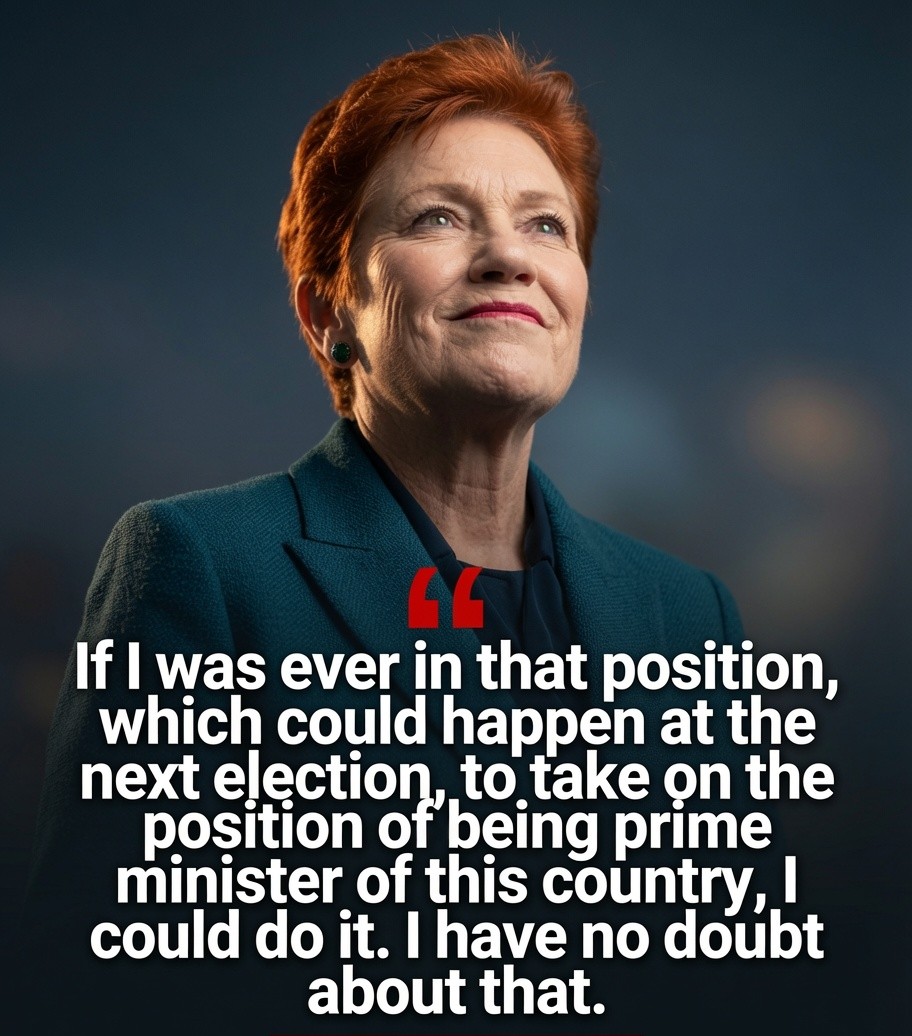
“If I was ever in that position, which could happen at the next election, to take on the position of being prime minister of this country, I could do it. I have no doubt about that,” Hanson said.
The comments came as One Nation continues to enjoy increased political attention ahead of the next federal election, with recent opinion polling showing stronger support for the party than in previous years. Hanson suggested that voters were increasingly looking beyond the traditional major parties as concerns over the cost of living, migration and energy policy continue to dominate public debate.
Reflecting on her background before entering politics, Hanson said operating a small business had given her firsthand experience of balancing budgets, employing staff and dealing with customers from all walks of life.
She contrasted that experience with what she described as the career paths of many professional politicians, arguing that governing requires practical life experience rather than simply political credentials.
Hanson first entered federal politics in 1996 after winning the Queensland seat of Oxley as an independent before later founding One Nation, a party that has built its platform around lower immigration, economic nationalism and criticism of what it describes as excessive political correctness. Over nearly three decades in public life, she has remained one of Australia’s most recognisable—and controversial—political figures.
A major focus of her Perth address was immigration.
Hanson argued that Australia faces growing security concerns linked to radicalisation and claimed migration policy remains an issue that governments have been reluctant to confront openly.
“You’ve got to call out the elephant in the room,” she told the audience while arguing against migration from what she described as “radical Islamic countries”.
She referred to Australia’s terrorism watch lists and previous terrorist attacks carried out by Islamist extremists, arguing that stronger immigration controls were necessary to protect national security.
During the event Hanson also praised aspects of former United States President Donald Trump’s immigration approach, suggesting Australia could offer free one-way tickets to people who are in the country illegally to encourage voluntary departures.
Her remarks drew loud applause from many attendees inside the venue.
However, Hanson rejected suggestions that her position amounted to support for the former White Australia policy.
When questioned about comparisons between her migration comments and Australia’s historical race-based immigration restrictions, she insisted her position was based on security concerns rather than race.
“It has nothing to do with a White Australia policy,” Hanson said, maintaining that her focus was on protecting Australia’s interests rather than excluding migrants on racial grounds.
The comments nevertheless sparked immediate criticism.
Outside the Perth event, dozens of protesters gathered to oppose Hanson’s appearance, chanting slogans supporting multiculturalism and condemning what they described as anti-migrant rhetoric. The demonstration highlighted the continuing divisions surrounding immigration policy in Australia.
Immigration has become one of the defining issues in Australian politics over recent years.
Supporters of tighter migration policies argue that reducing immigration would ease pressure on housing affordability, infrastructure, health services and wages while strengthening border security.
Others contend that migrants play a vital role in addressing labour shortages, supporting universities, contributing to economic growth and offsetting Australia’s ageing population.
These competing perspectives have ensured migration remains one of the country’s most contested political issues.
Hanson has consistently advocated significantly lower migration levels throughout her political career.
One Nation’s policy platform has long called for reduced permanent migration, stronger border protection, tighter refugee policies and greater emphasis on integrating migrants into Australian society. The party argues that current migration settings place excessive pressure on housing, public services and national cohesion.
Critics, however, argue that some of Hanson’s language risks unfairly stigmatising entire communities.
Community organisations and civil rights advocates have frequently responded to her comments by emphasising that the overwhelming majority of Australian Muslims reject extremism and contribute positively across all sectors of Australian society.
Australia’s counter-terrorism agencies have also consistently distinguished between violent extremist individuals and broader religious communities, warning against conflating faith with criminal behaviour.
The Perth speech also touched on Hanson’s recent overseas travel.
She defended her visit to the United Kingdom, where she met a range of political figures including controversial activist Tommy Robinson, saying she believed politicians should be willing to hear different viewpoints before forming opinions.
Hanson also rejected criticism surrounding financial support she has received from mining billionaire Gina Rinehart, saying she would not apologise for accepting backing from someone she described as a patriotic Australian.
Politically, Hanson portrayed herself as an outsider capable of representing Australians who feel disconnected from the major parties.
She argued that everyday experience in business and community life provides a stronger foundation for leadership than decades spent within political institutions, a message that has been central to her public image since entering Parliament.
Whether that message translates into greater electoral success remains uncertain.
Australia’s parliamentary system means the prime minister is normally the leader who can command the confidence of the House of Representatives, usually through winning a majority of seats or negotiating parliamentary support. While One Nation has increased its public profile, forming government would require a substantial expansion of its representation in the lower house.
Nonetheless, Hanson’s remarks underline the confidence with which One Nation is approaching the next federal election.
By presenting herself as a credible contender for the nation’s highest political office, she is seeking to position the party not merely as a protest movement but as a force capable of influencing the direction of Australian politics.
Her speech also demonstrated that immigration will remain one of the defining battlegrounds of the coming election campaign.
As Australia continues to debate housing affordability, border security, workforce shortages and social cohesion, Hanson’s uncompromising approach is likely to continue attracting strong support from some voters while provoking equally strong opposition from others.






