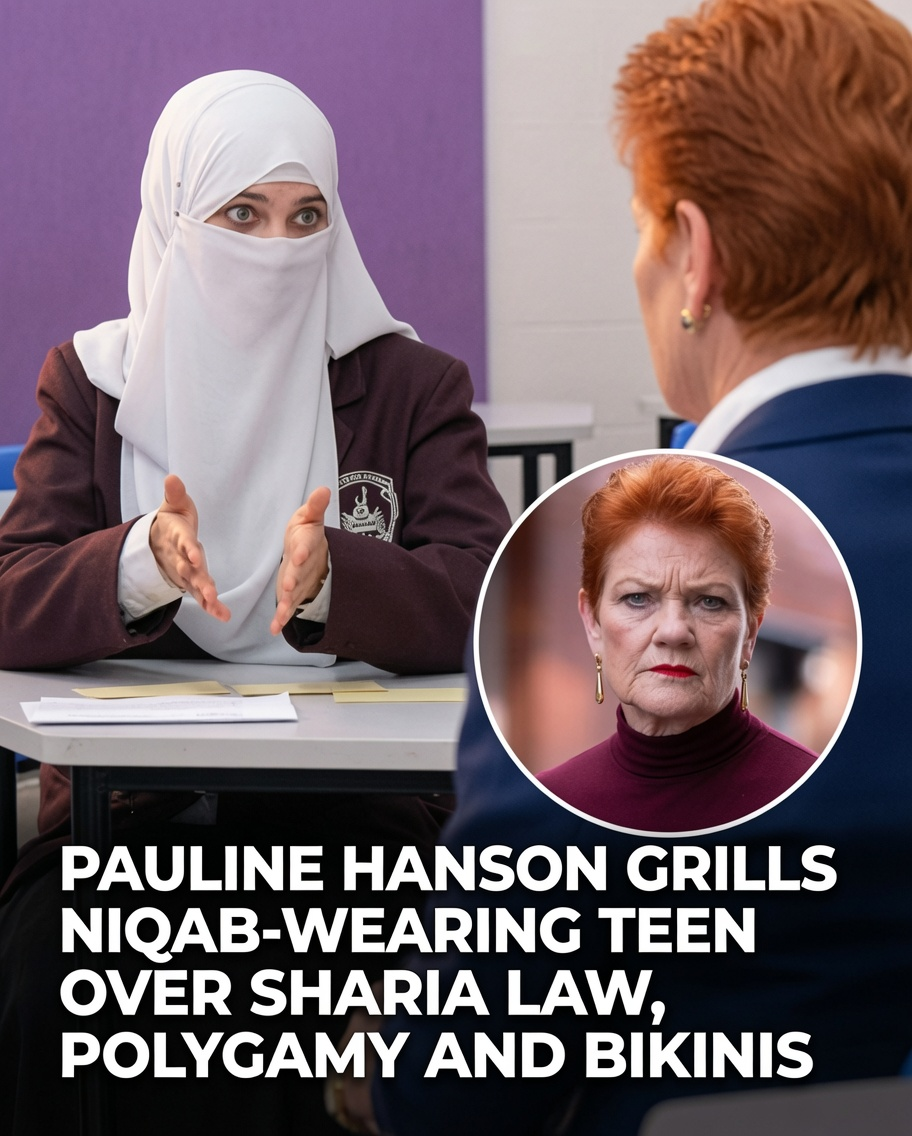
One Nation leader Pauline Hanson has questioned a 15-year-old Muslim student about her decision to wear a niqab, her understanding of sharia and contentious aspects of Islamic practice during a revealing visit to a Brisbane Islamic school.
The exchange, filmed at the Islamic College of Brisbane and aired as part of Seven’s Spotlight, brought Hanson face-to-face with young Australian Muslims as she challenged them on issues that have defined much of her political career.
During one of the most personal moments of the discussion, Hanson asked a student named Nabiha why she wore the niqab — a face covering that leaves only the eyes visible — and whether the decision had genuinely been her own.
Nabiha said her mother also wore the garment but insisted she had independently chosen to follow the practice.
“My mother wears it, but I chose to wear it,” the teenager said.
“As I grew older, my urge to wear it grew stronger. It was my own choice.”
Asked why she wanted to cover her face, Nabiha described the niqab as both an expression of faith and a way of distancing herself from social expectations surrounding physical appearance.
“Because I feel like it strengthens my connection with God,” she said.
She added that wearing it made her feel “liberated from social beauty standards”, allowing people to focus more on her character, speech and interactions rather than how she looked.
Hanson acknowledged the teenager’s explanation.
“It’s your choice. I acknowledge that and I accept that,” she said.
But the senator immediately raised a concern that has long formed part of her criticism of Islamic face coverings: whether all women who wear them are doing so voluntarily.
“But a lot of women are forced to wear it when they don’t want to,” Hanson said.
The exchange was notable for its directness but also for the contrast between two very different perspectives — Hanson approaching the niqab through questions about integration, women’s rights and religious influence, and Nabiha describing it as an individual expression of faith and personal autonomy.
Hanson raises fears about radicalisation
The conversation extended beyond religious clothing.
Hanson told students that her concerns were not directed at every Muslim Australian, but at what she regarded as the threat posed by radicalisation.
“We are seeing so much radicalisation happening in this country,” she said.
“People are in fear now of attacks. Most of those attacks come from radical Islam in this country. That’s where my concern is.”
Her comments came in the shadow of the December 2025 terrorist attack at Bondi Beach in Sydney, which targeted a Jewish Hanukkah gathering and became one of the deadliest acts of terrorism in Australian history.
Authorities have described the Bondi attack as inspired by Islamic State ideology, and the massacre intensified national debate over antisemitism, violent extremism, intelligence failures and the ability of authorities to identify individuals moving towards terrorism.
However, the existence of Islamist terrorism does not mean Muslim Australians generally can be equated with violent extremism.
Australia’s Muslim population encompasses highly diverse communities with different ethnic, cultural and theological backgrounds, and the overwhelming majority have no connection to terrorism.
That distinction is central to the broader debate surrounding Hanson’s language.
Supporters argue she is willing to discuss security, integration and religious practices that other politicians avoid. Critics argue her rhetoric too often generalises about Muslims and risks treating an entire religious community as responsible for the actions of extremists.
The discussion turns to sharia
Hanson also questioned students about sharia law, another subject that has repeatedly featured in Australian political debates about Islam.
The term “sharia” is frequently used in public debate as though it describes a single codified legal system intended to replace Australian law.
In practice, its meaning is much broader and varies substantially between Muslims, Islamic traditions and countries.
For many Muslims living in Western democracies, sharia can refer to personal religious principles governing matters such as prayer, fasting, charitable giving, diet, marriage and ethical conduct.
In some Muslim-majority countries, however, interpretations of Islamic law are incorporated into state legal systems to varying degrees, sometimes including family law and, in more restrictive jurisdictions, criminal law.
In Australia, there is no parallel Islamic legal system with authority above Australian law.
Australian law applies regardless of religious belief.
People are free to follow religious practices voluntarily, just as members of other faiths may follow religious rules or seek informal religious guidance, but those practices cannot override Commonwealth, state or territory law.
The distinction matters when discussing issues such as marriage.
Questions over men having multiple wives
The discussion also touched on polygyny — the practice under some interpretations of Islam that permits a man to have more than one wife under specified religious conditions.
Australian law does not permit a person who is already legally married to enter another legally recognised marriage while the first remains valid.
Bigamy is an offence under Australian law.
Religious beliefs or ceremonies do not create an exemption from those legal requirements.
However, the subject becomes more complicated when discussing religious-only relationships or marriages entered into legally overseas.
This distinction between religious practice and civil law is one reason discussions about “sharia law in Australia” can become confused.
A Muslim may follow religious principles in private life, but those principles do not displace Australian law.
For Hanson, questions about polygamy and sharia form part of a broader concern about whether cultural and religious practices are compatible with Australian social and legal norms.
For Muslim communities, the concern is often that complex religious beliefs are reduced to their most controversial interpretations and presented as representative of Muslims generally.
A highly symbolic visit
Hanson’s appearance at the Islamic College of Brisbane carried particular significance because of her long and contentious political history with Islam.
Since returning to federal Parliament in 2016, the Queensland senator has repeatedly called for restrictions on Muslim immigration and Islamic face coverings.
In one of the most controversial moments of her parliamentary career, Hanson entered the Senate chamber in 2017 wearing a burqa before removing it during debate.
The stunt was condemned by politicians across party lines, including then-attorney-general George Brandis, who warned against offending and marginalising Muslim Australians.
Hanson defended the action as an attempt to draw attention to national security and identification concerns surrounding full-face coverings.
Almost a decade later, her conversation with Nabiha presented a very different setting.
Rather than using a garment as a political symbol inside Parliament, Hanson was speaking directly to a teenager who had chosen to wear a niqab and asking her to explain that decision in her own words.
The student’s response complicated one of the assumptions often present in debates about Islamic dress: that a woman or girl wearing a face covering must necessarily have been forced to do so.
Nabiha explicitly said that was not her experience.
At the same time, Hanson maintained that coercion can exist in some circumstances and that voluntary choice in one case does not resolve broader concerns about women who may face family or community pressure.
Both issues can exist simultaneously.
Some Muslim women regard hijab or niqab as deeply personal expressions of faith and identity. Women’s rights organisations and governments internationally have also documented cases in which women face coercive dress requirements, particularly under authoritarian religious regimes.
The policy question in a liberal democracy is how to protect people from coercion while preserving the freedom of adults and families to practise religion voluntarily within the law.
Hanson’s UK trip adds another layer of controversy
The Islamic school visit aired as part of a broader Spotlight program that has itself become politically contentious.
Hanson was also filmed during a trip to Britain, where she met Tommy Robinson, the British far-right and anti-Islam activist whose real name is Stephen Yaxley-Lennon.
The meeting generated criticism in Australia and became a significant focus of media coverage surrounding Hanson’s trip.
Hanson has defended engaging with controversial international figures as part of examining immigration, social cohesion and political developments overseas.
Her critics argue the meetings lend legitimacy to extremist or divisive political movements.
The production of the Spotlight program has also become a story in its own right.
Hanson subsequently released communications relating to Seven’s original pitch for the program amid a dispute over how the trip was conceived and portrayed.
Seven has defended the final program as balanced journalism, while Hanson and figures close to her have criticised aspects of its presentation.
The dispute highlights the unusually complex circumstances surrounding the broadcast: a serving Australian senator, a commercial television investigation, meetings with controversial overseas political figures and a domestic debate over immigration and Islam occurring at the same time.
Why the Brisbane conversation matters
The encounter at the Islamic College arguably offered something different from the usual political debate surrounding Hanson.
For much of her career, arguments about Islam have taken place through speeches, parliamentary confrontations, television interviews and political campaigns.
At the school, those arguments became personal.
A politician who has spent decades questioning aspects of Islam was able to put questions directly to Muslim students.
The students, in turn, were able to explain their beliefs directly rather than having others speak for them.
That did not eliminate the disagreements.
Questions about religious freedom, women’s rights, integration, extremism and the boundaries between faith and secular law remain difficult precisely because Australians hold deeply different views about them.
But Nabiha’s explanation of her niqab demonstrated why individual experiences matter when discussing those questions.
For Hanson, a full-face Islamic covering can represent concerns about integration, security and the treatment of women.
For Nabiha, the same garment represents faith, personal choice and freedom from pressure to be judged according to physical appearance.
Those interpretations are not easily reconciled.
Australia’s wider debate over integration
The exchange also comes at a time when immigration and social cohesion have become increasingly prominent political issues.
Australia has experienced rapid population growth following the pandemic, driven heavily by high net overseas migration.
The resulting debate encompasses housing shortages, infrastructure pressure, university enrolments, labour markets and the appropriate scale of future migration.
Hanson and One Nation have gone considerably further than the major parties, advocating much lower immigration and placing greater emphasis on assimilation into what the party describes as Australian values and culture.
Hanson has also renewed controversial arguments about multiculturalism and the historical direction of Australia’s immigration policy during recent appearances.
Her critics accuse her of using legitimate concerns about migration levels to promote hostility towards particular ethnic and religious communities.
One Nation rejects that characterisation, arguing its policies focus on national cohesion, immigration control and the principle that Australian law and values must take precedence.
The disagreement is likely to become more politically important as One Nation’s support grows.
Recent national polling has shown the party reaching levels of support far above its historical performance, turning Hanson’s views on immigration and Islam from positions associated with a minor protest party into arguments with potentially much greater electoral influence.
The difference between Islam and Islamist extremism
The national security dimension requires particular care.
Australia faces a genuine threat from violent extremism, including Islamist terrorism, far-right extremism and individuals radicalised through online ideological networks.
The Bondi Beach attack demonstrated the catastrophic consequences that extremist ideology can have.
But counter-terrorism policy depends on distinguishing violent ideological movements from peaceful religious belief.
Islam is practised by hundreds of thousands of Australians.
Islamist extremism, by contrast, refers to political and ideological movements that can include extremist interpretations of religion, with a small subset advocating or committing violence.
Conflating those categories can undermine social cohesion and make cooperation between authorities and Muslim communities more difficult.
At the same time, avoiding difficult discussions about radicalisation does not make the security threat disappear.
The challenge for governments and communities is to confront extremist ideology without treating peaceful citizens as collectively responsible for it.
A conversation that reflects a much larger national argument
Hanson’s questioning of a 15-year-old student may appear at first to be a relatively small moment in a television program.
But the exchange captured many of the issues now sitting at the centre of Australia’s debate about identity and social cohesion.
Who decides what a woman wears?
How should religious freedom operate within a secular legal system?
Where is the line between respecting cultural difference and insisting on common civic norms?
How should Australia confront genuine Islamist extremism without casting suspicion over Muslims generally?
And how should politicians discuss these issues without either avoiding legitimate concerns or inflaming division?
Nabiha gave a straightforward answer to at least one of those questions.
She said the niqab was her choice.
Hanson accepted that answer while making clear it had not changed her broader concerns.
Their conversation did not resolve Australia’s long-running argument over Islam, immigration and integration.
But it did place two sharply different perspectives across from one another — a veteran politician who has spent three decades challenging aspects of multicultural Australia, and a teenage Australian Muslim explaining, in her own words, why the religious clothing Hanson has repeatedly questioned makes her feel more connected to her faith and less judged by her appearance.
As Australia continues debating immigration, extremism, multiculturalism and national identity, that distinction between what people assume about one another and what individuals actually believe may prove increasingly important.






