Pauline Hanson has offered a qualified apology to Prime Minister Anthony Albanese after days of criticism over remarks about his late mother’s decades in public housing, while insisting she had been trying to make a broader point about how scarce social housing should be allocated.
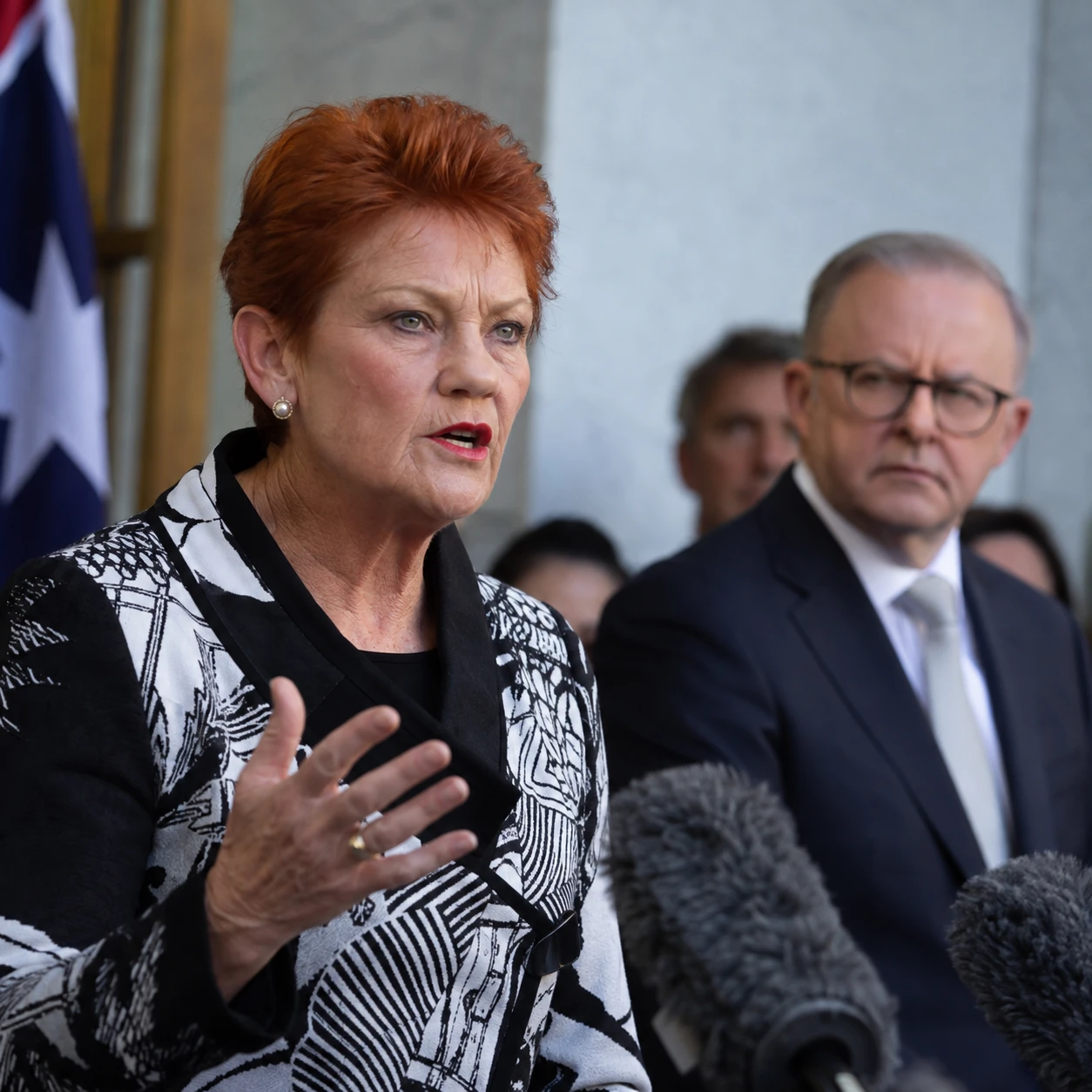
The One Nation leader was asked on Tuesday whether she regretted comments in which she said it was “not on” for people such as Maryanne Albanese to remain in housing commission accommodation for decades. Hanson said she did not believe the remarks had been derogatory towards the prime minister’s mother, but added that if Albanese had taken offence, she was sorry.
The response came after politicians from Labor and the Coalition called on Hanson to apologise and after Albanese mounted an unusually personal defence of his mother, who raised him in public housing in Sydney’s inner west and died in 2002.
Albanese said he was “stunned” by the criticism and described his mother as compassionate, generous and kind despite the serious health problems she lived with. Maryanne Albanese suffered severe rheumatoid arthritis, relied on a disability pension and spent much of her life in public housing. The prime minister said he remained proud of the community in which he grew up and rejected the suggestion that he had used that background as a grievance.
The dispute began after remarks Hanson made on a podcast earlier this year resurfaced. In those comments, she criticised Albanese’s repeated references to his housing commission upbringing and argued that public housing should be a temporary helping hand rather than accommodation that one household occupies for decades.
That argument touches on a genuine policy issue, but the political backlash has focused on the fact that the example she chose was the prime minister’s late mother, who had no role in the current political debate and who lived with significant disability.
Liberal frontbencher Andrew Hastie was among those who said mothers should be kept out of politics. Trade Minister Don Farrell called Hanson’s remarks inappropriate and appalling, while Housing Minister Clare O’Neil said the vast majority of public housing tenants were in deeply disadvantaged circumstances and that the debate should not be personalised around a deceased family member.
Hanson’s latest comments stop short of a full withdrawal. She continues to argue that she was discussing housing commission policy rather than attacking Maryanne Albanese personally. That distinction is likely to matter to her supporters, but it has not ended criticism from opponents who say the original remarks crossed an obvious boundary.
The episode has unfolded at the same time as Hanson has been under pressure over separate comments about Indigenous Australians. She also offered a qualified apology for using the word “primitive”, saying she regretted causing offence and did not intend to hurt people. The two controversies have placed One Nation’s leader under a level of national scrutiny that reflects the party’s growing electoral relevance.
One Nation is no longer operating only at the margins of federal politics. Recent polling has shown the party competing strongly with Labor and the Coalition on primary support, particularly among voters concerned about migration, housing, cost of living and distrust of major institutions. As its support grows, remarks that might once have circulated mainly within a sympathetic audience are increasingly being judged by the standards applied to a party seeking greater influence in parliament.
The housing argument beneath the personal dispute is significant. Australia’s public and community housing systems face long waiting lists, ageing stock and acute demand from people experiencing homelessness, disability, family violence and severe financial stress. Governments therefore have to decide how to balance security of tenure for existing tenants against the needs of people waiting for a home.
Supporters of long-term tenure argue that social housing is not meant to function only as crisis accommodation. For tenants with serious illness or disability, a stable home can be the foundation for medical care, community connections and family life. Moving people on simply because they have lived in a property for many years can create instability without necessarily solving the shortage, particularly if there is not enough affordable housing elsewhere.
Those who favour more frequent reviews argue that subsidised housing is a scarce public resource and should be targeted to people in the greatest current need. They say households whose circumstances improve should eventually transition to the private market so that another family can access support.
Both positions can be debated without questioning the dignity of an individual tenant. That is why the political reaction to Hanson’s remarks has been so sharp: critics say she could have argued for stricter eligibility reviews without making Albanese’s mother the example.
Albanese’s childhood has long been central to his political identity. He has repeatedly described being raised by a single mother in a housing commission home in Camperdown as evidence of how public institutions can create opportunity. He has said the stability of that home allowed him to attend university and build a life that would otherwise have been far harder.
Political opponents are entitled to challenge the way he uses that story or to argue that it has become overused. They are also entitled to question the government’s housing record, including whether public investment, planning reform and migration settings are delivering enough new homes. But family members who are not political actors are usually treated differently, particularly when they are deceased.
That convention is not written into law, but it remains a powerful norm because modern politics already places intense pressure on spouses, children and parents who did not choose public office.
Hanson’s defence is that her comments were about the policy, not the person. Albanese’s response is that the policy point could have been made without diminishing a woman who lived with illness and raised a child under difficult circumstances.
The two arguments are not mutually exclusive. Public housing policy can be reviewed and debated, and the language used to conduct that debate can still be judged as unnecessarily personal.
The practical challenge for governments remains unchanged. Demand for social housing continues to exceed supply in most jurisdictions, construction costs are high and private rents have placed more low-income households under pressure. Whether governments choose stricter tenancy reviews, more construction, greater rent assistance or a combination of measures, the system needs more capacity if it is to meet both emergency need and long-term disadvantage.
For Hanson, the immediate political question is whether her qualified apology closes the issue or prolongs it. By saying she is sorry if Albanese took offence while maintaining that her remarks were not derogatory, she has attempted to acknowledge the reaction without conceding the substance of her position.
For Albanese, the controversy has again placed his upbringing at the centre of public debate, but in a far more personal way than he would have chosen. His response also shows why attacks involving family can cut through differently from ordinary partisan criticism.
The larger lesson is that the line between policy argument and personal attack is easy to cross when politicians use individual lives as symbols. Australia does need a serious debate about who should receive public housing, how long secure tenure should last and how governments can reduce waiting lists. It is possible to have that debate without turning a deceased parent into a political weapon.