Pauline Hanson has officially launched One Nation’s campaign for Victoria’s November state election by appointing Warren Pickering as the party’s Victorian leader while triggering fresh political debate after banning journalists from the ABC, The Guardian and The Age from attending the announcement.
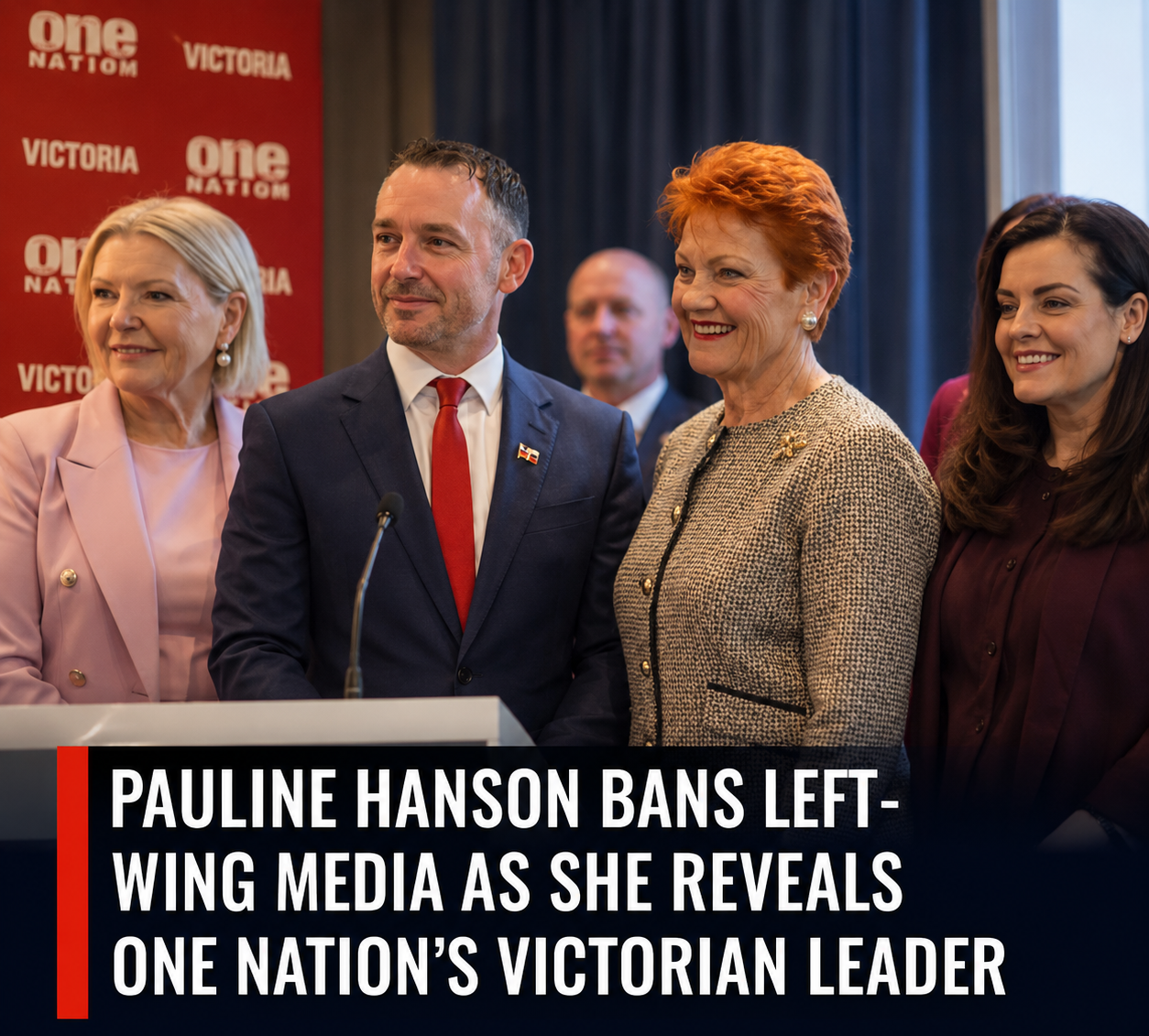
The Melbourne press conference marked the formal beginning of One Nation’s Victorian election campaign, with Hanson introducing Warren Pickering as the party’s new state leader and confirming he will contest the marginal lower house seat of Pakenham at the November election.
Pickering, 43, previously served as One Nation’s Victorian state president and had originally been expected to contest the Legislative Council before the party shifted him into the lower house campaign.
Pakenham is regarded as one of Victoria’s most marginal electorates, having been held by Labor on a margin of just 0.4 per cent following the 2022 election. Labor MP Emma Vulin is not recontesting the seat, increasing speculation that it could become highly competitive.
Alongside Pickering, Hanson unveiled the first group of One Nation candidates for the Victorian election.
Among them was Colleen Harkin, formerly a member of the Victorian Liberal Party’s State Administrative Committee before joining One Nation. Harkin will contest the South-Eastern Metropolitan region in the Legislative Council.
Other candidates announced included Geelong councillor and former police officer Chris Burson, political cartoonist Mark Nicholson, incumbent MP Rikkie-Lee Tyrrell, Fiona Lopez, Aaron Sandford and Natalie Adams, with further candidates expected before nominations close.
The campaign launch, however, attracted almost as much attention for who was absent as for the candidates themselves.
Before the event, One Nation informed the ABC, The Guardian and The Age they would not be permitted to attend the press conference.
Explaining the decision, Hanson accused the three organisations of repeatedly producing reporting that she believed was inaccurate or misleading.
“I’m not putting up with their rubbish, their spin, their lies,” Hanson said.
She argued the excluded outlets had consistently failed to report fairly on One Nation and claimed they had shown longstanding political bias against both herself and the party.
Instead, Hanson welcomed a range of other media organisations to the event, including Rebel News, while saying journalists who attended would still be free to ask difficult questions.
She maintained that the decision concerned what she regarded as repeated misrepresentation rather than an attempt to avoid scrutiny altogether.
The move immediately prompted criticism from political opponents and media organisations.
The Media, Entertainment and Arts Alliance (MEAA), Australia’s journalists’ union, has previously criticised similar actions by Hanson, arguing that excluding media organisations from political events undermines press freedom and limits the public’s ability to hold elected representatives to account.
ABC and The Guardian have likewise defended their reporting, rejecting Hanson’s allegations of dishonesty and maintaining that robust questioning is a core part of political journalism.
Commentators also argued that major political leaders should remain willing to answer questions from media organisations regardless of whether coverage is favourable.
Others, however, defended Hanson’s right to choose which organisations receive access to party events, arguing that political parties are not legally required to invite every media outlet to privately organised press conferences.
The disagreement has become part of a broader national debate over media access, political accountability and perceived bias within sections of Australia’s news industry.
Beyond the media controversy, Hanson used the launch to outline One Nation’s ambitions for Victoria.
She described the November election as an opportunity to challenge both Labor and the Liberal Party, arguing that Victorians had become increasingly dissatisfied with the state’s direction under the Allan government.
Pickering echoed that message, promising what he called “a November to remember” while criticising both major parties for failing to address issues including crime, cost-of-living pressures, regional infrastructure and government accountability.
Although One Nation did not release a comprehensive policy platform during the launch, Hanson indicated the party would campaign on law and order, education reform, integrity in government and stronger support for regional communities.
She also suggested One Nation would examine major infrastructure projects, including the Suburban Rail Loop, and has flagged the possibility of advocating for a royal commission into aspects of Victoria’s construction sector and the state’s “Big Build” program.
Victoria has traditionally been one of One Nation’s more difficult electoral battlegrounds.
Despite the party’s success in Queensland and parts of regional New South Wales, Victorian support has historically been lower than in several other states.
However, recent national polling indicating stronger support for One Nation has encouraged the party to significantly expand its Victorian campaign ahead of the November election.
Political analysts say the campaign will test whether One Nation’s recent national momentum can translate into electoral gains in Victoria, where the proportional upper house voting system offers smaller parties greater opportunities to win representation.
At the same time, Pickering’s appointment has already attracted additional scrutiny over previous public comments on immigration and other policy issues, highlighting the attention likely to accompany One Nation’s expanded campaign.
The launch therefore marked more than the introduction of new candidates.
It also reinforced One Nation’s increasingly confrontational approach to sections of the mainstream media while signalling the party’s intention to make a far more aggressive push into Victorian politics than in previous election cycles.
Whether that strategy broadens the party’s appeal or intensifies criticism is likely to become one of the defining political questions as Victoria moves closer to polling day.






