For months, Pauline Hanson’s political rise appeared to obey a simple rule.
The more controversy surrounding the One Nation leader, the stronger her party became.
Criticism from Labor did not stop her.
Attacks from the Coalition did not stop her.
Warnings from business, community leaders and political commentators did not stop her.
One Nation kept climbing.
Now, for the first time in four months, the Resolve Political Monitor has recorded a fall in the party’s primary support.
One Nation dropped three percentage points to 26 per cent.
The Coalition gained exactly three points, rising to 23 per cent.
Labor remained steady on 28 per cent.
The Greens held at 12 per cent.
Anthony Albanese also reclaimed the lead as preferred prime minister, rising four points to 33 per cent.
Hanson fell eight points to 25 per cent.
Opposition Leader Angus Taylor climbed from 16 per cent to 21 per cent.
One poll does not establish a political trend.
But after months of One Nation momentum, the movement inside the numbers matters.
The voters leaving Hanson appear to include two groups central to the political controversy surrounding her recent statements: women and migrants.
That raises an obvious question.
Has Pauline Hanson finally discovered the limit of blunt politics?
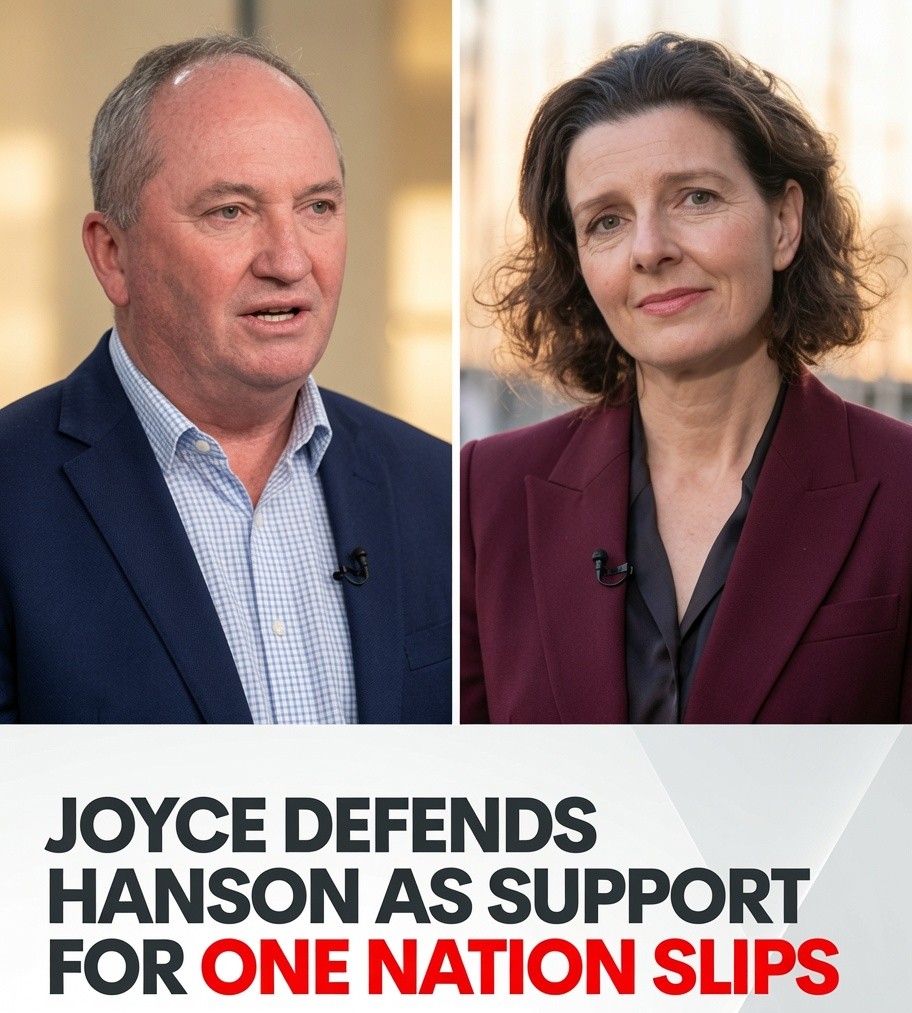
Barnaby Joyce does not think so.
The One Nation MP and former deputy prime minister appeared on Sunrise on Monday to defend his leader.
His argument was straightforward.
Hanson is direct.
Australians know what she thinks.
And that, Joyce believes, is one of her defining political strengths.
“She doesn’t try and gild the lily,” Joyce said.
“She’s straight down the barrel.”
There is considerable truth in that description.
Hanson has built almost her entire political career on the perception that she says things other politicians are unwilling to say.
She does not speak like a departmental briefing note.
She rarely buries her position beneath qualifiers.
She does not appear terrified that a difficult sentence might produce an uncomfortable headline.
For voters exhausted by political language engineered to offend nobody and reveal almost nothing, that style has enormous appeal.
But bluntness creates its own political problem.
Eventually, voters stop judging the courage required to say something.
They begin judging what was actually said.
That is the danger now confronting One Nation.
Hanson’s recent National Press Club address and the political debate that followed exposed Australians to a much broader One Nation agenda.
The party was no longer talking only about migration numbers, energy prices or government waste.
Hanson called for Australia to move away from multiculturalism towards what she described as a monoculture or single national culture.
She proposed abolishing paid parental leave.
Her comments about Muslims triggered condemnation from political opponents and community leaders.
Questions were raised about abortion policy.
Each issue reached a different group of voters.
That matters because One Nation’s recent polling success has required the party to grow far beyond its traditional political base.
A party polling in the high 20s cannot survive only on the support of voters who have followed Hanson for decades.
It needs women.
It needs suburban families.
It needs former Labor voters.
It needs former Liberal voters.
It needs migrants who may support lower immigration despite having migrated to Australia themselves.
It needs people who agree with Hanson on cost-of-living pressure but have never shared her broader cultural politics.
That is the coalition of voters One Nation has been attempting to assemble.
The latest Resolve poll suggests parts of that coalition may be fragile.
Reporting on the survey identified women and immigrants as the two groups driving much of One Nation’s decline.
The timing inevitably puts Hanson’s recent positions under scrutiny.
Consider paid parental leave.
For political strategists, the issue is not abstract.
It reaches directly into the lives of working families.
A voter can be angry about immigration and still rely on paid parental leave.
A woman can believe Australia’s population is growing too quickly and still expect the government to support parents after the birth of a child.
A former Coalition voter can want tougher border policy without wanting a major family entitlement abolished.
Political parties often make the mistake of assuming voters purchase entire ideological packages.
Most do not.
They assemble their own politics.
A voter may want lower immigration and stronger Medicare.
Another may support tougher criminal penalties and government-funded childcare.
A small-business owner may demand lower taxes while supporting action on climate change.
A migrant may favour stricter future migration because they believe population growth is placing too much pressure on housing.
Real electorates are filled with these combinations.
One Nation’s rapid growth was possible partly because Hanson became a vehicle for voters with different grievances.
Housing was too expensive.
Power bills were too high.
Migration was too large.
Government spending looked wasteful.
The Coalition appeared weak.
Labor appeared complacent.
One Nation offered a place to put the anger.
But a protest coalition is easier to build than a governing coalition.
The moment Hanson began explaining what a One Nation government might actually do, voters were forced to make a different calculation.
It was no longer simply: are you unhappy with Labor and the Coalition?
It became: do you want this policy?
That is a much harder political question.
Allegra Spender’s response to Joyce illustrated the challenge.
The independent MP rejected the suggestion that Australia must choose between multiculturalism and a shared national identity.
Spender spoke about her own family’s Italian background.
Her mother arrived without English.
The family retained elements of Italian culture.
They also understood themselves to be Australian.
For Spender, those identities were not contradictory.
“We don’t need to have this fight of monoculturalism or multiculturalism,” she said.
That argument reaches directly into the lives of millions of Australians.
Australia’s population includes people whose parents or grandparents arrived from Italy, Greece, Vietnam, Lebanon, India, China and hundreds of other communities.
Many speak another language at home.
They maintain food, family and cultural traditions inherited from elsewhere.
They also vote.
They serve in the military.
They run businesses.
They pay taxes.
They support Australian sporting teams.
They consider Australia home.
When Hanson talks about abandoning multiculturalism, some voters hear a policy debate about national cohesion.
Others hear a question about whether their family fully belongs.
Joyce is attempting to draw a distinction.
He argues the debate is not about colour, creed or religion.
It is about behaviour.
Australia, he says, needs cultural “guardrails”.
People living here must respect the liberties and views of others.
Those who hold views outside those guardrails may be incompatible with Australian society.
At its strongest, Joyce’s argument is not particularly radical.
Australia already has legal and democratic guardrails.
Violence is illegal.
Terrorism is illegal.
Threatening people is illegal.
Forced marriage is illegal.
Discrimination is regulated by law.
Citizens are expected to obey Australian law regardless of religious or cultural background.
Democratic government depends on accepting election results, freedom of political participation and the rule of law.
Few mainstream politicians would argue that Australia should tolerate violent extremism in the name of cultural diversity.
The disagreement begins when One Nation moves from conduct to identity.
What is outside the guardrails?
Who decides?
Is a religious belief outside the guardrails if most Australians dislike it?
Is a political opinion incompatible with Australian culture?
Can a person privately hold socially conservative views while obeying Australian law?
Does integration require cultural uniformity?
Joyce says the test is how people act.
Spender argues Hanson’s rhetoric has repeatedly targeted Muslims as a group.
That is the political fault line.
Spender said violent extremism of any creed has no place in Australia.
But she warned that attacking people simply because of their religion was itself inconsistent with Australian values.
Her argument is that tolerance is not the opposite of national culture.
It is part of it.
Joyce takes a different view of the cultural debate.
He points to countries with dominant traditions and identities.
Saudi Arabia has an Islamic culture.
Thailand has a Buddhist cultural tradition.
Japan has Shinto influences.
Australia, he argues, should not be embarrassed to say it possesses its own culture.
Again, the argument begins with a proposition most Australians would probably accept.
Australia does have a culture.
The dispute is over its definition.
Is Australian culture something inherited and protected from change?
Or is it something continually shaped by the people who become Australian?
Is it British institutions, the English language and the Westminster system?
Is it Indigenous history extending tens of thousands of years before European settlement?
Is it the postwar migration story?
Is it the democratic expectation that people can believe and worship differently while sharing the same citizenship?
The answer is probably all of those things.
That complexity is politically inconvenient.
Hanson’s strength has always been simplification.
One Nation identifies a problem and draws a clear line.
Immigration is too high.
Cut it.
Energy is too expensive.
Change the policy.
Government wastes money.
Stop the spending.
National culture is weakening.
Restore it.
The message works because voters immediately understand the position.
But the closer a party moves towards government, the more difficult simplification becomes.
Migration affects housing demand.
It also affects labour supply.
Energy policy affects prices.
It also affects investment, reliability and emissions commitments.
Government spending can be wasteful.
It can also fund hospitals, defence and pensions.
National cohesion matters.
So does individual liberty.
Government is the management of those collisions.
This is why the latest poll is important even if the three-point fall disappears next month.
One Nation is entering a new stage of political scrutiny.
For years, Hanson could claim victory when opponents became angry.
Outrage proved she was challenging the establishment.
Condemnation reinforced her outsider status.
Media criticism could be converted into fundraising, attention and voter loyalty.
That strategy works differently when a party is polling at 26 per cent and discussing government.
Voters begin examining consequences.
Women ask what happens to paid parental leave.
Migrants ask what “monoculture” means for their families.
Businesses ask what migration cuts mean for workers.
Mortgage holders ask whether economic promises are costed.
Parents ask what happens to services.
The scrutiny becomes practical.
Joyce understands the danger.
His defence of Hanson is carefully framed around character.
She is direct.
She is brave.
She speaks plainly.
She refuses to gild the lily.
Those are political virtues.
They are not answers to policy questions.
Joyce did not directly address whether Hanson’s paid parental leave proposal contributed to One Nation’s polling decline.
That omission matters because the Coalition has identified an opportunity.
Angus Taylor’s opposition is trying to force One Nation into the same level of scrutiny traditionally applied to major parties.
Cost the policies.
Explain the consequences.
Defend the details.
Andrew Hastie has argued voters are beginning to ask harder questions as One Nation presents itself as a potential government.
The Coalition’s political calculation is obvious.
It cannot simply tell former Liberal voters that Hanson is unacceptable.
Many of those voters have already ignored that warning.
Instead, the Coalition must convince them that One Nation is unprepared.
The Resolve numbers offer the first evidence in months that the strategy may have room to work.
Coalition support rose by the same three points One Nation lost.
That does not prove every departing Hanson voter moved directly to Taylor.
Poll movements are more complicated than a simple transfer between two parties.
But the direction will encourage the opposition.
The Coalition has spent much of the past year watching its conservative flank collapse.
One Nation’s surge transformed Hanson from a protest politician into a direct competitor for government.
Taylor now needs to rebuild a conservative voting coalition without simply copying Hanson.
That requires a difficult balance.
If the Coalition moves too close to One Nation, voters may choose the original.
If it remains too distant, conservative voters may continue to believe the Liberals have abandoned them.
The Coalition’s opportunity is competence.
Its pitch is increasingly that voters can demand lower migration, stronger national security and cultural confidence without accepting One Nation’s entire policy platform.
Whether that argument succeeds will depend partly on Hanson herself.
One Nation’s leader has never built her career by retreating after controversy.
She is unlikely to become cautious because of one Resolve poll.
Joyce’s defence suggests the party does not intend to soften its basic political style.
That may be the correct strategy.
Hanson’s authenticity is central to her appeal.
A media-trained, carefully moderated Pauline Hanson would probably lose the quality that made her political comeback possible.
But authenticity does not make every position popular.
That is the lesson inside the latest numbers.
A politician can be sincerely direct and still lose voters.
A leader can say exactly what she believes and discover that millions of Australians disagree.
Bluntness removes ambiguity.
Sometimes that attracts support.
Sometimes it clarifies the reason to leave.
One Nation remains extraordinarily strong by the standards of its history.
Twenty-six per cent primary support would have been almost unimaginable for the party only a short time ago.
The Coalition remains behind it.
Labor’s 28 per cent is hardly evidence of overwhelming public confidence.
Australia’s federal political system remains in unfamiliar territory, with One Nation’s rise disrupting the preference assumptions that traditionally shaped election modelling. Analysts have warned that the party’s ability to convert a large national vote into House of Representatives seats remains uncertain, particularly because its support is weaker in inner metropolitan electorates.
Hanson has not collapsed.
One Nation has not disappeared.
The party has lost three points after four months of growth.
That is a correction, not a political funeral.
But the demographic movement should concern One Nation.
If women continue leaving, the party has a structural problem.
If migrant voters who previously supported lower immigration begin to feel personally targeted by Hanson’s cultural rhetoric, the party has another.
If former Coalition voters return to Taylor as scrutiny of One Nation’s policies increases, Hanson’s route to government becomes narrower.
Joyce says Hanson is “straight down the barrel”.
He means it as a compliment.
For much of the past year, voters appeared to agree.
The latest Resolve poll raises a different possibility.
Australians may finally be looking straight back at One Nation.
And now that they can see more of the party’s agenda, some of them are deciding they do not like everything in the sights.






