One Nation leader Pauline Hanson has reaffirmed her decision to exclude journalists from the ABC, The Guardian, The Sydney Morning Herald and The Age from party events, accusing the organisations of publishing “lies”, engaging in “spin” and repeatedly treating her party unfairly.
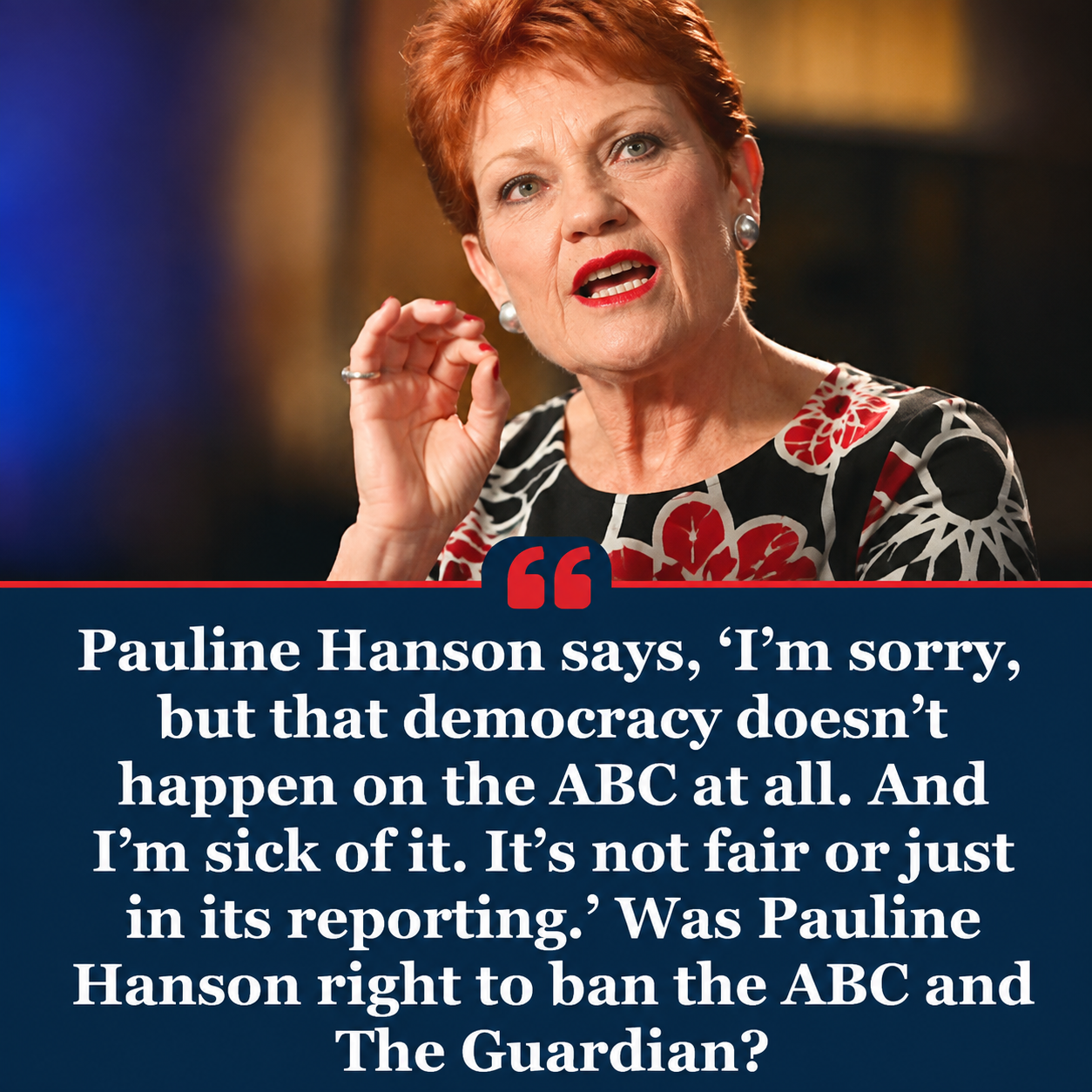
The comments came during a Melbourne press conference announcing One Nation’s Victorian election candidates, where Hanson defended the controversial media ban by arguing that she no longer intended to provide access to organisations she believes consistently misrepresent her statements and policies.
“I’m not putting up with their rubbish. I’m not putting up with their spin, their lies whatsoever. I want truth and honesty. You get it from me, I expect it back from the media,” Hanson told reporters attending the event.
The decision marks the latest chapter in One Nation’s increasingly strained relationship with several of Australia’s largest media organisations.
According to Hanson, the exclusion followed repeated disputes over what she describes as inaccurate reporting, selective quotations and attempts to portray the party unfairly.
Among the issues she highlighted were recent reports concerning comments she allegedly made about the former White Australia policy, claims she has repeatedly denied. Hanson has argued that some reporting failed to accurately reflect what she actually said during earlier public appearances.
The dispute also extends to the ABC’s handling of the controversial Race Around the World segment depicting fictional violence involving mining executive Gina Rinehart.
Hanson has criticised the national broadcaster for refusing to apologise or remove the segment despite legal action launched by Rinehart and Hancock Prospecting against the ABC and several senior executives.
She has suggested the broadcaster’s handling of that controversy reinforced her belief that the ABC no longer reports impartially on matters involving conservative political figures.
Hanson has also criticised The Guardian, accusing the publication of selecting photographs and framing stories in ways she believes are intended to damage her public image.
She argues these examples demonstrate a broader pattern of editorial bias rather than isolated disagreements over individual news reports.
During the Melbourne press conference, Hanson was challenged over whether excluding selected journalists was compatible with democratic accountability.
She rejected the criticism.
“Democracy doesn’t happen on the ABC at all,” Hanson replied, arguing the broadcaster had repeatedly failed to provide balanced reporting while instead relying on what she described as “gotcha moments” during interviews and press conferences.
The controversy has attracted strong criticism from political opponents.
Greens Senator Sarah Hanson-Young accused Hanson of “running scared of scrutiny” and argued that elected representatives should remain available to questioning from all accredited journalists regardless of editorial disagreements.
Employment and Workplace Relations Minister Amanda Rishworth similarly argued that political leaders should not choose which reporters are permitted to attend campaign events, saying accountability requires openness to difficult questioning.
One Nation rejects that interpretation.
The party maintains that privately organised campaign events are not subject to any legal obligation requiring invitations to every media organisation.
Supporters argue that media companies themselves routinely exercise editorial discretion over whom they interview and which political perspectives they highlight, and therefore political parties should likewise retain discretion regarding media access.
Victorian One Nation president Warren Pickering said the party welcomed rigorous examination of its policies, candidates and election platform.
However, he warned that One Nation would pursue legal remedies where reporting crossed the line into defamation or factual inaccuracy.
“We’re happy to be scrutinised,” Pickering said, while making clear that the party intended to challenge reporting it believed was false or misleading through legal channels where appropriate.
The Melbourne event itself focused primarily on launching One Nation’s Victorian campaign.
Hanson introduced several candidates who will contest the November state election, including former Liberal Party member Colleen Harkin, cartoonist and Please Explain creator Mark Nicholson, former police officer Paul Cumming and incumbent Legislative Council member Rikkie-Lee Tyrrell.
The party also outlined plans to release detailed policy announcements over coming weeks covering agriculture, energy, crime, corruption, education and cost-of-living pressures.
The launch attracted significant public attention not only because of the media ban but also because of protests outside the venue.
Victoria Police deployed Public Order Response officers and mounted police after approximately 100 demonstrators gathered outside the Tower Hotel in Hawthorn.
Police established security barriers to separate protesters from party supporters after several demonstrators reportedly breached the outer cordon. The event nevertheless proceeded as scheduled inside the venue.
The dispute highlights broader tensions between Australian political parties and sections of the media.
While mainstream news organisations argue unrestricted media access is fundamental to democratic accountability, some political parties increasingly rely on livestreams, social media and alternative media outlets to communicate directly with voters.
Supporters of this approach argue it allows audiences to watch complete press conferences without editorial selection.
Critics respond that independent journalism plays an essential role by verifying claims, providing context and asking difficult questions that political figures may otherwise avoid.
The disagreement reflects wider changes in Australia’s media landscape, where political communication increasingly occurs through a combination of traditional broadcasters, newspapers, digital publishers and direct online streaming.
As election campaigns become more digitally focused, disputes over media access are likely to remain a recurring feature of Australian politics.
For One Nation, the current ban forms part of a broader strategy of challenging what the party believes is long-standing institutional bias against conservative voices.
For its critics, however, restricting access to selected news organisations risks undermining transparency and limiting opportunities for independent scrutiny.
Whether the exclusion remains in place throughout Victoria’s election campaign has not been confirmed, but the issue has already become one of the defining controversies surrounding One Nation’s campaign launch.
As the party prepares to contest one of its largest Victorian campaigns, the debate over media access is likely to continue alongside the policy issues that will dominate the months leading to polling day.






