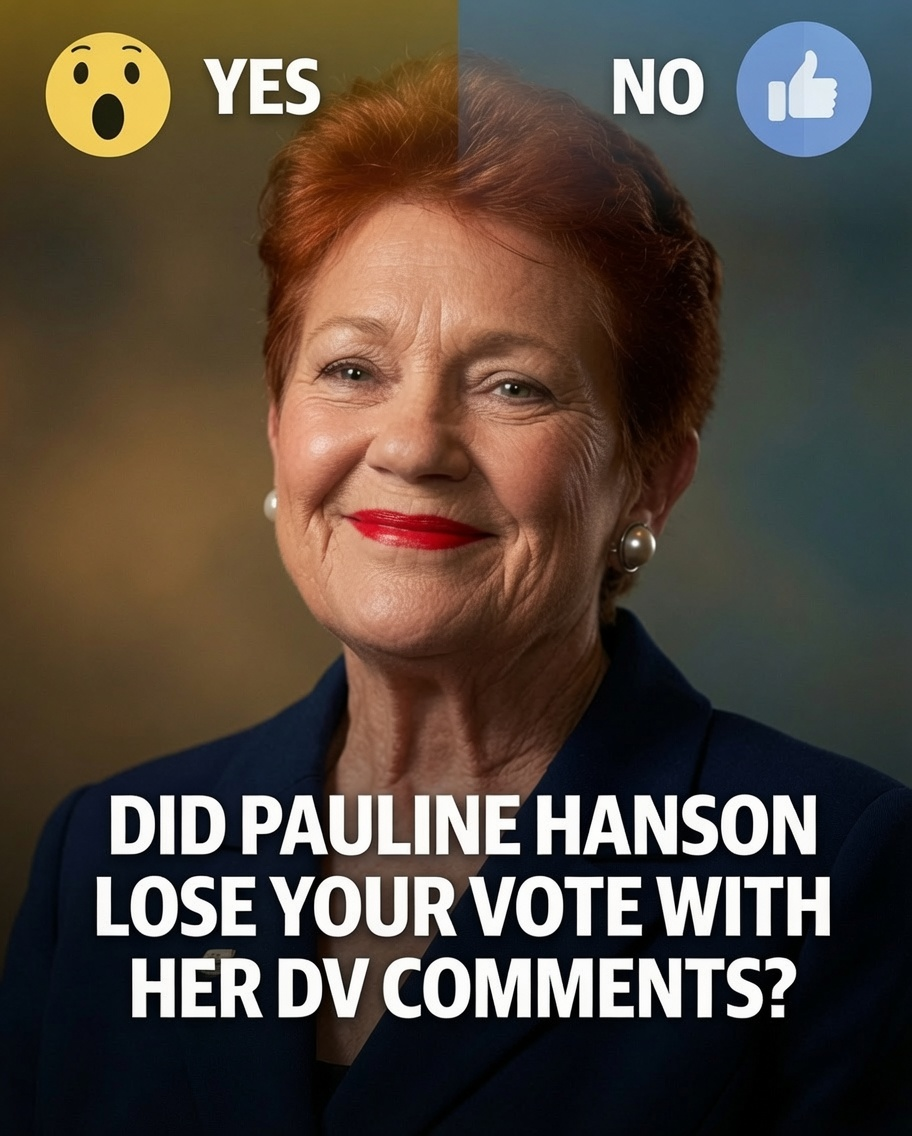
One Nation leader Pauline Hanson has defended controversial comments describing domestic violence as “a two-way street”, insisting her remarks have been taken out of context as political opponents and advocacy groups accuse her of minimising one of Australia’s most serious social problems.
The dispute began after Senator Hanson made comments during an interview on Brisbane radio station 4BC that quickly attracted criticism from senior Labor ministers, domestic violence advocates and other political figures.
In response to the backlash, Hanson published the full transcript of her remarks on social media, arguing that both the media and the Labor Party had misrepresented what she had actually said.
“Here’s exactly what I said on 4BC about domestic violence, so you don’t get it twisted by the media or the Labor Party,” Hanson wrote before reproducing her comments in full.
According to the transcript released by Hanson, she said:
“Domestic violence is wrong, but it’s also a two-way street.”
She continued:
“I’m not saying that it’s just men, women can lose their cool as well … Everyone is under so much pressure and it’s really hard. I don’t think we communicate enough with each other.”
Hanson also referred to her own personal experiences.
“Domestic violence is a scourge but look … I’ve been through it myself in my life. And I just feel if you’re not in a house where you feel safe … Then you shouldn’t put up with it. If these women are getting abused by men out there, then don’t put up with it.”
While Hanson argued the full context showed she condemned domestic violence unequivocally, critics said the broader message remained problematic because it appeared to equate male violence against women with relationship conflict more generally.
The controversy comes at a time when Australia continues to grapple with high rates of family and domestic violence, with recent killings of women drawing renewed attention to the issue nationally.
Education Minister Jason Clare was among those who rejected Hanson’s characterisation, arguing that describing domestic violence as “a two-way street” failed to reflect the reality experienced by most victims.
Clare said domestic violence is a crime, not a shared responsibility between perpetrators and victims, pointing to national statistics showing women are disproportionately affected by serious intimate partner violence.
Social Services Minister Tanya Plibersek also criticised Hanson’s suggestion that women should simply leave abusive relationships, warning that the period immediately after separation is often recognised by experts as the time when victims face the greatest risk of serious injury or death.
Domestic violence organisations have long argued that leaving an abusive relationship can be extremely difficult because victims may face financial dependence, coercive control, threats against children, isolation, or fear of escalating violence.
For that reason, support services generally encourage victims to seek specialist assistance and develop safety plans rather than viewing departure as a simple or immediate solution.
Australia’s Sex Discrimination Commissioner Anna Cody also condemned Hanson’s remarks, describing language that appears to shift responsibility towards victims as potentially harmful.
She said public figures have a responsibility to ensure discussions about domestic violence accurately reflect the evidence surrounding gender-based violence and coercive control.
Hanson, however, has continued to reject suggestions that she was blaming victims.
She argues her comments acknowledged that domestic violence can occur against both women and men while making clear that abuse is unacceptable regardless of who commits it.
Supporters of the One Nation leader have similarly argued that male victims of domestic violence often receive less public attention and that discussions should recognise abuse can occur in either direction.
Australian research confirms that family violence can affect people of all genders. However, government crime statistics and national safety surveys consistently show women are significantly more likely to experience severe physical violence, sexual violence, coercive control and homicide by current or former intimate partners.
According to the Australian Bureau of Statistics, approximately one in four Australian women has experienced violence by an intimate partner since the age of 15, while women account for the overwhelming majority of intimate partner homicide victims.
Men also experience family violence and have access to support services, although the patterns, frequency and severity of offending differ substantially across genders.
The latest controversy is not the first time Hanson has drawn criticism over comments relating to family violence.
Media outlets have also revisited remarks she made in a 2025 podcast discussing domestic violence, policing resources and paid domestic violence leave, comments that likewise attracted criticism from advocacy organisations and legal experts.
The political debate has unfolded against the backdrop of increasing national concern about violence against women.
Federal and state governments have introduced a series of reforms in recent years, including stronger coercive control laws in several jurisdictions, expanded crisis accommodation, increased funding for frontline support services and national campaigns encouraging earlier intervention.
The National Plan to End Violence against Women and Children identifies prevention, early intervention, victim support, perpetrator accountability and long-term cultural change as central priorities.
Successive governments have acknowledged that reducing domestic violence requires coordinated action involving police, courts, health services, schools and community organisations.
Political leaders from across the spectrum generally agree domestic violence remains one of Australia’s most significant public safety and public health challenges, although disagreements often emerge over how the issue should be discussed publicly and what policies are most effective.
For Hanson, the controversy has become part of a broader dispute with the Labor government, which she accuses of deliberately misrepresenting her words for political purposes.
For Labor ministers and many advocacy groups, the concern is not whether Hanson personally condemns domestic violence—something she explicitly stated—but whether describing it as “a two-way street” risks creating a false equivalence between perpetrators and victims in circumstances where evidence shows women are disproportionately subjected to the most serious forms of abuse.
The debate illustrates the sensitivity surrounding public discussion of domestic violence in Australia, where political leaders are increasingly expected to communicate carefully on an issue that affects thousands of families each year.
While Hanson maintains her comments have been quoted selectively, the strong reaction from ministers, experts and advocacy organisations demonstrates how language used by public figures can quickly become a focal point in broader national conversations about violence, victim safety and accountability.