Former prime minister Paul Keating has renewed his attack on AUKUS, arguing the submarine partnership risks tying Australia too closely to a future United States conflict with China and reducing Canberra’s freedom to make independent decisions.
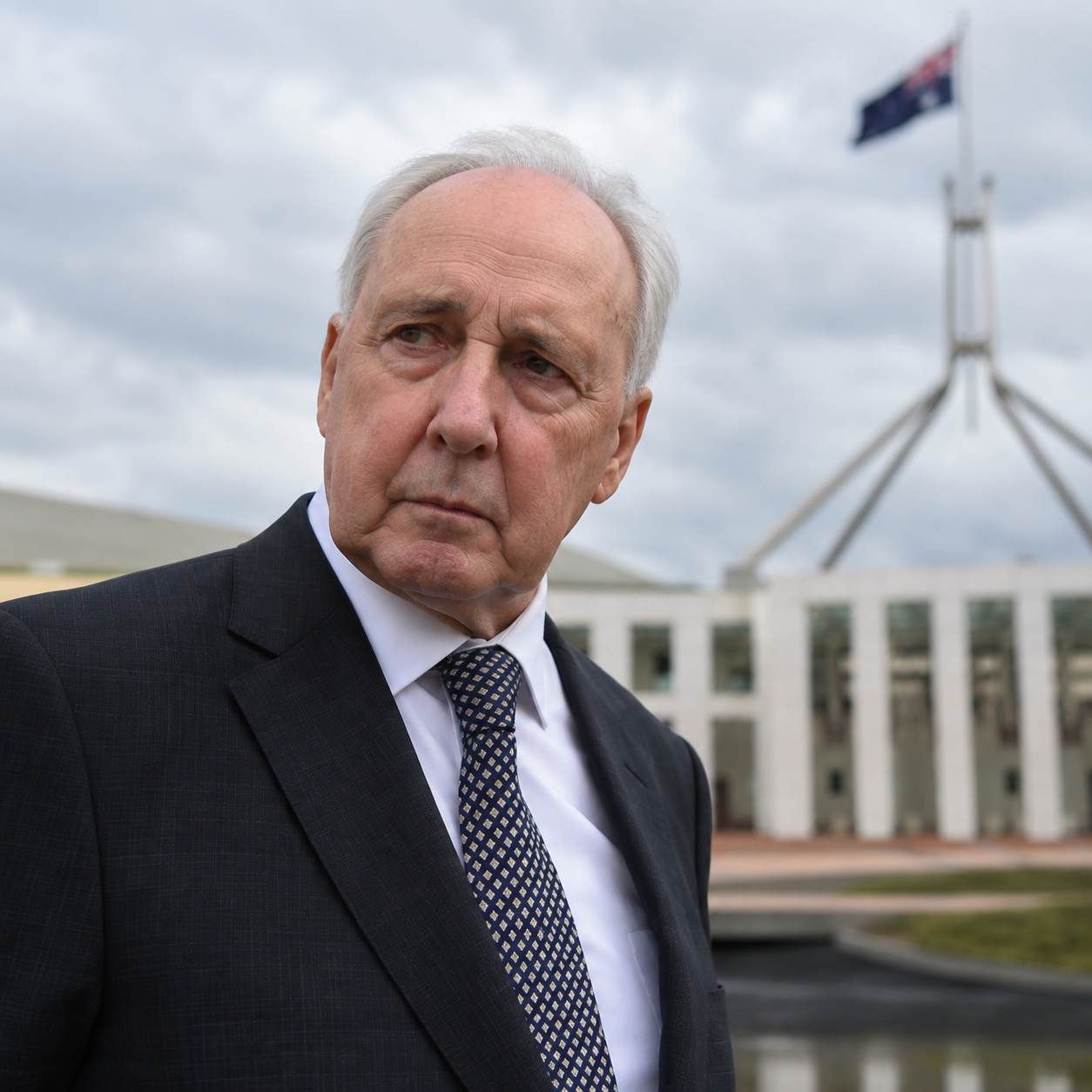
Keating’s comments are political and strategic judgments, not established predictions. They come in a long-running debate over whether AUKUS strengthens Australian sovereignty through greater military capability or weakens it by deepening dependence on the United States and United Kingdom.
Under AUKUS, Australia plans to acquire conventionally armed, nuclear-powered submarines, initially through Virginia-class submarines from the United States and later through the jointly developed SSN-AUKUS design with the United Kingdom.
The partnership also includes preparations for Submarine Rotational Force-West in Western Australia from 2027, when US and UK nuclear-powered submarines are expected to rotate through HMAS Stirling while Australia develops the workforce, maintenance systems and regulatory capability needed for its own fleet.
Keating argues that this deeper integration increases the chance Australia would be drawn into a US-led conflict over Taiwan or a wider confrontation with China. He has also questioned whether Australian bases and future submarine arrangements could make the country a target in a major war.
Those claims are contested by the federal government. Defence ministers argue AUKUS is intended to make Australia more self-reliant by giving the Royal Australian Navy a long-range, stealthy submarine capability able to operate across the Indo-Pacific.
The government says Australian-owned submarines will remain under Australian command and that interoperability with allies does not give another country the legal authority to decide how Australian forces are deployed.
That is the core disagreement. Keating sees the practical depth of the alliance as limiting genuine strategic independence, while the government argues that stronger military capability gives Australia more options and therefore strengthens sovereignty.
The debate has sharpened as the United States and China compete more intensely across the region. Taiwan is one of the most sensitive flashpoints, but neither an armed conflict nor Australian participation in one is predetermined.
Australia’s alliance with the United States does not automatically mean every US military operation requires Australian participation. Decisions to deploy Australian forces are made by the Australian government, although alliance expectations, intelligence cooperation, shared facilities and military interoperability can influence the strategic environment in which those decisions are made.
Keating’s warning therefore concerns political and strategic pressure as much as formal command. His argument is that a country can retain legal sovereignty while becoming so deeply integrated with an ally that saying no to a future operation becomes increasingly difficult.
Supporters of AUKUS make the opposite argument. They say Australia already depends heavily on maritime trade and faces a more difficult security environment, so failing to build stronger deterrent capability would leave the country more exposed to coercion.
In an official defence case for AUKUS published this year, the government argued nuclear-powered submarines can remain submerged for much longer than conventional boats, travel faster over long distances and carry more advanced sensors and systems.
Defence says those characteristics are particularly important for Australia because of the distances between the continent and potential operating areas in the Indo-Pacific. Conventional submarines need to surface or snorkel more frequently, making them easier to detect in contested waters.
The government also argues that nuclear-powered submarines can create uncertainty for a potential adversary, contributing to deterrence by making it harder to know where Australian submarines are operating.
The cost is substantial. Official Defence material says the government is investing between $71 billion and $96 billion over the decade in nuclear-powered submarines, related infrastructure and other capability spending. The full AUKUS submarine program extends across several decades and its long-term cost is much larger.
Critics say that scale of spending creates opportunity costs because money directed to submarines cannot simultaneously be spent on every other defence or domestic priority. They also question delivery risk, US shipyard capacity, nuclear waste arrangements and whether the strategic assumptions behind the program will hold for decades.
The government responds that no combination of smaller systems can fully replace the role of submarines in threatening hostile naval forces at long range, particularly if Australia’s maritime supply routes were at risk.
AUKUS is not limited to buying US submarines. Australia and the UK plan to develop the SSN-AUKUS class, while Australia is investing in a submarine construction yard at Osborne in South Australia and a defence precinct at Henderson in Western Australia.
The government says the industrial program will build an Australian workforce capable of constructing, maintaining and operating the future fleet. That is central to its claim that AUKUS will eventually increase sovereign capability rather than leave Australia permanently dependent on foreign operators.
Keating is unconvinced by that argument because key technology, nuclear propulsion expertise and early submarine supply depend on the United States and United Kingdom. He has consistently argued Australia should pursue a more independent strategic posture in Asia.
The disagreement also reflects different assessments of China. Keating has long warned against treating China primarily as a military threat and argues Australia should avoid being drawn into great-power rivalry. AUKUS supporters point to China’s military expansion and coercive behaviour as reasons Australia needs stronger defence capability.
Neither position removes uncertainty. A submarine program designed for the 2030s, 2040s and beyond is necessarily based on judgments about a strategic environment that cannot be predicted precisely.
That makes parliamentary and public scrutiny important. Australians are being asked to support a defence program that will run across multiple governments, require very large spending commitments and reshape military infrastructure in Western and South Australia.
Questions about sovereignty are therefore not just theoretical. They include who controls Australian submarines, what access allied forces have to Australian facilities, how intelligence is shared, what obligations attach to joint operations and how governments would make decisions in a crisis.
Current official policy is that Australian submarines will be Australian-flagged and commanded through the Australian Defence Force. The United States does not formally command them simply because the technology or initial boats come from the US.
At the same time, Submarine Rotational Force-West will bring more allied submarines, personnel and support activity into Western Australia. That makes the practical relationship between Australian and US forces closer, which is precisely why critics such as Keating say the strategic consequences need continued scrutiny.
The next major milestones are operational rather than rhetorical. Arrangements for the 2027 rotational force are being finalised, Australian personnel are training with US and UK partners, and infrastructure is being developed for maintenance, sustainment and future construction.
Whether those steps ultimately give Australia more strategic freedom or bind it more tightly to US choices is the central dispute. Keating has stated one side forcefully; the government states the other just as clearly.
What is factual today is narrower: AUKUS is proceeding, the government says it is essential to deterrence and sovereign defence capability, and Keating argues it creates unacceptable dependence and war risk. Claims about a future US-China conflict or how Australia would act in one remain judgments about events that have not happened.