Pat Conroy's attack on Greens senator David Shoebridge came in an interview about a senior British defence resignation and the future of the AUKUS submarine partnership. Conroy said Shoebridge had no credibility on defence, rejecting his reading of the resignation as a warning for Australia. The interview records Conroy's rebuttal to remarks made elsewhere; it does not document a fresh face-to-face exchange with Shoebridge.
Conroy's comments were made during an ABC interview about British defence politics, Australian defence spending and the planned nuclear-powered submarine program. The minister's response was unusually personal, but the substantive dispute concerned whether political uncertainty in a partner country should make Australians more worried about a long and expensive defence commitment.
Asked about Shoebridge's critical remarks, Conroy said the senator had 'no credibility in Defence' and attacked his earlier interview. He accused Shoebridge of making jokes about the resignation of a senior British figure and failing to recognise the significance of that minister's service.
The minister maintained that the resignation was about Britain's wider defence budget and not a change to the country's AUKUS commitments. That claim is part of the government's defence of the program. It does not mean delivery risks, funding pressures or shipbuilding constraints have ceased to exist.
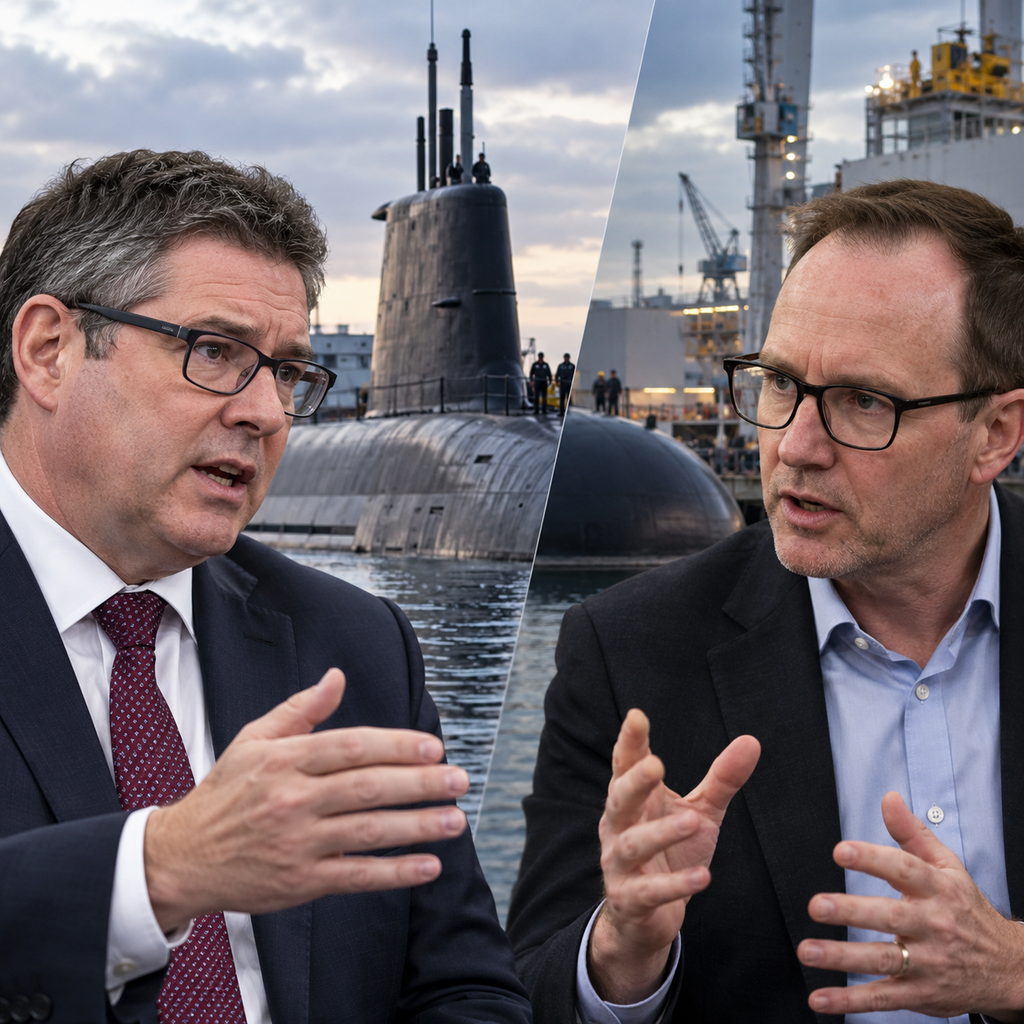
Conroy argued that Britain separated funding for nuclear systems, including its attack-submarine programs, from other military budget decisions. In his explanation, the political debate surrounding the resignation concerned the broader defence budget, while the submarine commitment had a different funding structure. That distinction was the basis of his rebuttal to Shoebridge.
The host pressed him on whether a resignation associated with concerns over military expenditure might nonetheless signal uncertainty about future defence capacity. Conroy resisted that interpretation. He said the departure should not be treated as an Australian crisis simply because it occurred in a country central to AUKUS.
The journalist put the central concern directly to Conroy: if a British defence minister had doubts about military spending, why should Australia feel confident that the submarine partnership was insulated? Conroy pointed to the UK's distinction between money allocated to nuclear systems and the rest of the defence budget. His answer supplied a reason for his confidence, but a minister's description of budget protections cannot remove every future delivery risk.
AUKUS is a trilateral security partnership involving Australia, the United Kingdom and the United States. Its submarine component is intended to provide Australia with nuclear-powered, conventionally armed boats and a long-term industrial capability. The government has described cooperation on technology, production and workforce development as central to the arrangement. Those ambitions depend on decades of decisions rather than a single overseas minister.
Conroy highlighted the work planned for shipyards and supply chains in both Australia and Britain. He described the UK as a vital partner, argued the submarine program remained in both countries' interests and pointed to work on components already being undertaken. His references to industrial progress were assurances from a minister responsible for the program, rather than an independent audit of every delivery milestone.
The ABC interview also examined the question of a capability gap. Australia intends to keep its Collins-class fleet available while preparing for the acquisition of Virginia-class submarines from the United States and the construction of its own AUKUS-class boats. Critics have questioned whether foreign construction capacity, complex technology and workforce demands could leave a period when Australia's submarine needs exceed available vessels.
Conroy expressed confidence in the planned schedule. Confidence is not certainty. Large defence projects can face cost pressure, design changes, workforce shortages and shifts in partner priorities. Those possibilities deserve scrutiny even where a government believes its agreements are secure. At the same time, it would be inaccurate to describe a feared delay as one already confirmed.
Ring-fencing a defence budget line is meaningful only in its proper scope. It may protect an allocation against spending pressures elsewhere in government. It does not manufacture scarce shipyard capacity, train nuclear-qualified workers or eliminate competition for engineers and industrial suppliers. Those constraints matter to Australia because the promised submarines depend on production systems across more than one country. Separating a financing assurance from the industrial task is essential to judging the government's reply.
Conroy's criticism of Shoebridge was therefore directed at both tone and interpretation. He objected to what he described as joking about a serious resignation, while asserting that the senator's broader conclusion about AUKUS was wrong. Shoebridge's concerns about major defence commitments form part of a legitimate parliamentary debate, but no direct reply from him to this particular Conroy interview has been established in the material examined.
Shoebridge's earlier comments prompted Conroy's attack, but the ministers were not recorded trading insults with one another in a face-to-face encounter. The documented criticism in this exchange ran from Conroy towards Shoebridge, with the original AUKUS questions providing its context.
Australian taxpayers have a direct interest in how this partnership is managed. The submarine pathway involves acquiring boats from the United States, cooperating on a future class with Britain, preparing Australian facilities and extending the service life of the Collins-class fleet. Each stage has different exposures: a purchase may depend on allied availability, construction on specialised labour, and sustainment on parts, infrastructure and trained crews. Those risks are more concrete than a verbal contest over which senator sounded credible.
Part of the difficulty for voters is that the term AUKUS covers more than a single purchase. The submarine pathway combines access to a US-designed class of vessel, cooperation on a later class developed with Britain and the creation of Australian facilities capable of building and sustaining exceptionally complex machines. Political confidence in the partnership cannot be measured by a single ministerial appointment, but neither can it be assumed from the existence of an agreement.
Conroy's broader defence of the arrangement included the assertion that Australian industry was making progress on components and that work with British counterparts was continuing. He spoke about manufacturing jobs and the industrial capability expected from the submarine program. Those forecasts concern a substantial undertaking involving training, manufacturing space, maintenance and supply chains. A minister can outline intended benefits; Parliament must still examine whether the expected capacity is being delivered and at what cost.
The availability of US-built Virginia-class submarines was another question in the interview. The concern is not simply whether Washington supports AUKUS in principle, but whether production can meet US requirements while making vessels available for Australia. Conroy defended the planned sequence and the consultations with American counterparts. His confidence is the government's position; the industrial schedules that would prove it remain matters for continuing scrutiny.
Britain faces a parallel test. Political commitments to nuclear shipbuilding can be durable even when other parts of defence face pressure, but commitments still depend on workforce, manufacturing capacity and procurement choices. AUKUS is therefore exposed to both political and operational risks, though the British resignation discussed in the interview did not by itself establish that any submarine contract had been cancelled.
The stakes are unusually high because replacing a submarine fleet is not a quick procurement decision. The vessels require specialised crews, shore infrastructure, nuclear stewardship arrangements, safety regulation and supply chains for decades of operation. Australia's planned boats are described as nuclear-powered but conventionally armed; nuclear propulsion does not mean the program entails Australia acquiring nuclear weapons. That distinction should remain clear amid heated exchanges about the project.
Australia's Collins-class submarines are central to contingency planning because the country cannot simply stop operating a fleet while waiting for replacements. Extending their service life creates a bridge, but it also requires maintenance, crews and expenditure. The strongest public test of the program is whether Defence can explain what happens if replacement boats are delayed, how it would sustain current capability, and what cost assumptions underpin that plan.
Conroy's rebuke was unusually personal, but the evidence he offered was more useful than the insult. His case rested on protected British nuclear spending and continuing allied commitments. Shoebridge's criticism reflected unease about the vulnerability of a major defence project to decisions made overseas. A responsible assessment can record both positions while checking whether each claim bears on the actual submarine pathway.
The Greens senator's concerns need to be separated from the precise claims made in his earlier media appearance. A question about the implications of a UK resignation should not be inflated into a verified claim that Britain had withdrawn from AUKUS. Likewise, Conroy's assurance should not be recast as proof that every cost and technical risk has been eliminated. Both interpretations would take political statements further than the evidence supports.
The household impact is indirect but substantial: major defence commitments compete for national budget resources and shape industrial investment, jobs and infrastructure. That does not mean spending on submarines can be treated as a simple substitute for a health or housing budget line. It means Australians deserve transparent cost estimates, meaningful performance milestones and candid accounts of what could change in a program dependent on allies.
The interview shows the government's preferred defence: the British resignation is not proof of an AUKUS retreat, and existing funding and industrial commitments should be assessed on their own terms. It also shows why the political argument will continue. Supporters see a strategic partnership with long-term benefits; critics demand evidence that the ambitious timetable and expense are justified. Conroy's remarks settle neither side's wider concerns, but they make the government's rejection of Shoebridge's interpretation unmistakable.






