A renewed political argument over artificial intelligence, electricity prices and nuclear energy has emerged after critics accused the Albanese Government of approving energy-hungry AI data centres while many Australian households continue struggling with rising power bills.
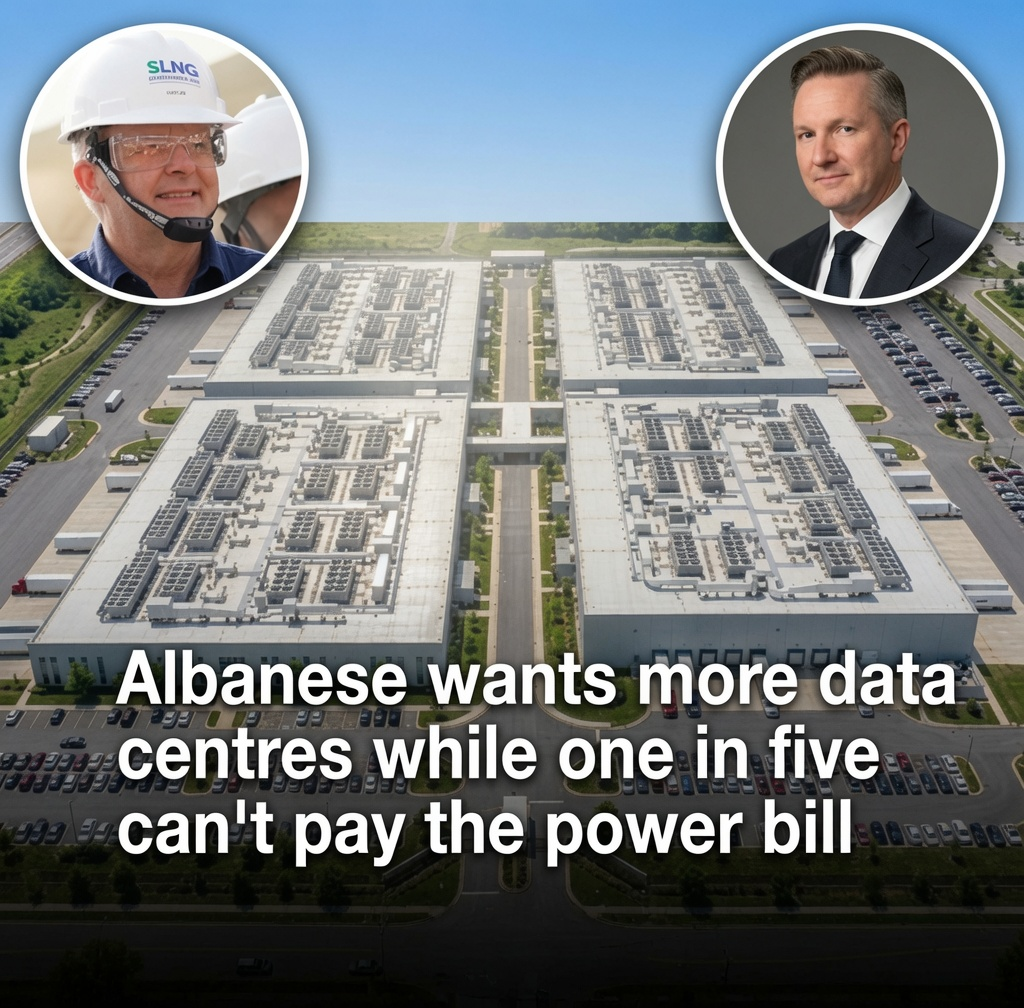
The criticism appears in a strongly worded opinion article that links three issues dominating Australia’s current policy debate: household energy affordability, the rapid expansion of artificial intelligence infrastructure and the federal government’s continued opposition to domestic nuclear power.
The opinion argues that Australia’s electricity system is facing increasing pressure as demand from hyperscale AI data centres accelerates, while many households remain under financial stress because of high energy costs.
According to Energy Consumers Australia, around one in five Australian households are experiencing energy hardship or are at risk of falling into hardship, with many families reducing spending on essentials in order to pay electricity bills. That finding has become a focal point for critics questioning whether governments should prioritise additional electricity demand before new generating capacity has been fully developed.
At the centre of the latest controversy is Prime Minister Anthony Albanese’s announcement of a new national framework for artificial intelligence.
The government has proposed creating an Office of AI within the Department of the Prime Minister and Cabinet while introducing national standards governing large-scale AI infrastructure. Those reforms are intended to establish consistent rules across Australia for artificial intelligence development, copyright protection, environmental impacts and the operation of major data centres.
As part of that proposal, new large-scale AI data centres would be required to provide additional electricity generation to offset their own demand, pay the full cost of connecting to the grid and minimise water consumption. The government says these measures are designed to ensure households and existing businesses do not subsidise future AI developments.
However, the legislation underpinning those requirements has not yet been introduced into Parliament.
Critics argue that because the legal framework is still being developed, approvals for some projects may proceed before the proposed safeguards formally take effect.
Environmental organisations have also expressed concern that Australia should establish stronger national rules before permitting another wave of hyperscale data centres. Some community groups have called for a temporary pause on approvals until the new regulatory framework is enacted.
The debate extends well beyond artificial intelligence.
The opinion article also highlights the Albanese Government’s recent decision to facilitate uranium exports to India under existing bilateral nuclear cooperation agreements.
Australia possesses the world’s largest known uranium resources but continues to prohibit commercial nuclear electricity generation domestically under current federal legislation. Supporters of nuclear power argue this creates an inconsistency whereby Australia exports uranium for overseas nuclear generation while refusing to permit the same technology at home.
The Albanese Government has maintained its long-standing position that nuclear power is not the most practical or cost-effective pathway for Australia’s energy transition.
Instead, Labor continues to pursue a strategy centred on renewable electricity supported by batteries, pumped hydro storage, expanded transmission infrastructure and other technologies intended to improve reliability while reducing emissions.
That policy has become one of the clearest differences between Australia’s major political parties.
The Coalition continues advocating for the eventual introduction of nuclear power stations, arguing they would provide reliable, low-emissions electricity capable of supporting heavy industry, manufacturing and rapidly growing digital infrastructure.
Labor, meanwhile, argues renewable energy can provide sufficient reliability when combined with storage technologies and appropriate investment in the electricity network.
The emergence of artificial intelligence has intensified this debate because modern AI facilities require enormous amounts of electricity.
Hyperscale data centres operate continuously, often consuming as much electricity as medium-sized regional cities. Their energy demand is expected to grow significantly over the coming decade as governments and technology companies expand AI capabilities.
Recognising those pressures, the Albanese Government says future AI developments should become net contributors to electricity supply rather than simply increasing demand on the existing grid. The proposed framework also seeks to encourage investment while protecting consumers from higher electricity costs associated with new digital infrastructure.
Industry responses have generally welcomed the government’s decision to establish clearer national AI rules, although business groups continue consulting on how the proposed energy obligations will operate in practice and whether they could affect Australia’s competitiveness as a destination for global technology investment.
The opinion article argues those measures arrive too late to address existing facilities already connected to the electricity system.
It also contends that renewable generation alone cannot reliably support rapidly expanding AI demand and points to the growing interest shown by several major international technology companies in nuclear energy projects overseas.
Supporters of Labor’s policy dispute that conclusion, arguing Australia’s energy transition is still underway and that batteries, pumped hydro and other forms of firming capacity will provide reliable electricity as renewable generation continues expanding.
The broader policy question now confronting Australia is how to balance three competing priorities: maintaining affordable electricity for households, attracting billions of dollars in AI investment and achieving long-term emissions reduction targets.
With electricity affordability remaining a major cost-of-living concern and artificial intelligence expected to become one of the country’s fastest-growing industries, that debate is likely to remain central to Australia’s political and economic agenda over the coming years.
Whether future governments ultimately retain Australia’s renewable-focused strategy or broaden the national energy mix to include nuclear generation will remain a matter for political decision. For now, the Albanese Government is proceeding with legislation designed to regulate AI development while maintaining its opposition to domestic nuclear power, even as critics continue challenging that approach.






