Australian politics has never been short of colourful moments, but few have spread across social media as quickly as Barnaby Joyce abruptly shouting at an off-camera dog during a live television interview.
What might otherwise have been remembered as another unusual Barnaby Joyce moment has instead become a metaphor for a broader political story unfolding inside One Nation.
In a satirical opinion piece published this week, the author argues that Pauline Hanson’s party had been hoping for a relatively quiet period before Mr Joyce’s now widely discussed television appearance thrust the party back into headlines for reasons unrelated to policy.
The commentary is written as political satire rather than straight news reporting, using humour to describe what the writer portrays as growing internal confusion, competing personalities and recurring controversies surrounding One Nation.
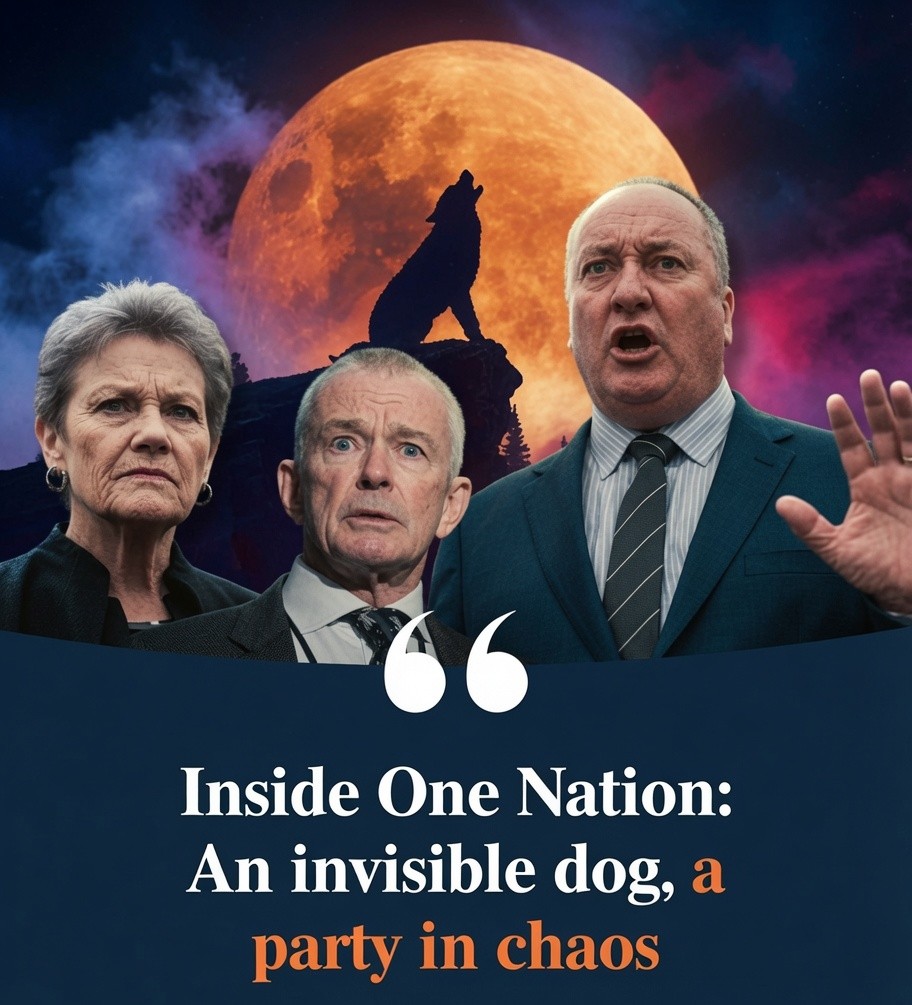
The article’s title — Inside One Nation: An Invisible Dog, a Party in Chaos — refers directly to Mr Joyce’s interruption during ABC’s 7.30 program, where he suddenly yelled at his dog before engaging in an uncomfortable exchange with host Sarah Ferguson.
The television interview quickly became one of Australia’s most talked-about political moments of the week.
While answering questions about One Nation leader Pauline Hanson and the party’s direction, Mr Joyce unexpectedly shouted “Sit down!” at his dog before apologising for the interruption.
The exchange then became tense as Ms Ferguson attempted to return the discussion to questions about the party’s political positioning and recent controversies.
Video of the incident rapidly circulated online, spawning memes, jokes and commentary across multiple social media platforms.
Mr Joyce later apologised for the interruption, explaining that the dog had been moving around beneath him during the interview and acknowledging that the moment had distracted from the discussion.
The opinion piece argues that the episode became symbolic because it arrived during an already difficult period for One Nation.
Rather than focusing on the party’s policy agenda, media attention has increasingly centred on a succession of controversies involving high-profile party figures.
Recent reporting has examined Pauline Hanson’s meetings with controversial British activist Tommy Robinson, comments by Senator Malcolm Roberts on a range of conspiracy-related topics, and the growing public profile of Barnaby Joyce following his decision to align himself politically with One Nation.
Throughout the column, the author adopts a deliberately exaggerated tone, joking that while Pauline Hanson was away, Senator Malcolm Roberts was effectively “in the basement” conducting research—an obvious satirical reference to criticism frequently directed at Roberts over his past public comments and unconventional policy interests.
The piece also revisits Roberts’ history of engaging with conspiracy theories, while acknowledging occasions where he has attempted to publicly reject claims he regarded as unsupported.
These passages are presented as political commentary rather than factual allegations about current conduct.
Political satire has long been part of Australian journalism.
Opinion writers frequently use humour, irony and exaggeration to criticise public figures or highlight perceived contradictions within political parties.
Unlike straight news reporting, opinion columns reflect the author’s interpretation of events and are intended to provoke debate rather than provide a neutral account.
The latest commentary therefore offers one perspective on One Nation’s internal dynamics rather than establishing factual conclusions about the party’s operations.
Nevertheless, it touches on genuine political challenges confronting Pauline Hanson.
After recording stronger electoral support during 2026, One Nation has attracted greater public attention than at any point in recent years.
That increased prominence has brought both opportunities and additional scrutiny.
Political analysts note that minor parties often face greater pressure once they begin expanding beyond their traditional support base.
Media attention tends to shift from policy announcements towards questions about candidate selection, internal discipline, leadership and organisational cohesion.
For One Nation, several recent controversies have coincided with the party’s attempts to position itself as an alternative to both Labor and the Coalition.
The party has campaigned heavily on issues including immigration, energy prices, cost-of-living pressures, government spending and opposition to a number of federal climate policies.
Polling over recent months has suggested those themes continue to resonate with some voters dissatisfied with Australia’s major political parties.
Senior Labor figures have publicly acknowledged that One Nation now represents a more significant electoral challenge than in previous years, particularly in parts of regional Australia and outer metropolitan electorates where household economic pressures remain acute.
Those political developments help explain why media attention surrounding individual One Nation figures has intensified.
Barnaby Joyce’s interview attracted attention not only because of the unusual interruption but because he was responding to questions about the party’s broader political direction.
The resulting viral moment quickly overshadowed the substance of the discussion.
In Australian politics, unscripted moments often travel further than carefully prepared policy announcements.
Television clips lasting only a few seconds can dominate news coverage, shape public perceptions and become enduring political symbols regardless of the underlying issues being debated.
The “invisible dog” episode illustrates that phenomenon.
What began as an apparently minor interruption during a live interview evolved into a national talking point, inspiring political cartoons, opinion columns and widespread online commentary.
The satirical article argues that the real story was never the dog itself.
Instead, it suggests the incident reflected a party struggling to control its public narrative while confronting multiple controversies at once.
Whether readers agree with that assessment ultimately depends on their own political perspective.
Supporters of One Nation may view the column as an example of the media focusing on personalities instead of policy.
Critics may see it as highlighting genuine organisational challenges within the party.
Either way, the commentary demonstrates how political satire continues to play a significant role in Australia’s media landscape, using humour to examine leadership, public image and electoral strategy.
For Pauline Hanson, the challenge remains ensuring that One Nation’s policy platform—not another unexpected television moment—dominates the political conversation as Australia moves further into the current parliamentary term.