One Nation’s promise to offer Australians 30-year fixed-rate mortgages at 5 per cent has an obvious political appeal: take on the big banks, give families certainty and stop Reserve Bank rate rises from repeatedly smashing household budgets.
But economists are warning the apparently simple mortgage offer could shift an enormous financial risk onto the federal government — and ultimately Australian taxpayers.
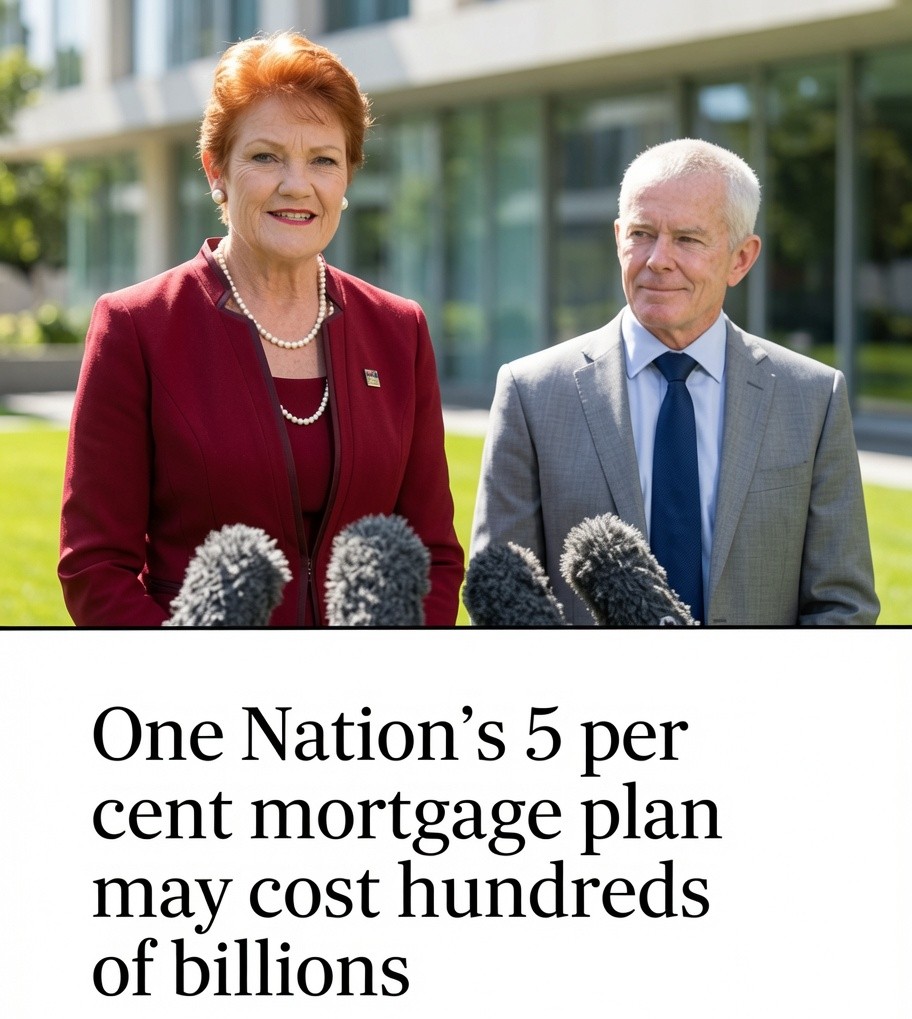
The proposal, described by One Nation as a “People’s Mortgage”, would offer eligible home buyers loans with a 5 per cent deposit and a 5 per cent interest rate fixed for 30 years.
That would be a radical departure from the Australian mortgage market.
Most Australian borrowers use variable-rate home loans or fix their rate for relatively short periods.
When the Reserve Bank raises the cash rate and lenders increase mortgage rates, millions of households can feel the effect relatively quickly.
One Nation wants to break that connection for borrowers using its scheme.
A family approved for a 5 per cent, 30-year fixed mortgage would know its interest rate from the beginning of the loan to the end.
No mortgage cliff after a two-year fixed term.
No immediate repayment shock because the Reserve Bank raises rates.
No need to refinance every few years simply to chase a competitive deal.
For borrowers exhausted by Australia’s recent interest-rate cycle, it sounds almost irresistible.
The problem is that fixing a borrower’s rate for 30 years does not eliminate interest-rate risk.
It moves the risk somewhere else.
And under One Nation’s proposal, economists fear that “somewhere else” could be the Commonwealth balance sheet.
The central question is brutally simple: where does the money come from?
A mortgage is a very large, very long loan.
If a government-backed lender advances $700,000 to a household, somebody must provide that $700,000.
Multiply the process across thousands of home buyers and the funding requirement quickly becomes enormous.
Australian Financial Review reporting on the proposal found economists warning a widely available scheme could require the federal government to find hundreds of billions of dollars.
The exact cost would depend entirely on the final design.
How many borrowers are eligible?
Is there an income cap?
Is there a maximum property price?
Can existing homeowners refinance into the scheme?
Is it restricted to first-home buyers?
How many loans can be issued each year?
Who assesses creditworthiness?
What happens when a borrower defaults?
Those details are not administrative footnotes.
They determine whether the People’s Mortgage is a relatively small targeted housing program or one of the largest financial interventions ever attempted by an Australian government.
Pauline Hanson has pushed back against warnings that the scheme could require hundreds of billions of dollars.
She says the program would be capped at $11.5 billion and funded by redirecting money associated with Labor’s Housing Australia Future Fund.
That response substantially changes the scale of the argument.
If the government is only willing to commit a fixed pool of $11.5 billion, the scheme cannot provide cheap mortgages to every Australian who wants one.
There would have to be a limit.
And once there is a limit, Canberra must decide who gets the 5 per cent mortgage and who returns to the commercial banking system.
An $11.5 billion cap would make the promise much smaller than many voters may imagine
Australia’s home prices mean mortgage balances can easily reach hundreds of thousands of dollars.
Consider a simplified example.
If the average loan advanced through the scheme were $700,000, an $11.5 billion pool could fund roughly 16,400 mortgages before allowing for administration, liquidity requirements and other costs.
At an average loan of $600,000, the same amount would support about 19,000 mortgages.
Those are rough illustrations rather than formal costings.
But they reveal the scale problem.
Australia has millions of mortgage holders.
Tens of thousands of new borrowers enter the housing market.
A program funded by a finite $11.5 billion capital pool could provide an extremely valuable benefit to a relatively small group of successful applicants.
It could not simultaneously become a universal alternative to the big four banks unless the government found substantially more funding or designed a mechanism to recycle and leverage the initial capital.
That is why economists want more detail.
When a politician promises a government-backed bank capable of taking on Australia’s major lenders, voters naturally imagine a large-scale competitor.
When the same proposal is described as capped at $11.5 billion, it begins to look more like a targeted lending scheme.
Those are very different policies.
One Nation itself has sent mixed messages about whether the proposal is settled policy
The confusion intensified this week when Barnaby Joyce, One Nation’s treasury spokesman, was questioned about the mortgage proposal.
According to the AFR, Joyce said the idea “hasn’t been made a policy”.
That sits awkwardly beside Hanson’s public defence of the plan and descriptions of how it would be funded.
The disagreement matters because One Nation is no longer being treated simply as a minor protest party.
Its rise in polling has brought far greater scrutiny to its economic platform.
Policies that once might have existed as campaign ideas or broad statements are now being examined as potential government programs.
Economists are asking for costings.
Opponents are testing assumptions.
Journalists are comparing statements from senior party figures.
Financial markets would eventually want to understand the implications for Commonwealth borrowing.
A 30-year mortgage program cannot be designed through a slogan alone.
If Hanson means the scheme is capped at $11.5 billion, One Nation needs to explain the allocation rules.
If Joyce means it is still an idea rather than formal policy, the party needs to explain what remains under development.
Until then, it is difficult to calculate the true fiscal exposure.
Why a 5 per cent fixed mortgage becomes dangerous when government funding costs rise
The financial risk can be understood through a basic example.
Imagine the government lends a household money at 5 per cent fixed for 30 years.
The borrower is protected.
If market interest rates rise to 7 per cent, the household continues paying 5 per cent.
That certainty is the entire attraction of the policy.
But the government still needs to fund the mortgage.
If Canberra’s own cost of borrowing rises, the margin between what the government pays for money and what it receives from the mortgage can shrink or disappear.
Australia’s long-term government bond yields have already been elevated in 2026.
The Reserve Bank said in its May Statement on Monetary Policy that government bond yields had increased and market pricing expected the cash rate to reach 4.7 per cent by the end of 2026.
A 5 per cent mortgage rate therefore leaves relatively little room for funding costs, administration, credit losses and the capital required to operate a lending program.
Commercial banks normally price those risks into mortgage rates.
They fund loans through deposits, wholesale markets and other sources.
They manage the maturity mismatch between their funding and their assets.
They hold capital against losses.
They assess borrowers.
They price different levels of credit risk.
And when banks make serious mistakes, shareholders can lose money.
A government lender can perform many of the same functions.
But if it deliberately offers mortgages below the rate required to cover its long-term risks, the loss does not vanish.
The taxpayer absorbs it.
A 30-year fixed rate creates another problem when interest rates fall
Rising rates are only one side of the risk.
Suppose the government issues a 30-year mortgage at 5 per cent.
Several years later, market mortgage rates fall to 3.5 per cent.
What does the borrower do?
If they are free to refinance without a significant penalty, many will leave the 5 per cent government loan and move to a cheaper product.
The government loses a relatively valuable 5 per cent mortgage asset.
But when market rates rise above 5 per cent, borrowers stay.
This creates an asymmetric risk.
The lender can be left holding low-rate loans when rates are high while losing borrowers when rates fall.
Mortgage markets that successfully support long-term fixed lending need mechanisms to manage this problem.
Denmark, for example, has a sophisticated mortgage bond system that links long-term fixed loans to capital markets and allows risks to be priced through a developed funding structure.
The United States also has a vast system of mortgage-backed securities and government-sponsored housing institutions supporting its 30-year fixed-rate mortgage market.
Australia does not currently operate an equivalent mass-market structure.
That does not mean long-term fixed mortgages are impossible here.
Consumer advocates have argued Australia should examine international models because Australian borrowers carry an unusually large share of interest-rate risk.
But creating a durable 30-year fixed mortgage market requires more than declaring a politically attractive interest rate.
The funding architecture matters.
The refinancing rules matter.
The treatment of early repayment matters.
The way interest-rate risk is hedged matters.
And somebody must be paid to carry that risk.
The policy could also push house prices higher
There is another danger familiar to Australian housing policy.
A measure intended to make homes more affordable can increase buyers’ purchasing power without increasing the number of homes available.
When more buyers can borrow more cheaply, they can bid more for property.
If housing supply does not respond, part of the benefit can flow into higher prices.
This is why economists repeatedly distinguish between demand-side and supply-side housing policies.
A cheap mortgage makes finance easier.
It does not build a house.
One Nation argues its wider housing platform would also reduce demand through lower immigration and increase supply by cutting regulation and development costs.
The party therefore does not present the People’s Mortgage as its only housing policy.
But the sequencing matters.
Housing supply responds slowly.
Planning changes take time.
Infrastructure must be built.
Developments require finance and construction workers.
A subsidised or government-supported mortgage can increase purchasing capacity much more quickly.
If thousands of eligible buyers suddenly gain access to a 5 per cent fixed rate while the number of homes for sale remains constrained, sellers may capture part of the benefit through higher prices.
Australia has already faced a similar debate over government-backed low-deposit schemes.
Critics argue that helping buyers enter the market can intensify competition for limited housing.
Supporters respond that individual households should not be forced to wait indefinitely for a perfect supply response before receiving assistance.
Both arguments have force.
But One Nation would need to demonstrate how its mortgage plan interacts with housing supply rather than simply assuming cheaper credit automatically produces affordable homes.
The political appeal comes from a real weakness in Australia’s mortgage system
The warnings about taxpayer risk should not obscure why the proposal has attracted attention.
Australian mortgage borrowers have endured extraordinary repayment volatility.
A household can borrow responsibly, pass a bank’s serviceability assessment and still face a dramatic increase in monthly repayments because monetary policy changes.
For highly indebted families, the Reserve Bank’s rate cycle can dominate household finances.
The Consumer Policy Research Centre argued in a March report that Australia’s mortgage market places too much risk on borrowers relative to lenders.
Its international comparison noted that Denmark offers fixed loans for up to 30 years through a bond-linked model, while longer fixed terms are also available in other mortgage systems.
That means One Nation has identified a genuine public frustration.
Borrowers want certainty.
A 30-year fixed mortgage gives them certainty.
The real economic dispute is not over whether payment certainty has value.
It clearly does.
The dispute is over how that certainty should be funded and priced.
If a private lender offers a 30-year fixed rate, it must manage the financial risks and charge accordingly.
If a government offers a rate that commercial lenders cannot match, economists will immediately ask whether the taxpayer is providing an implicit subsidy or guarantee.
One Nation’s political pitch is that Australians are already paying too much to major banks and that a public competitor could force the system to change.
That argument deserves examination.
Australia’s banking market is concentrated.
Competition in home lending matters.
Bank profitability and mortgage pricing are legitimate subjects for public policy.
But a government can always “undercut” private lenders if it ignores the risks private lenders are required to price.
That is not necessarily competition.
It can be a transfer of risk from borrowers to taxpayers.
The Housing Australia Future Fund is not currently a mortgage bank
Hanson’s suggestion that the People’s Mortgage would use $11.5 billion associated with Labor’s housing fund also raises a question about what would be displaced.
The Housing Australia Future Fund was established as a dedicated investment vehicle supporting social and affordable housing and other acute housing needs.
The fund is managed as an investment vehicle, with returns used to support housing programs.
The federal government’s broader commitment is to support tens of thousands of social and affordable homes by mid-2029 through the HAFF and related programs.
Redirecting that capital into individual home mortgages would represent a fundamental change in purpose.
One Nation may believe that is justified.
The party can argue that helping Australians own homes is a better use of public capital than Labor’s housing investment model.
But the money cannot perform two jobs at the same time.
If billions are redirected into the People’s Mortgage, the government would need to explain what happens to existing social and affordable housing commitments associated with the current framework.
Would contracts be honoured?
Would another funding source replace the HAFF?
Would planned projects be cancelled?
Would the mortgage program operate alongside a reduced social housing program?
These are distributional questions as much as financial ones.
A cheap mortgage primarily helps a household capable of buying a home and servicing a loan.
Social housing assists people who may never qualify for a $600,000 or $700,000 mortgage.
Redirecting money from one group to the other is a policy choice.
Voters deserve to know the trade-off.
One Nation now has to decide whether this is a slogan, a targeted scheme or a new national mortgage system
The People’s Mortgage has reached the stage where the detail matters more than the headline.
A tightly capped $11.5 billion program for a limited group of first-home buyers is financially and economically different from a government bank designed to compete directly with Commonwealth Bank, Westpac, NAB and ANZ across the mortgage market.
A loan available only for new homes has different effects from one available for established properties.
A scheme restricted by income and property value is different from one open to all borrowers.
A government that funds mortgages directly carries different risks from a government that guarantees securities issued through a bond-backed mortgage system.
One Nation needs to settle those questions.
It also needs its senior figures to describe the same policy.
Hanson says the scheme is capped at $11.5 billion.
Joyce has said it has not been made policy.
Economists examining the broader concept warn the exposure could run into hundreds of billions if it is implemented at sufficient scale to become a genuine alternative to the major banks.
Those positions cannot simply be blended together.
The idea addresses a real problem. That is exactly why the design cannot be vague.
Australians have legitimate reasons to be angry about mortgage stress.
They have legitimate questions about bank competition.
They are entitled to ask why borrowers in some other countries can obtain long-term payment certainty while Australian households remain heavily exposed to each interest-rate cycle.
A 30-year fixed-rate mortgage market is not inherently absurd.
International examples prove such loans can exist.
But those systems have financial structures designed to fund and distribute long-term mortgage risk.
One Nation’s promise currently begins with the number voters want to hear: 5 per cent.
The next stage must explain the numbers taxpayers need to understand.
How many loans?
How much Commonwealth capital?
What funding cost?
What default assumptions?
What happens when rates rise?
What happens when rates fall?
Can borrowers refinance?
Who receives the loans?
And what housing programs disappear if the Housing Australia Future Fund is redirected?
Until those questions are answered, economists will continue to see a potentially enormous risk hiding behind a very attractive mortgage rate.
Fixing a family’s home loan at 5 per cent for 30 years removes uncertainty from the kitchen table. It does not remove uncertainty from the financial system — it simply decides who will carry it.
Under One Nation’s plan, the biggest unanswered question is whether that person will ultimately be the Australian taxpayer.






