One Nation has surged ahead of both Victorian Labor and the Liberal-National Coalition in a massive poll of about 6,500 voters, sending a fresh shock through the state’s political establishment and prompting key unions to prepare for an election campaign blitz.
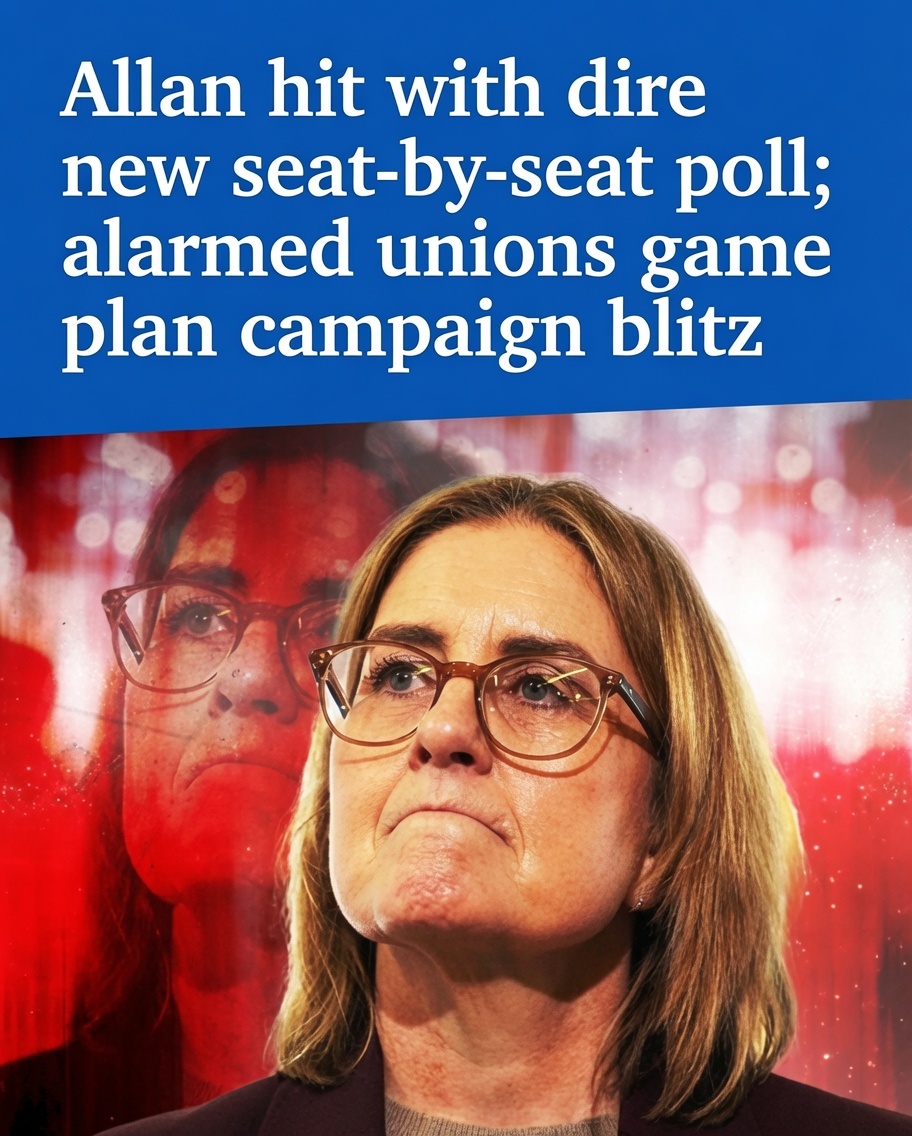
The RedBridge polling, commissioned by the Victorian Trades Hall Council, placed One Nation on 27 per cent of the primary vote ahead of the November state election.
Labor and the Coalition were tied on 26 per cent, while the Greens recorded 12 per cent and other parties and independents accounted for 8 per cent.
The result is extraordinary for a party that does not currently have a Victorian state leader and has historically operated outside the traditional Labor-versus-Coalition contest for government.
It also presents Premier Jacinta Allan with a political problem far larger than a conventional opposition challenge.
Victoria is no longer looking like a straightforward two-party election.
If the polling is even broadly reflected at the ballot box on 28 November, the state could face three-way contests across a large number of electorates, unpredictable preference flows and a lower house result that becomes extremely difficult to model using the assumptions that have guided Victorian elections for decades.
For Labor and the union movement, the warning is particularly stark.
The poll was not commissioned by One Nation or by a conservative campaign group seeking to embarrass the Allan government.
It was commissioned by Trades Hall.
And the results have reportedly been serious enough to prompt union leaders to prepare a major campaign response aimed at helping Labor survive.
A 6,500-voter poll has exposed a radically fragmented electorate
The size of the RedBridge survey makes the findings especially difficult for political strategists to ignore.
Polling of roughly 6,500 voters provides far greater scope for demographic and geographic analysis than a standard statewide poll of about 1,000 respondents.
According to reporting on the results, the research included detailed demographic data and was designed to help assess how the Victorian electorate is moving ahead of the state election.
What it found was a political landscape in which none of the three largest forces commands even 30 per cent of the primary vote.
One Nation: 27 per cent.
Labor: 26 per cent.
Coalition: 26 per cent.
That is not merely a close race.
It is fragmentation on a scale capable of breaking traditional electoral calculations.
Under Victoria’s preferential voting system, the statewide primary vote does not directly determine who forms government. Elections are won seat by seat, and preferences from eliminated candidates can determine which of the final two candidates secures a majority.
For generations, political strategists have generally been able to model most electorates around an eventual Labor-versus-Coalition contest.
A One Nation vote in the high 20s changes that assumption.
In some electorates, Labor could face One Nation in the final count.
In others, the Coalition could face One Nation.
Elsewhere, traditional Labor-Coalition contests may continue.
The problem for campaign headquarters is that preferences may behave differently in each scenario.
A former Liberal voter now supporting One Nation may preference the Coalition ahead of Labor.
A former Labor voter who has moved to One Nation over immigration, cost-of-living pressure or distrust of the political system may not follow the same pattern.
Greens preferences add another layer of complexity, particularly in metropolitan electorates.
The result is an election map with far more moving parts than Victoria has traditionally faced.
Labor’s possible seat range shows how volatile the election has become
Analysis accompanying the RedBridge polling reportedly produced an enormous range of possible outcomes for Labor.
In a severe scenario, the party could be reduced to a seat count in the 20s.
At the more favourable end of the modelling, Labor could still reach the mid-40s and retain a path to government.
Such a wide range is itself revealing.
It means the uncertainty is not simply about whether Labor loses three seats or seven seats.
The uncertainty is about the basic structure of the election.
Victoria’s Legislative Assembly contains 88 seats, meaning 45 are required for a majority.
Labor won the 2022 state election comfortably and began the current term with a commanding lower-house position.
But governments that remain in office for long periods often accumulate political liabilities that do not fit neatly into a single issue.
Labor has governed Victoria since 2014.
By the time voters go to the polls in November, the party will be asking for another four years after more than a decade in power.
The Allan government is carrying disputes over state debt, major infrastructure spending, housing, crime, cost-of-living pressure and allegations surrounding the construction industry and the CFMEU.
Not every voter will blame Labor for every problem.
But long-serving governments face a particular political danger when dissatisfaction begins to merge into a broader belief that the system itself needs to change.
That is the environment in which One Nation has grown.
The union movement is preparing to respond
The polling has reportedly triggered serious discussions within Victoria’s union movement about the scale of the campaign required before November.
Trades Hall and key unions have enormous experience in field campaigning.
Union election operations can include door-knocking, phone banking, workplace conversations, volunteer mobilisation and targeted messaging in electorates considered politically vulnerable.
For Labor, that organisational infrastructure has historically been an important campaign advantage.
But the nature of the threat in 2026 is different.
A traditional union campaign against the Liberal Party can draw on a familiar political divide: workers versus conservative economic policy.
One Nation complicates that argument because some of its strongest growth has come from blue-collar and lower-income voters who might once have been considered natural Labor targets.
At the federal level, analysis of One Nation’s rise has identified strong movement towards the party in working-class and outer-suburban communities.
The party has built its appeal around immigration, energy, national identity and a claim that both major parties have ignored ordinary Australians.
Those messages can resonate with voters who are economically insecure but culturally or politically distant from the progressive wing of Labor.
That creates an uncomfortable campaign question for unions.
How do they persuade a worker who has abandoned Labor for One Nation to return?
Attacking Pauline Hanson may not be enough.
If that voter believes the political establishment has ignored their concerns, an aggressive institutional campaign can potentially reinforce One Nation’s argument that powerful organisations are trying to protect the status quo.
The union movement therefore faces a more difficult task than simply identifying an opponent.
It must understand why former Labor voters are leaving.
Jacinta Allan remains at the centre of Labor’s problem
The latest poll adds to months of pressure on Premier Jacinta Allan.
Earlier polling has already shown serious dissatisfaction with the Labor government and weakness in the Premier’s personal standing.
A RedBridge and Accent Research poll published by the Australian Financial Review earlier in July also placed One Nation ahead of Labor and the Coalition in Victoria and reported a sharp deterioration in Allan’s approval rating.
That means the latest Trades Hall-commissioned research cannot easily be dismissed as a single rogue poll.
The exact numbers vary between surveys, but several polls have pointed to the same broader trend: Victoria’s electorate is fragmenting and One Nation has become a major political force.
In February, a Roy Morgan survey of 2,462 Victorian electors put One Nation on 26.5 per cent, slightly ahead of Labor on 25.5 per cent and the Coalition on 21.5 per cent.
A June DemosAU/PremierNational poll produced a different order but the same three-party disruption, placing the Coalition on 30 per cent, One Nation on 23 per cent and Labor on 21 per cent.
Now the large RedBridge poll has One Nation narrowly in front on 27 per cent.
Different pollsters use different methodologies.
Individual results should never be treated as election forecasts.
But when multiple surveys repeatedly show One Nation above 20 per cent and competitive with the major parties, the political significance becomes harder to deny.
For Allan, the challenge is particularly personal because Victorian elections inevitably become contests over the record and credibility of the government seeking re-election.
Labor can attack One Nation’s policies.
It can question whether the party has enough credible candidates to contest seats across the state.
It can argue that Pauline Hanson’s federal political brand does not translate into a serious Victorian government.
But Labor must also defend its own record.
That is the more difficult half of the equation.
One Nation has achieved the lead without a Victorian state leader
Perhaps the most striking element of the poll is that One Nation reached 27 per cent without a state leader capable of presenting themselves as Victoria’s alternative premier.
The party’s support is overwhelmingly attached to Pauline Hanson’s national brand and the broader political movement surrounding One Nation.
That creates both an opportunity and a vulnerability.
The opportunity is obvious.
If One Nation can recruit credible candidates, build a disciplined state campaign and give voters a clearer picture of what its Victorian program would look like, it may be able to convert national momentum into lower-house seats.
The vulnerability is equally significant.
Polling support does not automatically become parliamentary representation.
One Nation needs candidates.
It needs local campaign organisations.
It needs volunteers, scrutineers and preference strategies.
It needs policies relevant to state government rather than federal politics.
Victoria controls hospitals, schools, police, planning, public transport and major parts of the state’s infrastructure program.
A voter who supports Pauline Hanson’s position on immigration at the federal level may still ask what a One Nation candidate would do about their local hospital or train service.
The closer the party moves to power, the more those questions matter.
This is why a statewide 27 per cent primary vote should not be interpreted as proof One Nation is about to form a Victorian government.
It is evidence of enormous political potential.
Converting that potential into seats is the next challenge.
A competing poll shows why nobody can confidently predict November
The extraordinary uncertainty surrounding the election was reinforced by another poll released at almost the same time.
The Resolve Strategic survey placed Labor and the Coalition level on 27 per cent and One Nation on 22 per cent.
The Greens recorded 13 per cent.
That is a five-point difference in One Nation’s support compared with the RedBridge result.
It also changes the ranking of the three largest parties.
Critics of polling will inevitably point to the discrepancy.
But the two results share a more important feature.
Both show three major political forces separated by only a handful of percentage points.
Neither shows a dominant Labor government.
Neither shows a Coalition comfortably positioned to take office.
And neither shows One Nation as a minor player.
The disagreement is about which of the three is narrowly ahead.
That is a remarkable position less than five months before an election.
The Coalition faces its own One Nation dilemma
The polling is not only bad news for Labor.
Victorian Liberal leader Jess Wilson also faces a strategic problem.
In a conventional election against a government seeking a fourth term, the opposition might expect to be the natural destination for voters demanding change.
That is not happening automatically.
A large section of the anti-Labor vote is moving to One Nation instead.
The Coalition must decide whether to attack Hanson aggressively, cooperate with One Nation on preferences or attempt to win the party’s voters back through policy.
Each option carries risk.
A direct attack may alienate conservative voters who agree with One Nation on immigration, net zero or national identity.
A softer approach may allow Hanson to continue taking votes from the Liberals and Nationals.
Preference negotiations could also become politically explosive.
The fundamental problem for the Coalition is similar to Labor’s.
It must explain why voters who want change should choose a traditional major party rather than an insurgent alternative.
One Nation’s rise is therefore placing pressure on both sides of Victorian politics.
The election may be decided by where One Nation’s vote is concentrated
Statewide primary vote numbers tell only part of the story.
The geographic distribution of One Nation’s support will be critical.
A party can poll strongly statewide but win relatively few lower-house seats if its vote is spread evenly across electorates and it repeatedly finishes third.
Alternatively, concentrated support in outer-metropolitan and regional seats can produce significant parliamentary gains.
One Nation’s federal polling has shown particular strength outside inner-city areas.
If a similar pattern develops in Victoria, the party could become highly competitive in working-class outer suburbs and regional communities where dissatisfaction with Labor is strong and traditional Coalition support is unstable.
Those are precisely the electorates where union field campaigns may become most intense.
The final count in such seats could be unpredictable.
A three-way primary vote of roughly 30-30-30 does not tell voters which two candidates will survive to the final preference count.
A movement of just a few percentage points could eliminate Labor in one electorate, the Coalition in another and One Nation somewhere else.
Once one candidate is eliminated, their preferences determine the contest.
This is why political strategists are describing the Victorian election environment as “wild”.
The old statewide swing calculations may be less useful than usual.
Labor’s greatest danger is that the election becomes a referendum on the status quo
Jacinta Allan still has a path to victory.
The large RedBridge poll itself reportedly modelled scenarios in which Labor could reach the mid-40s and retain government.
The party has incumbency, campaign infrastructure and an experienced union movement capable of mobilising thousands of volunteers.
One Nation still faces serious organisational questions.
The Coalition has its own leadership and strategic challenges.
But Labor’s danger is no longer simply a Liberal opposition campaign.
It is the possibility that enough Victorians decide they want to vote against the political system they associate with the past decade.
One Nation benefits when the election is framed in those terms.
The party does not need every voter to agree with every Pauline Hanson policy.
It needs enough voters to believe that Labor and the Coalition have both failed to address the issues they care about.
For unions preparing their campaign blitz, that is the central problem.
A sophisticated field operation can identify voters, deliver messages and increase turnout.
It cannot manufacture trust where trust has already collapsed.
Labor’s campaign therefore needs to do more than warn Victorians about One Nation.
It must give disillusioned voters a reason to choose the government again.
November is moving into unknown territory
The RedBridge poll does not prove Pauline Hanson’s party will win Victoria.
It does not prove Jacinta Allan will lose government.
And the conflicting Resolve numbers show why individual polls should be treated as snapshots rather than predictions.
But the broader warning is unmistakable.
Victoria is heading towards an election unlike the contests that produced Labor’s victories in 2014, 2018 and 2022.
One Nation is polling at a level that could place its candidates in the final count across numerous electorates.
Labor is fighting to defend more than a decade in government.
The Coalition is discovering that dissatisfaction with Labor does not automatically translate into Liberal votes.
And the union movement is preparing to deploy its campaign machinery in an electorate where traditional political loyalties appear increasingly weak.
The biggest number in the new poll may be 27 per cent.
But the most important fact is that One Nation, Labor and the Coalition are separated by a single percentage point.
Five months from election day, Victoria does not have a clear political frontrunner.
It has a three-way fight.
And for Jacinta Allan, the fact that a massive poll commissioned by the union movement itself has put One Nation on top may be the most uncomfortable warning yet.






