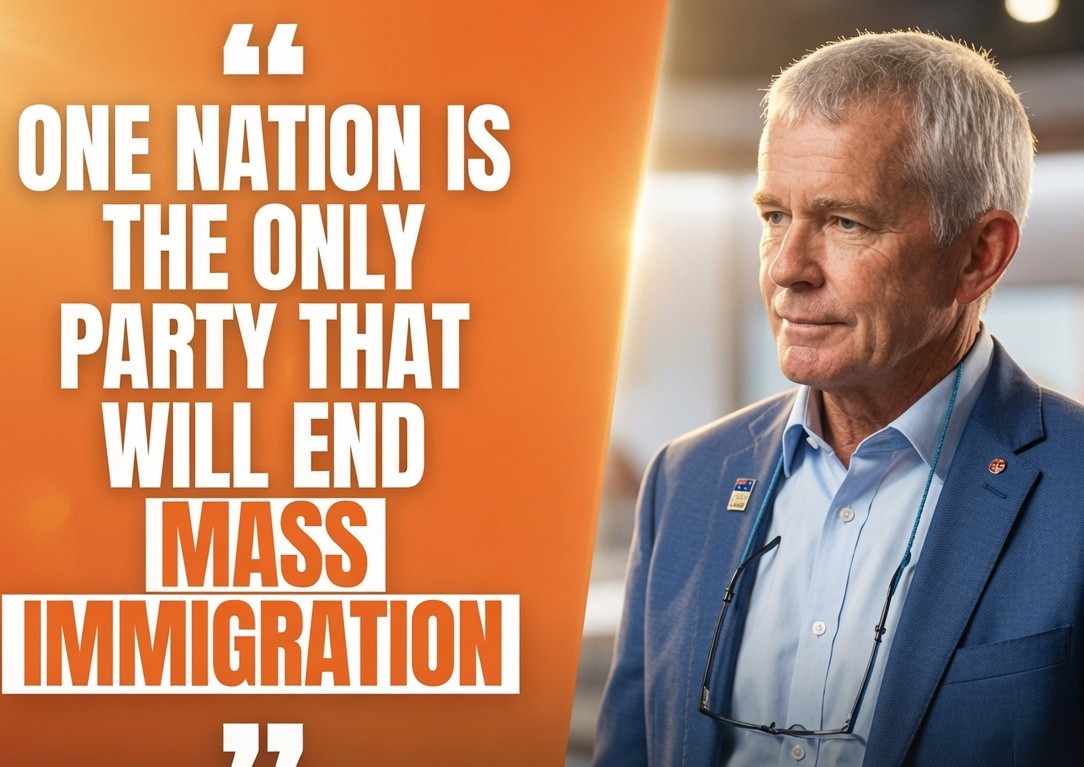
Pauline Hanson’s One Nation has reduced one of Australia’s biggest political arguments to a simple claim.
Mass immigration is hurting Australian living standards.
The party says it would return the country to a “sensible and sustainable immigration program” that puts Australians first, protects social cohesion and preserves what it calls the nation’s “fair dinkum Aussie identity”.
It is deliberately blunt language.
It is also finding an audience.
After years of soaring rents, a housing shortage, strained infrastructure and weak productivity growth, immigration is no longer being debated primarily through abstract arguments about economic growth.
Australians are asking a much more personal question.
If the economy keeps getting bigger, why does life feel harder?
That question sits at the centre of One Nation’s political rise.
But the evidence on migration is more complicated than either side of the national debate often admits.
Migration can increase Australia’s economic capacity.
Skilled migrants can fill critical jobs, strengthen the tax base and help offset the effects of an ageing population.
At the same time, rapid population growth can intensify housing demand and increase pressure on infrastructure when governments fail to expand supply quickly enough.
The real argument is therefore not whether every migrant makes Australia richer or poorer.
It is whether Australia’s migration program has been operating at a scale the country can physically and economically absorb.
Australia added more than 400,000 people in a single year
The latest Australian Bureau of Statistics population data provides the scale of the debate.
Australia’s population reached 27.8 million at the end of December 2025.
The country added 412,500 people during the year.
Natural increase — births minus deaths — contributed 111,500.
Net overseas migration contributed 301,000.
In other words, almost three-quarters of Australia’s population growth came from overseas migration.
That was lower than the extraordinary post-pandemic migration surge.
Net overseas migration had already fallen from 429,000 in the 2023–24 financial year to 306,000 in 2024–25.
But the numbers remain large by historical standards.
For One Nation, this is the starting point.
The party argues Australia has allowed population growth to run ahead of the country’s capacity to provide housing, transport and essential services.
Its official immigration platform promises to cap visas at 130,000 a year.
One Nation says this would reduce immigration by more than 570,000 people compared with what it describes as current Labor levels.
The Albanese government, by contrast, has set the permanent Migration Program at 185,000 places for 2026–27.
Those figures cannot be compared directly with net overseas migration as though they are the same measurement.
This distinction matters.
The permanent Migration Program covers permanent visa places.
Net overseas migration is a population measure based on people arriving and departing under the ABS’s residence rules.
It includes temporary migrants such as international students and other long-term arrivals.
A politician can cut the permanent program without automatically reducing net overseas migration by the same number.
That is why Australia’s migration debate is frequently confused by competing numbers.
One Nation’s 130,000 visa cap is a policy commitment.
Australia’s 301,000 net overseas migration figure is a demographic outcome.
They describe different things.
But the broader political reality remains.
Migration has become the dominant driver of Australian population growth.
The housing argument is where One Nation’s case is strongest
Australia has spent years arguing about whether migration causes the housing crisis.
The most accurate answer is that migration did not create every structural failure in the housing market.
But additional population creates additional housing demand.
That basic relationship is difficult to dispute.
A new arrival needs somewhere to live.
So does a child moving out of the family home.
So does a couple separating into two households.
So does an Australian returning from overseas.
Housing demand has multiple sources.
The problem arises when the number of households seeking accommodation grows faster than the number of suitable homes available.
Australia has struggled to build enough housing.
Planning delays, infrastructure constraints, construction costs, builder failures, workforce shortages and poor productivity have all limited supply.
Against that background, a rapid increase in population places additional pressure on an already constrained market.
New Australian research presented through an ABS migration conference in June examined the relationship between net overseas migration and residential property markets at a neighbourhood level.
The researchers estimated that a one percentage point increase in net overseas migration as a share of the local population raised house rents by 2.8 per cent and unit rents by 4.3 per cent.
They also found an estimated 3.2 per cent increase in unit prices.
That does not mean every migrant personally increases someone’s rent by a fixed amount.
Nor does it prove migration is the only cause of Australia’s housing affordability crisis.
It demonstrates something more useful.
When migration-driven demand rises rapidly in housing markets with limited supply, rents can respond.
For Australians competing for a rental property, that economic relationship is not theoretical.
They experience it at the inspection.
Twenty people arrive.
Then 40.
Applications are submitted immediately.
The landlord has multiple potential tenants.
The renter has very little bargaining power.
One Nation has successfully connected that lived experience with immigration policy.
The party’s message is simple: stop adding demand faster than Australia can add homes.
Labor can say migration is falling. Voters can still believe the pressure remains too high
The Albanese government has a legitimate response to claims that migration is simply accelerating without restraint.
Net overseas migration has fallen.
It was 429,000 in 2023–24.
It fell to 306,000 in 2024–25.
Population growth is slowing from the extraordinary post-pandemic rebound.
The government’s 2025 Population Statement expects growth to moderate further as net overseas migration declines and Australia’s fertility rate remains low.
Labor has also made changes affecting international education and migration settings.
But politically, falling from an extraordinary peak does not necessarily feel like relief.
A renter does not compare today’s housing competition with an ABS chart.
They compare today’s rent with what they paid three years ago.
A commuter compares the road or train with their daily experience.
A parent trying to find a GP does not calculate whether population growth has slowed from 2.5 per cent to 1.5 per cent.
They ask whether the appointment is available.
This creates a major political problem for governments.
Policy can be moving in the right direction while voters still experience the accumulated consequences of previous pressure.
Housing supply does not immediately catch up because migration falls.
A missing home remains missing.
A road that needed upgrading remains congested.
A school requiring additional classrooms cannot expand overnight.
A hospital workforce cannot be created in a budget speech.
One Nation is exploiting the gap between improving migration statistics and persistent pressure in everyday life.
But the economic case against migration is not as simple as One Nation suggests
If Australia dramatically reduces migration, it does not receive only the benefits of slower population growth.
It also loses some of the benefits migrants provide.
This is the part of the debate One Nation’s messaging tends to minimise.
Australia’s migration program has historically been heavily focused on skills.
Productivity Commission research has found that increasing skilled migration can make a positive contribution to future per-capita income levels.
Migrants add workers.
They add consumers.
They start businesses.
They pay taxes.
They bring qualifications and professional experience.
In industries facing genuine labour shortages, migration can increase the economy’s productive capacity.
Australia also has a demographic problem.
The fertility rate has fallen to record lows.
The population is ageing.
As the proportion of older Australians increases, demand for health care, aged care and government support rises.
At the same time, the relative share of working-age taxpayers can come under pressure.
Migration does not permanently “solve” population ageing.
Migrants age too.
But because migrants are often younger than the existing population, migration can slow the ageing process and expand the labour force.
Treasury has repeatedly identified population, participation and productivity as fundamental drivers of Australia’s long-term economy.
A dramatic reduction in migration would therefore involve trade-offs.
Fewer people competing for homes does not automatically mean a stronger economy if Australia also loses nurses, engineers, construction workers and other skilled employees it needs.
The policy challenge is selection.
Who does Australia need?
How many?
Where are the genuine shortages?
Are migrants actually working in occupations that use the skills for which they were selected?
And can the country provide housing and infrastructure for the population it admits?
Those are harder questions than simply declaring immigration high or low.
The most damaging economic criticism is that Australia used population growth as a substitute for productivity
One Nation’s argument has gained strength because Australia’s broader economic performance has been weak.
The Reserve Bank has downgraded its assumption for trend annual productivity growth to 0.7 per cent.
The OECD has warned that improving productivity growth and housing affordability will be essential to supporting Australia’s high living standards.
This matters because a country can grow in two very different ways.
It can become more productive.
Each worker can produce more value through better technology, stronger skills, more efficient businesses and improved infrastructure.
Or the economy can become larger because there are more people working and consuming.
Both increase total GDP.
But voters live per person.
A larger national economy does not automatically mean an individual household is better off.
If population grows rapidly while productivity remains weak, total economic output can increase without delivering strong improvements in per-capita living standards.
That is why Australia’s recent experience has created so much political anger.
Governments can point to economic growth.
Households can point to falling purchasing power, high rents and expensive mortgages.
Both can be describing genuine data.
GDP is national. Living standards are personal.
Migration becomes politically vulnerable when voters believe governments are using population growth to produce impressive headline economic numbers while failing to improve life per person.
That criticism extends well beyond One Nation.
Economists and policy institutions have increasingly focused on Australia’s productivity weakness.
Grattan Institute’s 2026 productivity submission argued that lifting living standards requires reforms including tax changes, better use of talent, improved skilled migration and substantially more housing.
Notice the combination.
Better migration.
More homes.
Higher productivity.
The serious economic argument is not that Australia must choose one.
It is that population policy cannot compensate indefinitely for failures in the other two.
Social cohesion is much harder to measure than rent
One Nation goes further than the economic case.
The party says high immigration threatens Australia’s social cohesion and its “fair dinkum Aussie identity”.
This is where the debate becomes more contested.
Housing supply can be measured.
Population growth can be counted.
Rent increases can be analysed.
National identity is not a quarterly statistic.
Australia is already one of the world’s most migrant-shaped societies.
ABS figures show 8.8 million people living in Australia in June 2025 were born overseas.
That was almost one-third of the population.
Migration is not a recent experiment imposed on an otherwise culturally static country.
Postwar migration fundamentally changed Australia.
Successive waves of European, Asian, Middle Eastern, African and other migrants became part of Australian life.
Many Australians who now demand tighter migration are themselves migrants or the children and grandchildren of migrants.
That does not make concerns about social cohesion illegitimate.
The pace of change can matter.
Governments can make integration harder when population growth is concentrated rapidly in particular communities without sufficient schools, housing and services.
English proficiency matters.
Shared civic expectations matter.
Respect for Australian law matters.
Extremism and sectarian conflict imported from overseas are legitimate national security concerns.
But One Nation’s language about protecting an Australian identity will face intense scrutiny over where the party draws the line between integration and exclusion.
A government can reasonably expect migrants to participate in Australian civic life without pretending there has only ever been one acceptable way to be Australian.
That is the political boundary Hanson is testing.
Her supporters believe multicultural policy has discouraged assimilation and weakened a shared national identity.
Her critics believe One Nation uses concerns about migration to divide Australians according to ethnicity, religion and origin.
The argument is unlikely to be settled by another population target.
A 130,000 visa cap would force One Nation to answer difficult practical questions
If One Nation wants its immigration policy to be treated as a program of government rather than a protest slogan, the detail now matters.
Which visas count towards the 130,000 cap?
How would temporary students be treated?
What happens to working holiday visas?
Would health workers receive priority?
Would regional employers receive separate allocations?
How would family migration be affected?
What industries currently dependent on migrant labour would be expected to adjust?
Could Australian universities survive a major reduction in international students without higher domestic fees, reduced courses or additional taxpayer support?
Would construction capacity fall at the same time One Nation wants more homes built?
These questions do not disprove the case for lower migration.
They determine whether lower migration actually produces the benefits being promised.
One Nation argues a smaller program would force businesses to train Australians and improve wages rather than relying on imported labour.
That may occur in some sectors.
In others, an unfilled vacancy may simply remain unfilled.
Aged care provides an obvious example.
If a provider cannot recruit an Australian worker, removing access to a migrant worker does not automatically create a local employee.
The same problem can occur in health, engineering and specialist occupations.
A serious migration reduction therefore requires a domestic workforce strategy.
Training takes time.
Universities take years to produce professionals.
Apprenticeships require employers willing to invest in young workers.
Australians also need incentives to enter and remain in shortage occupations.
Cutting migration can reduce demand quickly. Replacing migrant labour can take years.
The strongest case for lower migration may simply be that government capacity has failed
Australia could theoretically sustain a larger population.
It is a continent with enormous land mass.
But Australians do not live evenly across the continent.
They concentrate in cities and coastal regions.
Jobs concentrate.
Universities concentrate.
Infrastructure concentrates.
Water, transport and housing constraints are local.
The practical question is not how many people could physically fit inside Australia’s borders.
It is how quickly Sydney, Melbourne, Brisbane, Perth and other growth centres can add homes and services without damaging living standards.
Recent experience has weakened public confidence in government’s ability to manage that task.
Housing targets are missed.
Major infrastructure projects run late or over budget.
Construction productivity remains a problem.
Rents rise.
Then governments insist migration is economically necessary.
For voters already under pressure, the argument can sound backwards.
If government cannot build fast enough for the population it is adding, why is the population target not adjusted to the capacity government can actually deliver?
That is One Nation’s most politically powerful question.
Labor and migration advocates have an economic answer.
Australia needs skills.
It needs workers.
It needs a younger labour force.
Migration can increase per-capita incomes when the program is well designed.
But those benefits are harder to sell when a young Australian cannot afford a home and spends half their income on rent.
The migration debate is really becoming a debate about trust
Australians are not being asked simply whether they like immigration.
They are being asked whether they trust government to control it.
Do voters believe migration numbers are linked to housing capacity?
Do they believe visa settings genuinely target skills Australia needs?
Do they believe infrastructure will arrive before congestion becomes intolerable?
Do they believe governments care about per-capita living standards as much as total GDP?
Do they believe new arrivals are expected and supported to integrate into Australian society?
One Nation’s answer is no.
Its proposed solution is a dramatic reduction in immigration and a renewed emphasis on assimilation and national identity.
The Albanese government argues Australia can manage migration down from the post-pandemic surge while retaining the economic benefits of a skilled permanent program.
The data provides ammunition to both sides.
Net overseas migration has fallen substantially from its peak.
It still accounted for nearly three-quarters of Australia’s population growth in 2025.
Migration can improve economic capacity and per-capita income.
Rapid migration can intensify housing pressure where supply is constrained.
Younger migrants can slow population ageing.
More people also require more homes and infrastructure.
The mistake is pretending only one side of that equation exists.
Australia’s immigration program should not be judged by whether total GDP rises.
Nor should it be judged by the assumption that every additional person is a burden.
The test is whether the program improves the lives of the people already here while giving new arrivals a realistic opportunity to build successful lives in Australia.
That requires the right skills.
The right scale.
Enough housing.
Enough infrastructure.
And a government capable of adjusting migration when those systems cannot keep pace.
One Nation says Australia has already crossed that line.
Its opponents say Hanson’s answer would sacrifice economic benefits and turn a complex policy failure into a cultural grievance.
But after years of housing stress and weak productivity, the old political response — that migration is simply good for economic growth — is no longer enough.
Australians want to know whether growth is making their country richer on paper or making their own lives better.
Until governments can answer that question convincingly, Pauline Hanson’s immigration argument will continue to find voters willing to listen.






