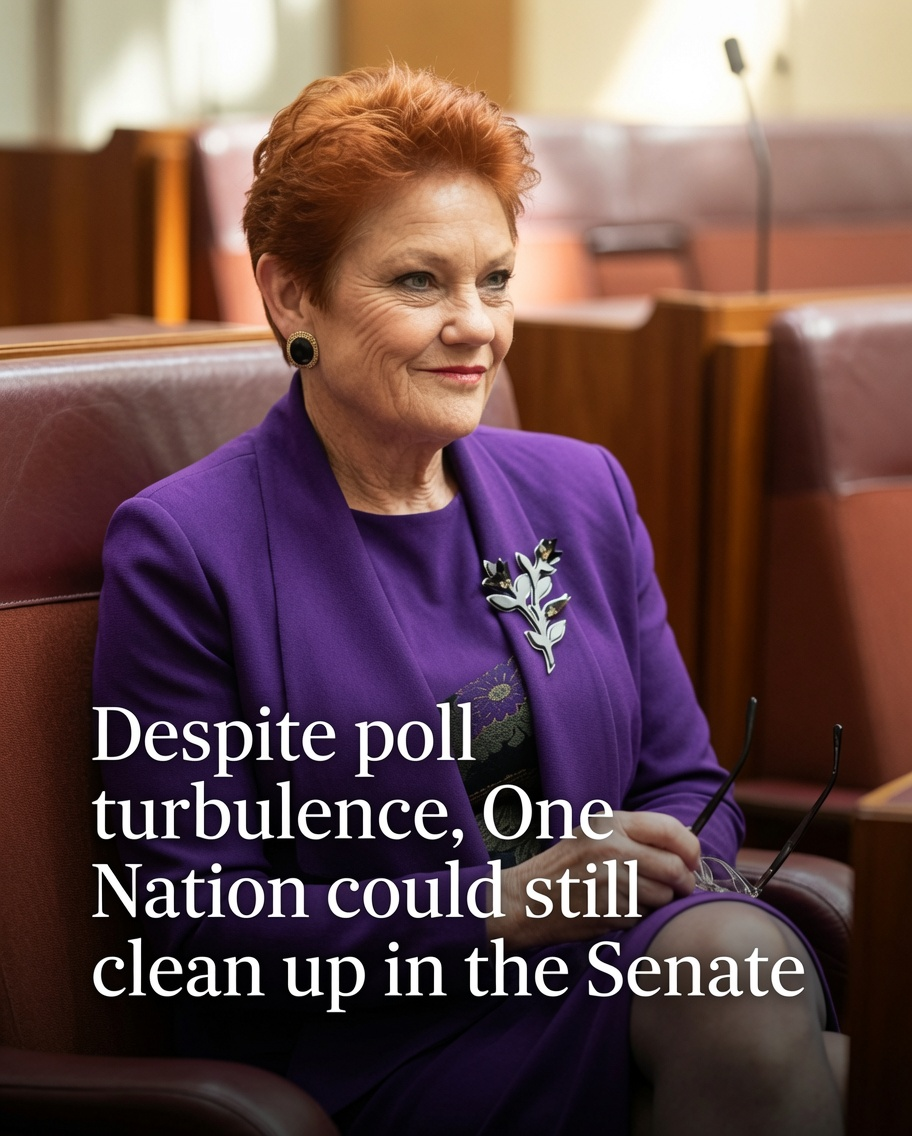
Pauline Hanson’s One Nation may have suffered its sharpest polling setback in months, but a new analysis suggests the party could still emerge from the next federal election with something potentially more valuable than another headline-grabbing primary vote: the balance of power in the Senate.
On current polling, One Nation has been projected to hold between nine and 15 Senate seats if an election were held now.
That range is not an election result and should not be treated as a guaranteed forecast.
Australia is not due to hold an ordinary federal election immediately, polling can change rapidly and Senate contests are determined state by state rather than through a single national vote.
But the projection reveals why the political consequences of One Nation’s rise may survive even if Hanson’s extraordinary surge has begun to lose momentum.
The party does not need to win government to become enormously powerful.
It may not even need to replace the Coalition as the official opposition.
If One Nation can build a large enough Senate bloc, a future government could repeatedly find itself needing Hanson’s votes to pass legislation.
That would give the party leverage over tax, migration, housing, energy, industrial relations and almost every other contested bill that cannot command a Senate majority without crossbench support.
The latest polling turbulence therefore raises two very different questions.
Has One Nation’s national surge peaked?
And even if it has, has the party already reached a level of support capable of fundamentally changing the Senate?
The answer to the second question may be far more important than the first.
Hanson has just suffered a serious polling blow
The latest Resolve Political Monitor showed One Nation losing support after weeks of intense scrutiny of Hanson, senior party figures and the party’s emerging policy platform.
One Nation’s primary vote fell eight percentage points to 22 per cent in the Resolve survey.
The Coalition recovered to 24 per cent, moving narrowly back ahead of Hanson’s party.
Labor remained clearly in front on 35 per cent.
The deterioration in Hanson’s personal numbers was even more striking.
Her positive rating fell 16 points to 26 per cent, while the proportion of voters with a negative view of her rose to 55 per cent.
Among women, her positive rating dropped particularly sharply.
The results followed an extraordinary period of political exposure.
Hanson used a National Press Club address to prosecute a hardline case against mass immigration and multiculturalism.
She faced criticism over comments about paid parental leave.
Her trip to Britain generated controversy after she met and recorded content with Tommy Robinson.
Andrew Bolt, a prominent conservative commentator who has frequently defended the concerns of Hanson voters, publicly questioned her judgment in meeting the British activist.
One Nation’s economic policies have also come under much closer examination.
Economists have questioned the fiscal and financial risks of the party’s proposed 5 per cent, 30-year fixed-rate People’s Mortgage.
Tax promises have been costed by analysts at potentially tens of billions of dollars.
And public comments from senior One Nation figures have sometimes created uncertainty over whether individual proposals are settled party policy.
For a political movement that spent months benefiting from voter anger with Labor and the Coalition, this is a new phase.
One Nation is now being scrutinised as a potential party of power rather than simply a vehicle for protest.
That scrutiny appears to be hurting.
But it has not yet erased the party’s extraordinary gains.
A bad poll for Hanson can still represent an extraordinary Senate vote
This is the part of the story that can easily be missed.
A primary vote of 22 per cent may look disappointing when a party has recently polled around 30 per cent.
For One Nation, however, 22 per cent would still represent a transformation compared with the last federal election.
At the 2025 election, One Nation recorded about 5.7 per cent of the national Senate first-preference vote.
The party emerged with four senators in the new Parliament.
Official parliamentary figures as at May 2026 show Labor with 30 senators, the Coalition with 27, the Greens with 10 and One Nation with four.
The remaining seats are held by other minor parties and independents.
Neither Labor nor the Coalition controls the 76-seat chamber alone.
Thirty-nine votes are required for a Senate majority.
Labor therefore needs nine additional votes when the Coalition opposes a bill and all senators are voting.
At present, the Greens’ 10 senators give Labor one obvious pathway to 40 votes when the two parties agree.
But a dramatically expanded One Nation bloc would alter the mathematics.
If Hanson controlled nine senators, One Nation could potentially provide Labor with the votes required to reach 39 without the Greens.
If One Nation reached 15 senators, its negotiating position would be even more significant.
The exact balance after a future election would depend on how many seats Labor, the Coalition, the Greens and other crossbenchers won.
But the broader point is clear.
Nine to 15 senators would make One Nation extremely difficult for any government to ignore.
The Senate rewards support very differently from the House of Representatives
One reason Hanson’s Senate prospects matter is that Australia’s two federal chambers use different electoral systems.
To win a House of Representatives seat, a candidate must survive preferential counting in a single electorate and ultimately secure an absolute majority after preferences.
A party can attract millions of votes nationally but still struggle to convert those votes into lower-house seats if its support is spread inefficiently.
That is one of the great uncertainties surrounding One Nation’s current rise.
Polling analysts are operating in unfamiliar territory because the party has moved from a minor competitor into serious contention across a large number of outer-suburban and regional electorates.
At the 2025 federal election, One Nation reached the final two candidates in only two House seats and the final three in 26.
More recent modelling has suggested the party could become competitive much more widely if its support remains elevated.
But nobody can confidently predict how preferences will flow in three-way contests involving Labor, the Coalition and One Nation.
The Senate is different.
Senators are elected through proportional representation.
In a normal half-Senate election, six senators are elected from each state.
The Australian Electoral Commission calculates the quota by dividing the number of formal votes by one more than the number of vacancies, then adding one after disregarding the remainder.
With six vacancies, the practical quota is just over one-seventh of the formal vote — approximately 14.3 per cent.
A party that receives more than one quota in a state is in a strong position to elect at least one senator.
A vote approaching two quotas can put a second seat into contention, although preferences, vote distribution and the precise count remain critical.
This is why a One Nation primary vote in the twenties can produce dramatic Senate projections.
The party does not need to win 50 per cent of a state.
It needs enough support to reach quotas and remain competitive as preferences are distributed.
A national poll cannot simply be converted into Senate seats
There is an important warning attached to every projection of nine to 15 One Nation senators.
The Senate is not elected through one national constituency.
Votes in Queensland cannot compensate for weak support in Victoria.
A huge result in South Australia does not automatically elect a senator in New South Wales.
Each state conducts its own Senate contest.
The two territories also elect senators under their own arrangements.
That means the geographical distribution of One Nation’s support matters enormously.
A national primary vote of 22 per cent could theoretically produce very different Senate results depending on where those voters live.
If One Nation polled consistently above a quota in every state, it would be positioned to elect senators broadly across the country.
If its support were heavily concentrated in Queensland and regional areas while remaining much weaker in some metropolitan states, the result could be less impressive.
Preferences add another layer of uncertainty.
Senate voters can number parties above the line or candidates below the line.
Votes are transferred according to the preferences marked by individual voters.
A candidate who begins below a full quota can still be elected through preference distributions.
That makes exact seat forecasts difficult months or years before an election.
The nine-to-15-seat range should therefore be read as an illustration of One Nation’s potential power at current polling levels, not as a prediction that 12 Hanson senators are already guaranteed.
But the lower end of the range alone would represent a political earthquake.
Why the balance of power matters
The Senate cannot normally choose who becomes prime minister.
Government is formed by the party or coalition capable of commanding confidence in the House of Representatives.
That can make Senate politics appear secondary during election campaigns.
In practice, the upper house can determine whether a government’s legislative program survives.
Most bills must pass both houses of Parliament.
If a government lacks a Senate majority, it must negotiate.
Sometimes that negotiation is with the opposition.
Sometimes it is with the Greens.
Sometimes individual crossbench senators become critical.
A large, disciplined One Nation bloc would create another pathway.
Consider migration legislation.
One Nation could demand tougher settings in exchange for supporting a government bill.
On housing, it could attempt to attach elements of its policy platform to negotiations.
On tax, it could withhold support until concessions were made.
On energy, climate policy or industrial relations, the party could become the decisive group between Labor and the Coalition.
This does not mean Hanson would always get what she wanted.
A government can abandon legislation.
It can negotiate with another crossbench group.
Labor and the Coalition can vote together.
Governments can reject demands they consider unacceptable.
But balance-of-power politics creates leverage because every negotiation has alternatives and costs.
If One Nation’s senators provide the easiest route to 39 votes on a particular bill, ministers will talk to them.
The Greens would face a new threat to their Senate influence
A One Nation expansion would not only create problems for Labor and the Coalition.
It could weaken the Greens’ strategic position.
The Greens currently hold 10 Senate seats according to official parliamentary figures.
That number often makes them central to Labor’s legislative negotiations.
When Labor and the Coalition disagree, the government frequently looks left for the additional votes it needs.
The Greens can use that position to demand amendments or stronger policy.
A large One Nation bloc would give Labor another potential negotiating partner on some issues.
That would create an extraordinary political dynamic.
On a bill where Labor could secure either Greens or One Nation support, the government might be able to negotiate with both sides.
The Greens could no longer assume that rejecting a proposal would automatically kill it.
One Nation could not assume Labor had nowhere else to go either.
The government would gain options.
But on issues where One Nation and the Coalition shared a position against Labor, an expanded Hanson bloc could also make the government’s life more difficult.
The balance of power is rarely a permanent alliance.
It is a position from which a party can make itself relevant vote by vote.
Hanson’s biggest challenge may now be protecting a vote she has already built
The latest Resolve poll suggests One Nation’s rise is not unstoppable.
For months, the party benefited from an unusually favourable political environment.
Cost-of-living frustration remained intense.
Housing pressures continued.
Migration became a central national debate.
The Coalition struggled to rebuild after its 2025 election defeat.
Hanson was able to present One Nation as the clearest anti-establishment alternative.
That drove voters towards the party faster than its policy platform could be subjected to detailed scrutiny.
Now the scrutiny has arrived.
Every overseas meeting is examined.
Every controversial statement is replayed.
Every major spending or tax promise is costed.
Senior party figures are being asked whether they agree with one another.
The question is no longer simply whether Australians are angry with the major parties.
It is whether those voters trust One Nation to exercise political power.
That is a much higher test.
The sharp fall in Hanson’s personal rating suggests some voters are reconsidering.
But the Senate analysis reveals how far the political baseline has moved.
One Nation can lose eight points in a poll and still be sitting on a level of support that would once have been unimaginable for the party.
Twenty-two per cent is a slump only when the starting point was an extraordinary surge.
The next election could produce a very different kind of One Nation power
For decades, Pauline Hanson has been one of Australia’s most visible protest politicians.
Her political power has often come from shaping debate rather than controlling parliamentary numbers.
She could force migration into the news.
She could pressure Coalition politicians worried about losing conservative voters.
She could use Senate speeches and media appearances to dominate political arguments far beyond the size of her party room.
A bloc of nine to 15 senators would be different.
That would be institutional power.
It would mean committee positions, parliamentary resources and a much larger group of legislators capable of voting as a bloc.
Most importantly, it could mean governments needing One Nation votes to turn policy announcements into law.
There are still enormous uncertainties.
Polling can collapse.
Candidate controversies can damage minor parties.
One Nation’s support may prove geographically inefficient.
Preferences may produce unexpected results.
The Coalition may recover more strongly and pull voters back from Hanson.
Labor may improve its position.
And the next Senate election will not simply reproduce a national opinion poll taken in July 2026.
But the possibility can no longer be dismissed as a fringe scenario.
One Nation already holds four seats in the 76-member Senate.
Recent polling has placed the party far above the vote it achieved at the 2025 federal election.
Even after a major setback, its support remains at levels capable of making it competitive for Senate quotas across multiple states.
That is why Hanson’s poll slide and One Nation’s Senate prospects can both be true at the same time.
The party has lost momentum.
Hanson has suffered a serious personal backlash.
Controversies have created doubts among voters.
Yet One Nation may still be closer to genuine parliamentary power than at almost any point in its history.
The next federal election will be fought primarily over who governs from the House of Representatives.
But the more consequential result may be unfolding on the longer Senate ballot paper.
If One Nation emerges with nine, 12 or even 15 senators, Pauline Hanson would not need the keys to The Lodge to reshape Australian politics.
She could hold the votes a future prime minister needs to govern.






