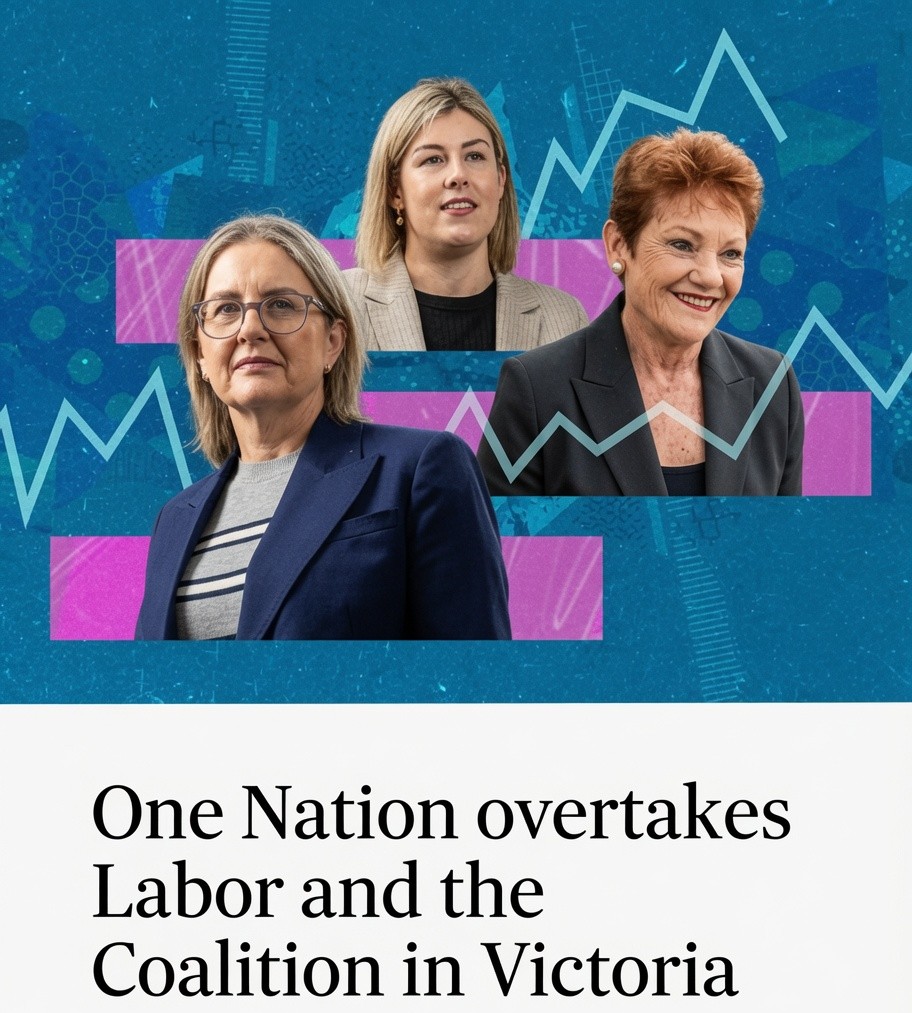
Pauline Hanson’s One Nation has seized on a new Victorian opinion poll showing the party leading the state’s primary vote, claiming the result reflects growing frustration with both the Labor Government and the traditional opposition ahead of the next state election.
In a statement released after the poll became public, One Nation described the findings as evidence that Victorians are increasingly looking beyond the state’s two major political parties.
“Interesting poll in Victoria! It has us out in front,” the party said.
One Nation also highlighted the polling of Premier Jacinta Allan, arguing that the Labor leader has become one of the least popular premiers in modern Victorian political history.
The party further criticised the Victorian Liberals, saying that while Labor’s support has continued to weaken, the opposition has spent too much time dealing with internal political disputes instead of presenting itself as a government-in-waiting.
“A lot of work is currently taking place behind the scenes to ensure we have the team and the policies to deliver the change Victorians need and deserve,” the statement said.
The comments follow a large RedBridge survey of approximately 6,500 Victorian voters which placed One Nation on 27 per cent of the primary vote, narrowly ahead of both Labor and the Coalition, which each recorded 26 per cent. The Greens were on 12 per cent, with other parties accounting for the remaining support.
The findings represented a remarkable shift in Victorian politics, where One Nation has historically struggled to achieve the same level of electoral success enjoyed in parts of Queensland and regional New South Wales.
Political analysts caution, however, that a strong primary vote does not automatically translate into government under Australia’s preferential voting system.
Preference flows, local candidate strength and electorate-by-electorate contests all play a decisive role in determining who ultimately wins seats in the Legislative Assembly.
Even so, the polling has intensified debate over the direction of Victorian politics as both major parties confront growing voter dissatisfaction.
Premier Jacinta Allan continues to face mounting pressure following a series of controversies affecting her government.
Recent political debate has focused on integrity issues surrounding the construction sector, questions about oversight of major infrastructure projects, housing affordability and persistent cost-of-living pressures.
The RedBridge polling has reportedly fuelled concern within Labor ranks that the government could suffer a significant electoral setback if current trends continue.
Labor has rejected claims that polling alone reflects the likely election outcome, arguing voters will ultimately judge the government on its record in health, education, transport and economic management.
The Allan Government has continued to highlight investment in hospitals, schools and infrastructure while defending its approach to managing Victoria’s finances after years of major capital spending.
Meanwhile, the Liberal Party has also faced scrutiny over its own ability to capitalise on Labor’s declining popularity.
Internal disagreements, leadership challenges and questions about policy direction have prompted criticism from political observers who argue the opposition has not yet fully convinced voters it is ready to govern.
One Nation has attempted to use that political vacuum to position itself as an alternative for voters dissatisfied with both major parties.
The party continues to campaign heavily on issues including cost-of-living pressures, housing affordability, immigration, crime, energy prices and government accountability.
According to One Nation, many Victorians believe the existing political establishment has failed to address everyday concerns affecting households and small businesses.
Supporters argue the latest polling demonstrates increasing public willingness to consider alternatives outside the traditional Labor-Coalition contest.
Critics, however, question whether One Nation can convert polling support into enough lower-house victories to exercise significant influence over the next Victorian Parliament.
Electoral experts note that Victoria’s geographic voting patterns differ substantially from Queensland, where One Nation has historically achieved stronger results.
Urban Melbourne remains considerably more competitive for the Greens and the major parties, while One Nation’s strongest opportunities are generally expected to come from regional and outer suburban electorates where concerns about housing, infrastructure and living costs are particularly acute.
The RedBridge poll nevertheless highlights increasing fragmentation within Victorian politics.
Instead of two dominant parties competing for government, voters appear increasingly willing to support smaller parties and independents, creating greater uncertainty over future election outcomes.
That fragmentation could make preference negotiations more important than ever before, particularly if neither Labor nor the Coalition secures a clear parliamentary majority.
For Labor, the challenge will be rebuilding confidence among voters concerned about affordability, public services and integrity in government.
For the Liberals, the task is convincing Victorians they offer a credible alternative administration capable of replacing Labor after more than a decade in office.
For One Nation, maintaining recent polling momentum while translating statewide support into individual seat victories will be the critical test.
Although opinion polls provide only a snapshot of public sentiment rather than a prediction of election results, the latest Victorian survey has intensified political debate and reinforced the increasingly competitive nature of the state’s political landscape.
As campaigning gathers pace, housing affordability, cost-of-living pressures, infrastructure spending and confidence in political leadership are expected to remain central issues shaping the contest for government.






