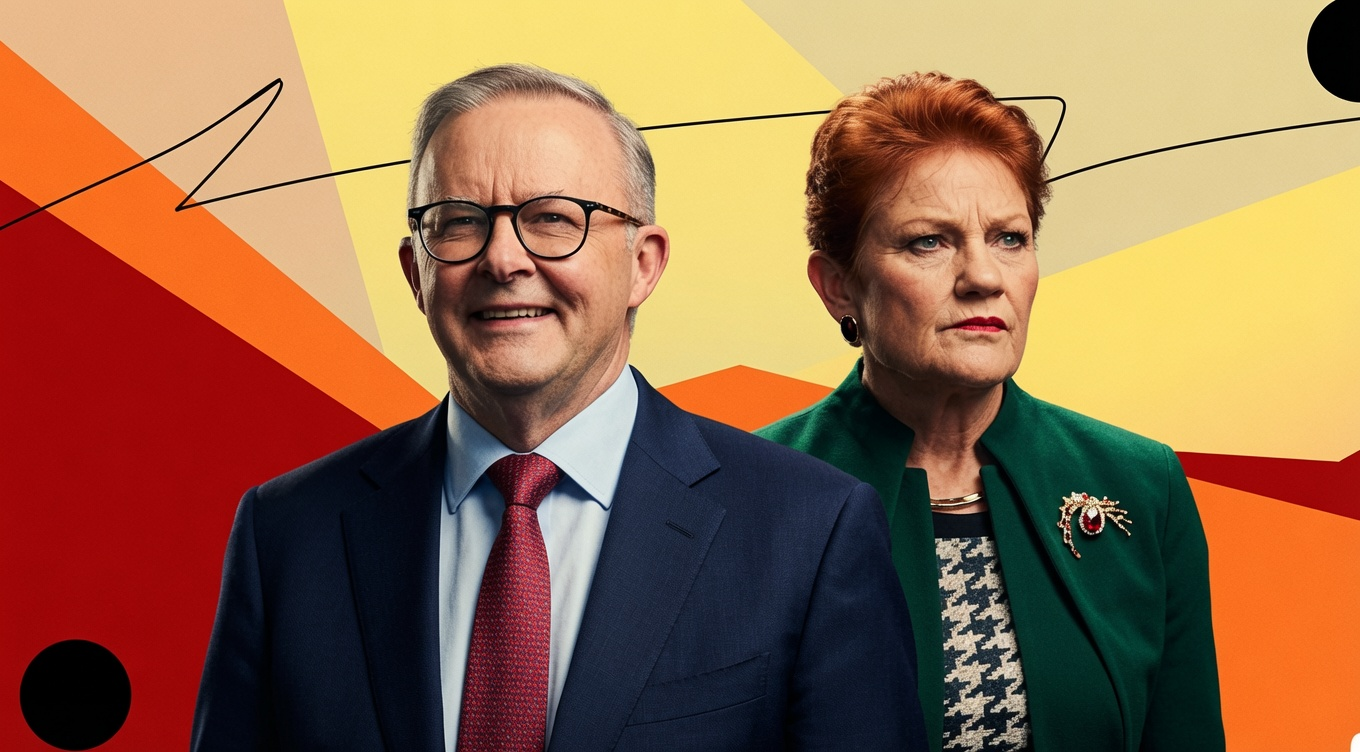
One Nation has rebounded to draw level with Labor in the latest Newspoll, recovering from a brief decline in support and reinforcing the party’s emergence as one of the dominant forces in Australian federal politics.
The survey recorded Labor’s primary vote at 30 per cent, matching One Nation after Pauline Hanson’s party regained support lost during a turbulent period in June. The Coalition remained in third place on the primary vote, highlighting the continuing fragmentation of Australia’s traditional two-party political landscape.
The result is particularly notable because it follows several weeks of intense public scrutiny surrounding Hanson’s overseas trip, her meeting with British activist Tommy Robinson, criticism of comments about Australia becoming “monocultural”, and media attention over her European holiday with Hancock Prospecting executive chair Gina Rinehart.
Despite those controversies, the latest polling suggests One Nation’s core electoral support has remained resilient.
Speaking after the poll was released, One Nation MP Barnaby Joyce argued voters were focused on issues that directly affect their lives rather than media coverage of Hanson’s overseas activities.
“People don’t really give a toss if she goes to a Dolce & Gabbana show. I mean, who cares?” Joyce said, arguing Australians were more concerned about the cost of living, housing, immigration and economic security than a politician’s travel itinerary.
Recovery follows a brief setback
The latest figures represent a recovery rather than a sudden surge.
Only weeks earlier, several national polls had shown One Nation slipping after Hanson’s National Press Club address, in which she argued Australia should become “monocultural” and criticised high migration levels.
That speech generated widespread criticism from Labor, the Coalition, community organisations and multicultural groups, while also producing renewed debate over One Nation’s long-standing immigration platform.
Some polling immediately after the speech suggested support had softened.
However, the latest Newspoll indicates much of that decline has now been reversed, with One Nation climbing back to 30 per cent.
The rebound suggests that although Hanson’s rhetoric continues to polarise opinion, it has not significantly weakened support among the party’s core voter base.
That distinction is politically important.
Controversy can sometimes reduce support among undecided voters while simultaneously strengthening loyalty among existing supporters who view criticism as evidence that established political and media institutions are targeting outsider movements.
Why the poll matters
Australia has experienced an unusually volatile polling environment since the 2025 federal election.
Support for both Labor and the Coalition has weakened compared with historical norms, while One Nation has achieved polling levels previously considered extraordinary for a minor party.
Different polling organisations have produced varying figures throughout 2026, but many have pointed towards the same broader trend: dissatisfaction with the major parties has created political space for alternatives.
The latest Newspoll reinforces that picture.
Rather than showing a temporary protest movement fading after media controversy, it suggests One Nation continues to compete directly with Labor for primary vote support.
That does not necessarily mean the party would win a comparable number of parliamentary seats.
Australia’s preferential voting system means primary vote figures are only one part of the electoral equation.
Primary vote is not the same as forming government
The headline numbers inevitably attract attention, but they require careful interpretation.
Australia elects members of the House of Representatives using full preferential voting across individual electorates rather than a nationwide proportional system.
A party can record a strong national primary vote yet still struggle to convert that support into seats if its voters are spread broadly across the country rather than concentrated in particular electorates.
Preference flows also play a decisive role.
Historically, One Nation has often received fewer preferences from supporters of other parties than Labor or the Coalition, making it more difficult to translate primary support into victories in lower-house contests.
Political analysts therefore caution against interpreting a 30 per cent primary vote as meaning One Nation would necessarily be in a position to form government.
Nevertheless, sustained polling at this level fundamentally changes the political conversation.
Even without governing, a party attracting around one-third of first-preference votes becomes capable of reshaping electoral contests, influencing Senate outcomes and forcing the major parties to respond to its policy agenda.
Immigration remains the defining issue
One Nation’s resurgence has coincided with heightened public concern over migration, housing affordability and pressure on public infrastructure.
The party has consistently argued Australia’s migration settings have exceeded the country’s capacity to provide housing, transport, schools and health services.
Hanson’s recent trip to Britain was presented as a fact-finding mission examining the consequences of high immigration and multiculturalism.
During the visit she met Tommy Robinson, appeared on his podcast and toured Luton, a town frequently referenced in Britain’s immigration debate.
The meetings generated significant criticism because of Robinson’s criminal convictions and long association with anti-Islam activism.
Hanson defended the trip, arguing politicians should examine international experiences directly rather than relying solely on media reports.
The controversy dominated headlines for days.
Yet according to Joyce, ordinary voters are not treating those issues as central to their voting decisions.
Instead, he says they are asking whether governments have effectively addressed rising living costs, housing shortages and immigration levels.
Cost of living continues to dominate
Opinion research throughout 2026 has consistently shown the cost of living remaining one of Australia’s highest political priorities.
Households continue to face elevated housing costs, insurance premiums, grocery prices and utility bills despite inflation easing from its earlier peak.
International comparisons have also shown Australia experienced one of the sharper declines in real household disposable income among OECD economies following the pandemic.
That economic backdrop has created fertile ground for political parties promising significant policy change.
One Nation has linked living standards directly to migration, arguing population growth has intensified housing shortages and infrastructure pressures.
Labor rejects that analysis.
The Albanese government argues migration remains necessary to address workforce shortages while pointing to tax relief, Medicare investment, energy bill assistance and housing initiatives designed to ease financial pressure.
The Coalition has likewise criticised Labor’s economic management while proposing its own alternatives on taxation, housing and energy.
The polling suggests many voters remain unconvinced that either major party has fully addressed their concerns.
The ‘monoculture’ debate
One of the most controversial moments in Hanson’s recent political campaign was her National Press Club address, where she argued Australia should aspire to become “monocultural”.
The remarks prompted widespread criticism from political opponents, who accused her of reviving divisive debates over multiculturalism and national identity.
Hanson later argued her comments had been misunderstood and that her emphasis was on shared civic values, integration and social cohesion rather than race or ethnicity.
The debate nevertheless dominated national headlines and contributed to a temporary fall in One Nation’s polling during late June.
The latest Newspoll indicates that any damage may have been temporary.
Political scientists often observe that highly polarising politicians tend to have relatively stable support bases.
Their public standing can fluctuate among undecided voters while remaining remarkably consistent among committed supporters.
The latest figures appear broadly consistent with that pattern.
Why Gina Rinehart attracted attention
Media interest also focused on Hanson’s European holiday with Gina Rinehart following the UK tour.
Rinehart has long supported conservative causes and has previously backed campaigns associated with Hanson and One Nation.
Critics questioned the optics of the trip given One Nation’s frequent emphasis on representing ordinary Australians.
Joyce dismissed the criticism as politically irrelevant.
His argument was that Australians were unlikely to alter their vote because of where Hanson holidayed or which fashion events she attended.
Instead, he suggested voters continued evaluating parties primarily through the lens of economic management, migration and household finances.
Whether that assessment proves correct will become clearer as additional polling emerges over coming months.
Pressure on the major parties
The latest survey places renewed pressure on both Labor and the Coalition.
For Labor, a primary vote of 30 per cent represents one of its weakest positions since Anthony Albanese became Prime Minister.
Although preference flows may still leave Labor competitive under Australia’s electoral system, declining primary support limits strategic flexibility and increases vulnerability in marginal electorates.
The Coalition faces a different challenge.
Its continued position behind both Labor and One Nation raises questions about whether it is successfully reconnecting with conservative voters who have shifted towards Hanson.
Some analysts argue One Nation’s growth is drawing support mainly from former Coalition voters, while others suggest Labor has also lost backing to Hanson among working-class Australians dissatisfied with economic conditions.
The answer is likely to differ between states and individual electorates.
Can One Nation sustain its momentum?
The central question now confronting Australian politics is whether One Nation can maintain support at this level over a longer period.
Minor parties often experience rapid rises followed by equally rapid declines.
Maintaining high polling over many months requires organisational capacity, credible candidates, disciplined campaigning and policies capable of surviving detailed scrutiny.
One Nation will also face increasing examination of its costings, migration proposals, economic platform and broader governing capability if polling continues to place it alongside the major parties.
That scrutiny has already intensified as Hanson’s public profile has expanded.
Her overseas activities, speeches and media appearances are now attracting a level of attention once reserved almost exclusively for Labor and Coalition leaders.
Whether that attention ultimately strengthens or weakens the party remains uncertain.
A changing political landscape
The latest Newspoll illustrates a broader transformation in Australian politics.
For decades, elections were dominated by Labor and the Coalition, with minor parties competing mainly for Senate representation.
That assumption is increasingly being challenged.
One Nation’s return to 30 per cent primary support suggests dissatisfaction with the established political order remains strong despite weeks of intense controversy surrounding Hanson.
At the same time, the polling should not be interpreted as a prediction of election results.
Primary vote figures provide an important measure of public sentiment but do not determine parliamentary outcomes on their own.
Australia’s electoral system rewards parties capable of winning individual seats and attracting preferences, not simply recording the largest national first-preference vote.
Even so, the latest numbers demonstrate that One Nation has moved well beyond the status of a traditional protest party.
Whether its resurgence ultimately reshapes the balance of power in Canberra will depend not only on continued polling strength, but on its ability to convert that support into parliamentary representation when Australians next go to the polls.






