Indian Prime Minister Narendra Modi’s historic visit to New Zealand became a flashpoint for the country’s increasingly combustible immigration debate, with nationalist activists and rival protest groups taking to the streets as thousands of supporters gathered to welcome the visiting leader.
In Wellington, more than a dozen black-clad and mostly masked activists associated with a group calling itself White New Zealand gathered outside the capital’s railway station carrying a banner declaring: “New Zealand, not New Delhi.”
The small demonstration was explicitly directed at mass immigration and the growing Indian presence in New Zealand.
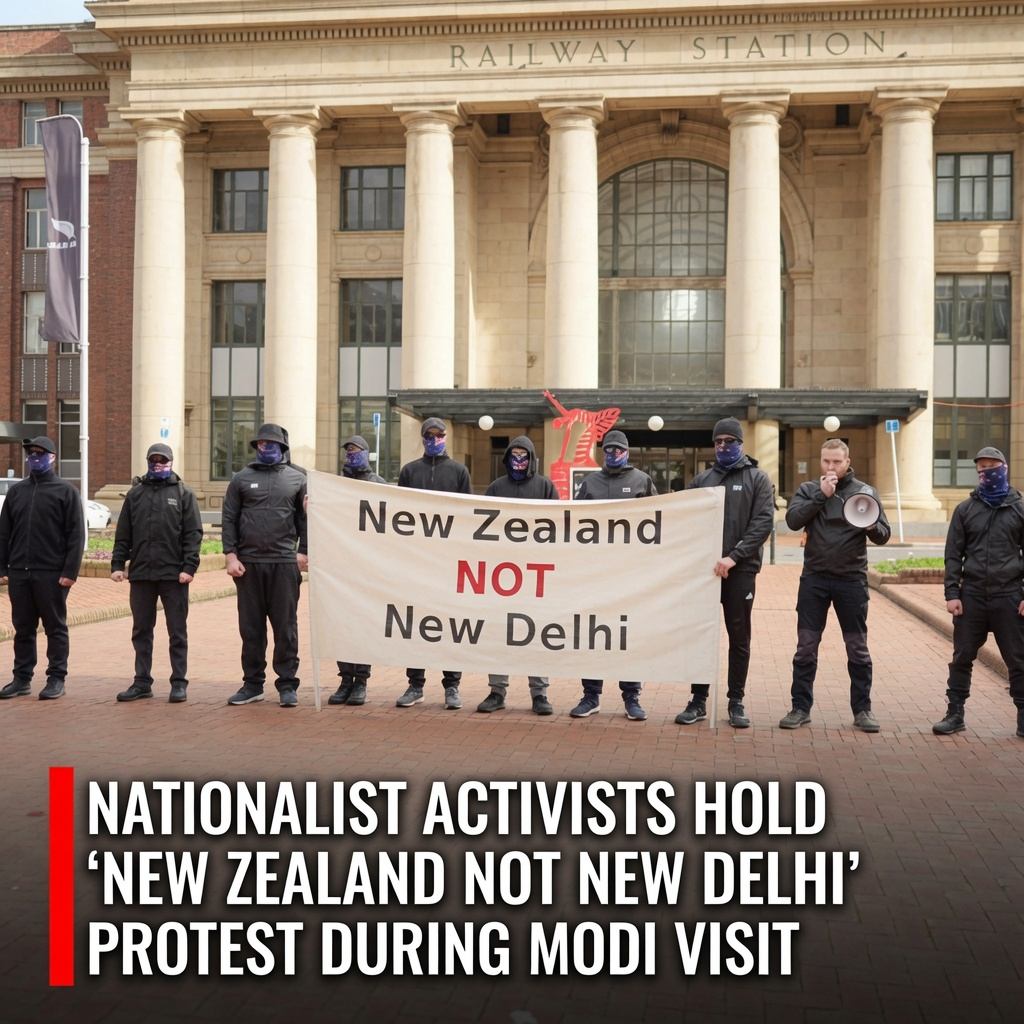
A speaker addressing the group through a megaphone delivered a speech filled with racial language and sweeping attacks on Indian migrants. The rhetoric went far beyond a conventional argument about migration numbers, housing pressure or infrastructure, framing demographic change in openly racial terms and portraying people of Indian background as inherently unable to assimilate.
The group later promoted footage of the protest through its own online channels, calling for an “end and reversal” of New Zealand’s immigration settings and attacking what it described as government appeasement towards India.
The language was extreme. The underlying political issue it sought to exploit, however, is now firmly embedded in New Zealand’s national debate.
Immigration, population change and the country’s relationship with India have become increasingly difficult issues for New Zealand politicians to separate.
Modi’s whirlwind visit brought all three into the same place at the same time.
While officials celebrated a major diplomatic upgrade between Wellington and New Delhi, protesters outside the official events were arguing over a very different question: how much migration-driven demographic change New Zealanders are prepared to accept, and what political consequences will follow if a significant section of the public believes that change is moving too quickly.
A second confrontation unfolded in Auckland
The Wellington demonstration was not the only protest during Modi’s visit.
Outside Auckland’s Spark Arena, where the Indian leader appeared at the large Kia Ora Modi diaspora event, a separate group of anti-immigration protesters gathered with New Zealand flags and banners carrying slogans including “remigration now” and “end mass migration”.
Local reporting put the anti-immigration crowd at at least 100 people.
Inside the arena, the atmosphere could hardly have been more different.
More than 10,000 members of New Zealand’s Indian diaspora attended the event, according to the Indian Prime Minister’s Office. Modi addressed the crowd while New Zealand Prime Minister Christopher Luxon also joined the gathering.
Supporters described the visit as a moment of pride and recognition for a community that has become a major part of modern New Zealand.
Outside, the competing demonstrations revealed the political and social tensions surrounding that same transformation.
Sikh separatist protesters opposed to Modi were also present, reflecting longstanding tensions over the Khalistan movement and the Indian government’s relationship with sections of the Sikh diaspora.
Other demonstrators carried pro-Palestinian messages.
The result was a highly charged scene in which Modi supporters, anti-immigration activists and political protesters with entirely different grievances occupied the same public space.
Police maintained a presence around the event as rival groups traded chants.
For New Zealand, the significance of the confrontation extended beyond the visit of one foreign leader.
It showed how international political disputes, immigration anxieties and domestic identity politics can increasingly overlap in a country where almost three in ten residents were born overseas.
Modi’s visit was historic for a very different reason
Narendra Modi arrived in Auckland on Friday, 10 July, for the first visit to New Zealand by an Indian prime minister in four decades.
The trip was brief, but diplomatically significant.
Modi and Luxon elevated relations between India and New Zealand to a strategic partnership, presenting the agreement as a reflection of shared democratic values, deep people-to-people connections and common interests in the Indo-Pacific.
The two countries also signed a defence cooperation arrangement and pledged closer collaboration on maritime safety.
For Wellington, India represents an enormous economic and strategic opportunity.
India is the world’s most populous country and one of its largest major economies. New Zealand governments have long sought greater access to the Indian market while attempting to diversify trade relationships and strengthen partnerships across the Indo-Pacific.
For New Delhi, closer ties with New Zealand form part of a wider effort to expand India’s strategic presence in the Asia-Pacific.
Modi’s 2026 regional trip also included Indonesia and Australia before he arrived in New Zealand.
In diplomatic terms, the visit was designed to demonstrate a relationship moving forward.
Yet the protests showed that closer ties with India are increasingly being interpreted through New Zealand’s domestic immigration debate.
New Zealand’s Indian community has grown rapidly
The scale of demographic change is central to understanding why the issue has become politically sensitive.
About 292,000 people identified as Indian in New Zealand’s 2023 Census, representing roughly 5.8 per cent of the population under Stats NZ’s total-response ethnicity measure.
The Indian ethnic population increased from about 239,000 in the 2018 Census.
That growth has made Indian New Zealanders one of the country’s largest ethnic communities.
The broader transformation is even more striking.
New Zealand’s 2023 Census showed 28.8 per cent of the population was born overseas. The Asian ethnic population reached more than 861,000 people, or about 17.3 per cent of the population under the census total-response method.
Those numbers reflect decades of migration and changing immigration patterns rather than one single government policy or one recent migration surge.
They also require careful interpretation.
Ethnicity and citizenship are not the same thing. A New Zealander who identifies as Indian may have been born in Auckland, may be a New Zealand citizen and may have family connections to the country stretching back generations.
New Zealand’s Indian communities are also internally diverse, including people with roots in India, Fiji and elsewhere, and encompassing different languages, religions and political views.
That reality is frequently lost in the most aggressive immigration rhetoric.
But the pace of population change remains a legitimate subject for public policy debate.
The difficult question is where arguments about migration levels end and racial hostility begins.
The Wellington protest demonstrated how quickly that boundary can disappear.
Migration numbers have already become a political pressure point
New Zealand experienced an extraordinary post-pandemic migration surge.
Annual migrant arrivals reached a provisional peak of 234,800 in the year to October 2023, according to Stats NZ.
Net migration has since fallen sharply from those extraordinary highs, but migration remains politically sensitive.
Stats NZ estimated an annual net migration gain of 23,200 people in the year to January 2026, compared with 19,700 in the year to January 2025.
Indian citizens have remained an important part of migration flows.
In the year to November 2025, New Zealand recorded 17,300 migrant arrivals by Indian citizens, behind arrivals of New Zealand citizens but ahead of Chinese, Filipino and Sri Lankan citizens in the citizenship breakdown published by Stats NZ.
Those figures help explain why India has become so visible in the immigration argument.
But they also complicate claims that New Zealand is simply experiencing an endlessly accelerating migration wave.
The record post-pandemic surge has already receded substantially.
The political argument is therefore no longer only about whether net migration is rising or falling in a particular month.
It is increasingly about the cumulative impact of rapid population growth and whether housing, infrastructure, public services and social cohesion have kept pace.
For voters worried about immigration, a decline from record migration levels may not feel like a solution if they believe the underlying system still admits more people than the country can successfully absorb.
For migrant communities, the same debate can feel increasingly threatening when policy criticism is accompanied by collective blame or racial abuse.
Both realities are now visible in New Zealand.
Economic arguments are colliding with questions of national identity
Supporters of immigration frequently point to labour shortages, skills, business growth and the economic contribution of migrant communities.
A June 2026 report on the economic contribution of Kiwi Indians, drawing on census and economic data, highlighted a highly educated community. It found 46 per cent of Kiwi Indians held a Level 7 qualification or higher in 2023, compared with 27 per cent of the total New Zealand population.
Modi’s supporters at Spark Arena also emphasised the contribution Indian migrants had made to their adopted country.
But economic contribution does not automatically settle the immigration debate.
Opponents of high migration argue that headline economic growth can conceal pressure on a per-person basis and that population expansion can increase demand for housing, roads, hospitals and schools if investment fails to keep pace.
Those are policy arguments that democratic governments must be able to confront openly.
The problem arises when legitimate concerns about migration numbers are transformed into claims that people of a particular race are biologically incapable of assimilation or inherently responsible for social decline.
Such claims were central to the rhetoric used at the Wellington demonstration.
They are not necessary to argue for lower migration.
New Zealand can debate immigration targets, visa rules, infrastructure capacity and citizenship without declaring entire ethnic populations inferior.
Indeed, the growth of openly racial rhetoric may make a serious migration debate harder, because governments and migrant communities can become more defensive while voters with genuine concerns feel their questions are being grouped together with extremist politics.
Anti-Indian sentiment has become a growing concern
Reuters reported during Modi’s visit that Indian New Zealanders have described increasing racial abuse as the community has become a flashpoint in the immigration debate.
The visibility of Indian migrants has grown alongside the community’s population.
That visibility has also made India and Indians a target for some of the country’s most aggressive anti-immigration movements.
The “New Zealand, not New Delhi” slogan is deliberately designed to collapse several different issues into one emotional message.
It links immigration policy, demographic change and New Zealand’s diplomatic relationship with India as though they are a single process.
They are not.
Luxon’s government can pursue closer trade and security relations with New Delhi while changing domestic immigration settings. New Zealand can welcome an Indian prime minister while debating how many temporary workers or new residents the country should accept.
Foreign policy does not require unlimited immigration.
Equally, reducing migration does not require hostility towards New Zealand citizens and residents of Indian heritage.
The political danger is that these distinctions are increasingly being lost.
The debate is moving closer to mainstream politics
Immigration concerns are not confined to masked activists outside railway stations.
New Zealand First, a member of the governing coalition, has pushed for tighter migration settings and has increasingly focused on questions of citizenship, voting rights and national identity.
Party leader Winston Peters has also been involved in tensions within the coalition over the government’s developing economic relationship with India.
That matters because the political incentives surrounding immigration are changing.
When public concern about migration remains high, mainstream parties face pressure to address it. If they do not, smaller parties and activist movements can attempt to define the issue on their own terms.
New Zealand is not alone in facing this challenge.
Australia, Britain, Canada and countries across Europe are engaged in similar arguments about the relationship between migration, housing, wages, infrastructure and national identity.
Across those countries, one political pattern has repeatedly emerged.
Governments that treat all immigration criticism as prejudice can leave space for harder movements to grow.
At the same time, politicians who exploit racial hostility can deepen social divisions without producing a workable immigration system.
The policy challenge is to separate legitimate questions about migration scale and national capacity from collective attacks on people because of their ethnicity.
That task becomes more difficult when extremist language dominates the headlines.
Modi’s visit exposed two competing visions of modern New Zealand
Inside Spark Arena, more than 10,000 people celebrated the visit of the Indian prime minister and the growing relationship between the countries they connect with.
Outside, protesters demanded “remigration”.
In Wellington, masked activists stood beneath a banner declaring “New Zealand, not New Delhi”.
Those scenes presented sharply different ideas about what New Zealand is becoming.
One sees a more diverse country using migration and international connections to build economic and strategic opportunities.
The other sees rapid demographic change as a loss of national continuity and believes governments have ignored the social consequences of high immigration.
Between those positions are millions of New Zealanders whose views are likely to be more complicated.
They may value migrants in their workplaces and communities while believing migration levels have been too high. They may support closer trade with India while worrying about infrastructure. They may reject racial politics while still demanding tougher immigration controls.
That middle ground will determine the political future of the issue.
Modi was in New Zealand for barely a day.
He left with a new strategic partnership, closer defence ties and the symbolism of the first visit by an Indian prime minister in 40 years.
But the protests surrounding his trip exposed a domestic argument that will remain long after his departure.
The question for New Zealand is no longer whether immigration will be debated.
It is whether the country’s political system can debate it seriously before the loudest and most extreme voices on either side take control of the conversation.






