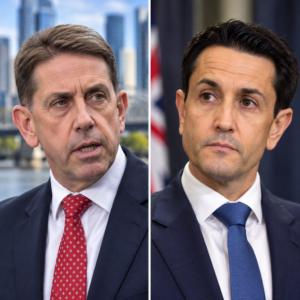
Nationals leader Matt Canavan has called on Australians opposed to the Albanese Government to place Labor last on their ballot papers, while indicating he is prepared to work with Pauline Hanson’s One Nation in Parliament as the minor party continues its rise in national opinion polls.

The comments come after a new RedBridge poll dramatically reshaped Australia’s political conversation by placing One Nation on a primary vote of 31 per cent, ahead of Labor on 29 per cent and the Coalition on 22 per cent. Although Labor retained a lead on the two-party-preferred measure, the poll highlighted the growing electoral strength of Pauline Hanson’s party.
Responding to the survey, Canavan argued Australians dissatisfied with the Albanese Government should focus on defeating Labor at the next election.
“The key message is: put the Labor Party last,” he said, encouraging conservative voters to maximise preference flows against the government.
Canavan also indicated he would be prepared to cooperate with One Nation on legislation and parliamentary matters where policy objectives aligned.
He said that while a formal coalition between the Nationals and One Nation was highly unlikely because the parties compete against each other in many electorates, practical cooperation after an election should not be ruled out if it helped remove Labor from government.
“I’m willing to cooperate with anybody who wants to get rid of this Labor government,” Canavan said, arguing that the government’s handling of cost-of-living pressures had created widespread voter dissatisfaction.
His remarks represent one of the clearest acknowledgements by a senior Coalition figure that One Nation’s growing electoral support could influence the balance of power in future parliaments.
At the same time, Canavan distinguished parliamentary cooperation from a formal political alliance, noting that the Nationals and One Nation remain direct competitors for many conservative voters.
The polling that prompted the discussion suggests Australians continue to rank cost-of-living pressures, housing affordability and healthcare among their highest priorities.
The RedBridge survey found Labor retained a modest advantage on economic management and health, while One Nation was viewed more favourably on immigration and crime—issues that have become increasingly prominent in public debate over the past year.
Political analysts caution that a single opinion poll does not predict election outcomes.
Australia’s preferential voting system means primary vote figures alone do not determine who forms government, as preference flows and seat-by-seat contests often prove decisive.
Nevertheless, sustained growth in One Nation’s support could significantly affect electoral dynamics by reshaping preference negotiations and increasing the party’s influence in both federal and state politics.
Pauline Hanson welcomed the poll as evidence that more Australians were turning away from the major parties.
She has argued that dissatisfaction over immigration, energy policy, taxation and the cost of living has created an opportunity for One Nation to expand beyond its traditional support base.
The party has recently strengthened its organisational structure by appointing former Morrison adviser Chris Taylor as Hanson’s chief of staff while moving long-time strategist James Ashby into the newly created role of Party Director to oversee campaign operations nationwide.
The Coalition’s broader position on One Nation remains more cautious.
Deputy Liberal leader Jane Hume recently ruled out any formal coalition with Pauline Hanson’s party, stating the Liberal–National Coalition remains focused on governing through its long-standing partnership rather than entering an alliance with One Nation.
Her comments contrasted with Canavan’s willingness to cooperate on individual parliamentary matters, highlighting differing approaches within the broader conservative movement regarding One Nation’s growing influence.
Political observers note that cooperation between parties on individual bills is not uncommon in Australia’s Parliament.
Minor parties and independents frequently negotiate with governments and oppositions on legislation without entering formal coalition agreements.
Canavan’s remarks therefore reflect a willingness to negotiate on
The Nationals leader has increasingly positioned himself as an advocate for regional Australia, arguing that many voters outside metropolitan centres feel ignored by both major parties.
Since becoming Nationals leader in March 2026, Canavan has emphasised manufacturing, energy security, agricultural interests and cost-of-living relief as central priorities, while seeking to reconnect with voters attracted to One Nation’s populist message.
For One Nation, the latest polling reinforces a period of sustained political momentum.
The party has recently expanded its organisational capacity, unveiled candidates for Victoria’s state election and recruited experienced policy advisers from outside its traditional ranks.
Supporters argue those developments demonstrate One Nation is evolving into a broader national political force rather than remaining solely a protest party. Critics, however, caution that opinion polls often fluctuate significantly between elections and that converting polling support into parliamentary seats remains a substantial challenge.
The debate also highlights the increasingly fragmented nature of Australian politics.
With support for the major parties under pressure and minor parties attracting larger shares of the vote, preference flows and crossbench negotiations are expected to play an increasingly important role in determining future governments.
Whether One Nation’s current polling translates into lasting electoral success will ultimately depend on voter behaviour at election time.
For now, however, Matt Canavan’s comments underscore a changing political reality: One Nation has become an increasingly significant force that both major conservative parties must take into account as Australia moves toward its next federal election.