Labor may finally have broken Australia’s long-running tax reform freeze, but economists are warning the Albanese government that the hardest and most politically dangerous decisions are still waiting.
Two months after the 2026–27 federal budget, the scale of the shift in Canberra’s tax debate is becoming clearer.
The government did something many economists had stopped expecting.
It took on parts of the tax system that create obvious winners and losers.
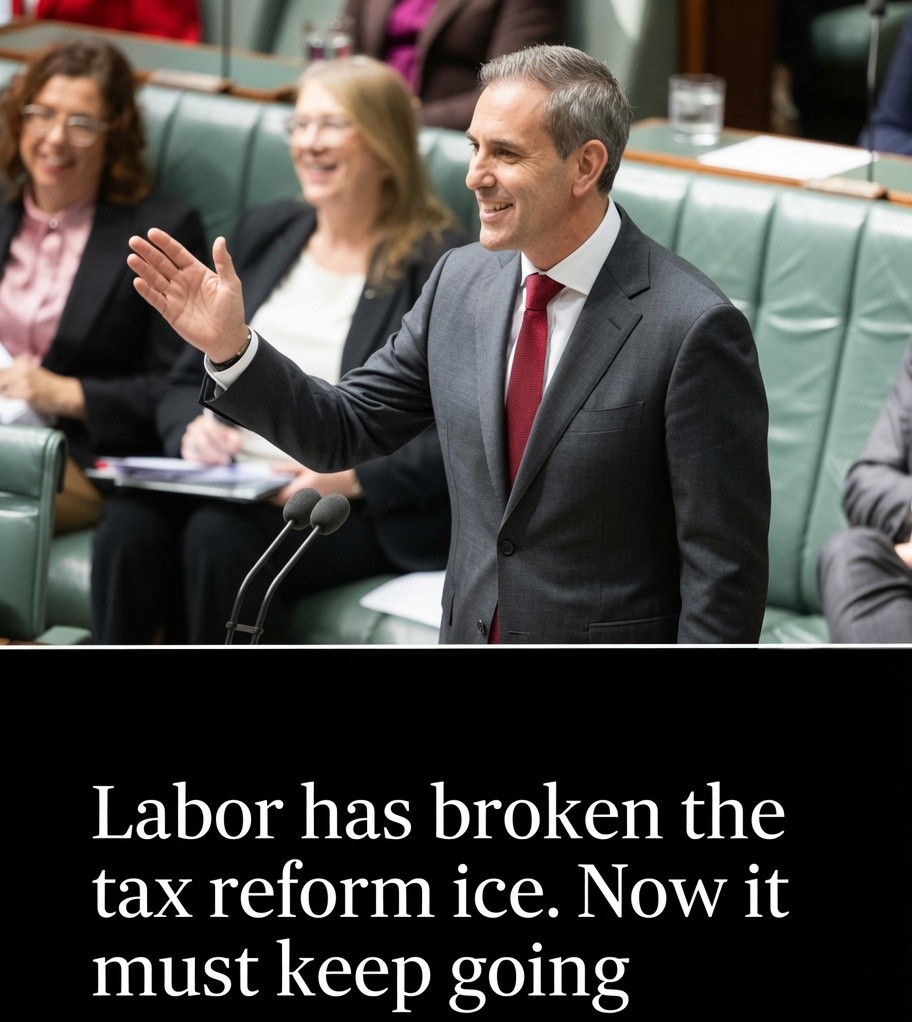
Labor announced major changes to capital gains tax arrangements, moved to limit negative gearing for residential property, proposed a new minimum tax treatment for discretionary trusts and introduced measures intended to encourage business investment and risk-taking.
Not every economist agrees with every detail.
Business groups are already fighting over proposed carve-outs and eligibility rules.
Investors have attacked parts of the capital gains tax overhaul.
Small business advocates have raised concerns about the treatment of trusts.
States are watching for consequences to their own revenue bases.
But for economist Melissa Bray, the important first lesson from the budget is that the government displayed more political courage than many observers expected.
Labor has broken the tax reform ice.
The problem is that Australia cannot afford to stop there.
The next list of reforms is arguably more difficult than the first.
It includes the company tax system, the way Australia prices the extraction of publicly owned natural resources and a GST base that is steadily losing relevance as the economy changes.
These are not technical arguments that belong only in Treasury papers.
They determine who pays for an ageing population, how Australia attracts investment, how much governments collect from finite natural resources and whether workers increasingly carry a larger share of the tax burden.
The budget crossed a political line previous governments were reluctant to approach
Tax reform is one of the easiest phrases to use in Australian politics and one of the hardest policies to deliver.
Almost everybody supports a tax system that is simpler, fairer and more efficient.
Agreement tends to collapse as soon as a government identifies whose concession will be reduced, which asset will be taxed differently or which industry will pay more.
That political reality has helped produce years of incremental changes rather than comprehensive reform.
The 2026–27 budget was different.
Labor announced that the existing 50 per cent capital gains tax discount would be replaced with an inflation-based approach for affected gains from 1 July 2027, alongside a minimum 30 per cent tax rate on capital gains.
The government also moved on negative gearing, restricting its future use for residential property while seeking to preserve incentives for investment in new housing supply.
Discretionary trusts entered the reform program as well, with the government proposing a 30 per cent minimum tax on taxable income in affected trusts from July 2028.
At the same time, Canberra announced billions of dollars in business tax measures designed to support investment, innovation and resilience.
That is a substantial package by the standards of recent Australian tax politics.
It also explains the backlash.
Once a government changes the tax treatment of property, trusts and capital gains, every affected industry begins calculating the consequences.
The government has already been forced to clarify, consult and adjust parts of its program.
Critics have seized on complexity in proposed start-up concessions.
Small business groups are examining the trust changes.
Property investors are reconsidering future decisions.
None of this necessarily means the reform process has failed.
It means tax reform has become real.
A reform that changes nobody’s behaviour, affects nobody’s tax position and creates no political resistance probably does not alter much.
Australia’s next company tax debate will be even harder
One of the biggest unresolved questions is company tax.
Australia’s headline corporate tax rate is 30 per cent for larger companies, while eligible base rate entities face a 25 per cent rate.
The problem is not simply whether those numbers are too high or too low.
The deeper question is what Australia is trying to achieve with company taxation.
Governments want revenue.
They also want businesses to invest.
They want multinational companies to locate activity in Australia.
They want Australian firms to expand rather than shift investment overseas.
They want companies to take productive risks.
And they want voters to believe large corporations are paying a fair share.
Those objectives can collide.
A high tax rate can raise substantial revenue from profitable companies, but the tax system can also influence where multinational businesses invest and how companies structure their operations.
A lower rate may encourage some investment but immediately raises the political question of why corporations should receive tax relief while households are struggling with living costs.
Australia has attempted to manage some of these tensions through concessions, deductions and targeted incentives.
That creates another problem.
The headline rate becomes only one part of the system.
Companies make decisions based on the effective tax treatment of an investment, including depreciation, losses, financing arrangements and the availability of specific concessions.
The 2026 budget’s business measures demonstrate that the government understands this.
Labor has proposed loss carry-back arrangements for companies with annual global income below $1 billion and other measures intended to encourage investment and sensible risk-taking.
But targeted changes are not the same as a complete company tax strategy.
Australia still needs to decide whether it wants a broader base with a different rate, stronger investment allowances, more neutral treatment of different forms of capital or continued reliance on industry-specific incentives.
Every option creates winners and losers.
That is precisely why governments have struggled to settle the issue.
Then there is the question of Australia’s natural resources
Australia is extraordinarily rich in natural resources.
Iron ore, coal and gas have generated enormous export earnings.
The country has benefited from global demand for commodities and from the development of major resource projects.
But a fundamental economic question remains contested.
When a private company extracts a finite natural resource, how much of the economic value should flow back to the public?
This is different from ordinary company tax.
A mineral deposit or petroleum resource cannot be recreated once extracted.
The resource itself exists before a company begins production.
The company contributes capital, technology, labour, expertise and risk to turn that resource into a commercial product.
It should be able to earn a return on those investments.
But economists have long argued that governments should also capture an appropriate share of the economic rent associated with valuable, scarce resources.
Australia has repeatedly struggled with the politics of doing so.
The mining tax battles of the 2010s remain a warning to every federal government considering major resource taxation reform.
The Petroleum Resource Rent Tax has also been the subject of continuing criticism and reform.
Supporters of stronger resource taxation argue Australians are receiving too little for the extraction and export of assets that ultimately belong to the public.
Industry groups warn poorly designed taxes can discourage investment, make projects less competitive and reduce future production.
Both arguments need to be taken seriously.
The objective should not be to punish resource companies for being profitable.
Nor should Australia effectively give away valuable resources because governments are frightened of a political campaign.
The real policy challenge is pricing access to natural resources in a way that allows commercially viable projects to proceed while ensuring exceptional resource rents are shared with the public.
That requires careful design.
It also requires political stamina.
The GST is slowly becoming less suited to the economy it is supposed to tax
The third major issue is the shrinking GST base.
When the Goods and Services Tax was introduced in 2000, it represented a major restructuring of Australia’s tax system.
The basic idea of a consumption tax is relatively straightforward.
People pay tax when they consume goods and services.
But Australia’s GST was never applied to all consumption.
Important categories were excluded or treated differently.
Over time, the economy itself has changed.
Australians are spending more on services, including areas that can sit outside the GST base.
Health and education have become larger parts of household and government expenditure.
As the composition of consumption changes, the share of spending effectively captured by GST can decline.
This matters because GST revenue is distributed to the states and territories.
State governments face enormous spending pressures.
Hospitals are expensive.
Schools are expensive.
Transport infrastructure is expensive.
An ageing population will increase demand for health-related services.
Yet the consumption tax intended to support state finances is attached to a base that does not automatically grow in line with every major area of spending.
Governments therefore face several politically difficult options.
They could broaden the GST base.
They could increase the rate.
They could leave the GST largely unchanged and rely more heavily on other taxes.
Or federal and state governments could attempt a much larger restructuring of their revenue relationship.
None is easy.
Broadening the GST means applying tax to goods or services that are currently exempt.
Increasing the rate immediately raises concerns about lower-income households because consumption taxes can take a larger proportion of income from people who spend most of what they earn.
Compensation through the transfer and income tax systems can address some of that impact.
But compensation makes reform more complicated and creates its own budget cost.
Leaving the system unchanged is politically simpler.
It does not make the structural problem disappear.
Australia’s tax burden is increasingly tied to workers
Behind the individual reform debates is a much larger concern about the balance of Australia’s tax system.
Personal income tax remains a central source of Commonwealth revenue.
As wages rise over time, taxpayers can move into higher tax brackets unless thresholds or rates are adjusted.
This phenomenon, commonly called bracket creep, can increase the average tax burden without a government explicitly announcing a new tax increase.
Governments periodically respond with income tax cuts.
The 2026 budget included a new Working Australians Tax Offset worth up to $250 annually from 2027–28, building on previously legislated tax cuts and the $1,000 instant tax deduction.
Those measures provide relief.
They do not answer the structural question.
If Australia requires more revenue to fund defence, health, aged care, the NDIS and other services, where should that money come from?
Workers?
Consumption?
Companies?
Land?
Natural resources?
Wealth?
Environmental externalities?
The tax system currently uses a mixture of all these bases, but not necessarily in a coherent way.
Australia also has multiple levels of government imposing taxes that economists have criticised for decades.
State stamp duties are a classic example.
They raise substantial revenue but can discourage people from moving homes and create large tax bills around individual property transactions.
Economists have repeatedly argued for a shift towards broader land taxation.
Politically, the transition is extremely difficult.
Homeowners fear paying a new annual tax after already paying stamp duty.
State governments fear losing reliable revenue during the transition.
Oppositions can easily campaign against a “new property tax”.
Once again, the economic argument is often easier than the politics.
The real test for Chalmers is whether reform becomes a process rather than a single budget event
Treasurer Jim Chalmers has spent years talking about economic reform, productivity and the need to modernise Australia’s economy.
The 2026 budget has given that language more substance.
The government has now legislated or begun implementing a significant first tranche of tax changes.
Consultation on discretionary trust reform is continuing.
Legislation covering business tax measures has entered Parliament.
Treasury is working through the implementation of capital gains tax changes.
The government will inevitably make concessions.
Some rules will need rewriting.
Industry groups will identify unintended consequences.
Opponents will argue that the entire agenda should be abandoned.
The danger for Labor is that it concludes the political cost of the first package is enough and declares the reform task complete.
That would be a mistake.
Australia’s fiscal pressures are not temporary.
The population is ageing.
Demand for government services is rising.
Defence spending is under pressure.
The energy transition requires investment.
States face major infrastructure and service-delivery costs.
At the same time, productivity growth has been weak and governments cannot simply assume rapid economic growth will solve every revenue problem.
A tax system designed around the economic structure of previous decades will become increasingly inefficient if the economy changes around it.
Tax reform does not mean collecting more money at any cost
One danger in the current debate is the assumption that reform is simply a polite word for higher taxes.
It should not be.
A good tax reform can raise the same amount of revenue in a less damaging way.
It can remove incentives that distort investment decisions.
It can shift taxation away from productive activity and towards economic rents or bases that are harder to avoid.
It can make the system simpler.
It can reduce compliance costs.
It can improve fairness without destroying incentives to work, invest or build businesses.
Bad reform can do the opposite.
A poorly designed company tax change can discourage investment.
A badly structured resource tax can create uncertainty around long-term projects.
A GST expansion without adequate compensation can place disproportionate pressure on low-income households.
A complex concession intended to encourage start-ups can become so difficult to access that innovative businesses simply ignore it.
That is why the quality of the design matters as much as political courage.
Labor deserves scrutiny over every detail of its existing package.
The government has already faced legitimate criticism over complexity in parts of the proposed capital gains tax concessions for innovative businesses.
Consultation should change policy when experts identify genuine problems.
But disagreement over individual measures should not become another excuse for Australia to abandon the broader reform debate.
Labor has opened a door Canberra spent years avoiding
Melissa Bray’s central argument is ultimately about momentum.
The government has demonstrated that politically difficult tax changes can be placed in a federal budget and defended.
That does not mean voters will support every measure.
It does not mean the current package is perfectly designed.
It certainly does not mean the political fight is over.
But the reform freeze has been broken.
The question now is what Labor does with that opportunity.
Company tax remains unresolved.
The taxation and pricing of natural resource extraction remains contested.
The GST base continues to face structural pressure.
State taxes still contain some of the most economically damaging features of the Australian revenue system.
And the Commonwealth must decide how much of the future tax burden should continue to fall on personal incomes.
These debates cannot be solved in one budget.
They may not be solved by one government.
But Australia has spent years producing reviews, reports and speeches explaining why the tax system needs reform.
The 2026 budget suggests Canberra may finally be willing to move beyond explaining the problem.
Labor has broken the ice. The real measure of its courage will be whether it keeps moving when the next reforms are even harder than the first.






