An explosive private message by Barnaby Joyce about Scott Morrison became a public test of trust inside the Coalition government. Joyce had described Morrison as a “hypocrite and a liar” while outside the deputy prime minister’s office. When the message became public, Joyce apologised and offered his resignation. Morrison declined to accept it, allowing the working relationship at the top of the government to continue.
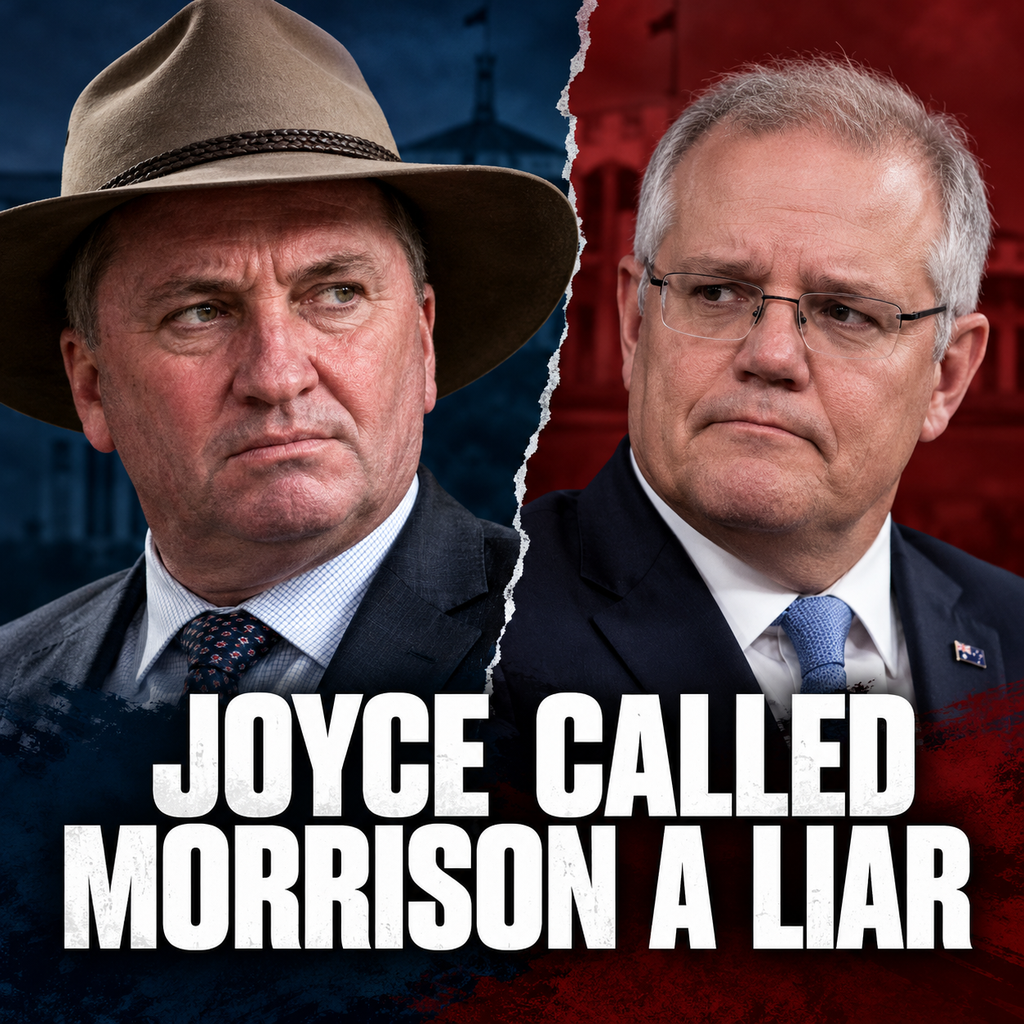
The controversy was documented in public reporting and statements by the participants. The words were Joyce’s assessment of Morrison, not an independently established finding that Morrison had lied in a specified instance. Joyce later said his view had been formed from assumptions and commentary rather than their direct working relationship. An accurate account must contain both the original attack and his subsequent explanation.
The text was sent through a third party to former Liberal staffer Brittany Higgins, whose allegations about her treatment in Parliament House had become a serious national issue. That context helps explain why private messages among political figures attracted attention. It does not mean the wording of Joyce’s message proved any allegation about Higgins or Morrison, and it would be inappropriate to treat an insult in a private exchange as evidence in an unrelated legal matter.
Joyce’s words were blunt. In the message, he accused Morrison of hypocrisy and dishonesty and said he distrusted him. In the ABC’s reporting, Joyce acknowledged the message and apologised directly to the prime minister. He said he had offered to quit as deputy prime minister after the text emerged and that Morrison had rejected the offer.
The offer of resignation was significant because Joyce was not an ordinary backbencher. The deputy prime minister’s role depended on the Coalition partnership between the Liberal and National parties. Both organisations retained their own leadership, policy priorities and political constituencies. A leadership crisis involving the head of the Nationals could therefore become a question about the stability of the entire government.
Yet the distinction between an offer and a completed resignation is essential. Joyce did not leave the role as a consequence of this incident. The prime minister’s refusal to accept his offer meant the proposed exit did not take effect. Headlines suggesting he resigned, was removed or was forced from office over the message would misstate the reported outcome.
Joyce tried to draw a line between his feelings as a backbencher and his experience as a senior member of government. He said his earlier view had been based on what he had heard and assumed, rather than on direct dealings with Morrison as a colleague in their governing arrangement. That was a public retraction of confidence in the basis for the initial character assessment, but it did not erase the fact that he had written the message.
The exchange illustrates why personal trust is an important, though often invisible, part of cabinet government. Ministers must negotiate priorities, discuss confidential options and present a coherent position to the public. A leader who believes colleagues cannot be trusted may struggle to secure agreement even where the underlying policies are compatible. Public confidence can be weakened when citizens see senior figures accusing each other of dishonesty, even if those figures later say their relationship has improved.
Coalition governments face an additional layer of negotiation. The Liberal and National parties share government while representing different mixes of metropolitan, regional and rural interests. Disagreements about agriculture, infrastructure, energy, environmental regulation and regional funding may involve genuine policy trade-offs. It would, however, be speculative to assign a particular spending decision or ministerial compromise to the Joyce message without evidence connecting the two.
The political damage in the incident was therefore reputational rather than a documented failure of a named government service. Voters had reason to ask how candidly leaders spoke about one another and whether the public presentation of unity reflected their private attitudes. Those questions are fair. But asserting that the government’s financial or administrative decisions were corrupted by the dispute would require evidence not supplied by the text.
The involvement of a personal message also raises a media ethics question. Private communications from public officials can have strong public interest when they bear on integrity, the functioning of government or the treatment of staff. Journalists still need to distinguish an authentic message from the truth of any accusations contained within it. A leaked statement can prove that a person expressed a view; it cannot automatically prove the view itself.
Reporting also needs care because the surrounding circumstances involved another individual’s serious allegations about Parliament House. Those allegations had their own evidentiary and legal issues. Joyce’s use of the message to convey a personal opinion about Morrison should not be turned into a finding about anyone else. Respecting the boundaries between connected stories protects both accuracy and the people whose experiences have become subjects of intense public attention.
From a leadership perspective, Morrison’s decision not to accept the resignation gave him an opportunity to present the issue as contained. A leader can decide that continued cooperation is more useful than a public rupture. That choice does not certify that all personal grievances have disappeared, and the prime minister’s reasons should not be invented. It establishes only that he rejected the offer and that Joyce remained in position.
Joyce’s apology presented a different calculation: acknowledge the words, express regret and explain why his understanding had changed. Political apologies often combine personal and institutional motives. There is no sound factual basis to guess whether his regret was sincere in order to report what he said and did. Readers can assess the explanation and its consistency with the original message.
For ordinary households and businesses, high-level leadership arguments matter most when they affect the government’s ability to make decisions. Stable administration influences expectations around budgets, regional services, procurement and regulation. But it is easy to overstate the impact of a dramatic headline on the economy. The existence of political tension is not the same as a measured change to borrowing costs, consumer prices or commercial confidence.
The episode remains a sharp example of how private language can collide with the demands of public office. Joyce’s original message was damaging because of its directness and its subject. His apology and resignation offer showed the pressure created by its disclosure. Morrison’s decision not to accept the offer supplied a clear political outcome. The broader question — how much trust voters should place in a government whose senior members privately speak in such terms — remains one for public judgement, not an issue that can be conclusively settled from a single message.
One of the most revealing aspects of the dispute was the shift between the two settings in which Joyce spoke. A private message can contain language a public officeholder would not choose for a press conference. Disclosure does not transform that language into objective truth, but it can expose a contrast between public cooperation and private mistrust. The appropriate question for citizens is whether that contrast affects accountability, not whether every unguarded opinion should be treated as a formal government statement.
The chain of communication is significant as well. Joyce had sent the message through a third party rather than issuing a public attack on Morrison. The message entered public debate only after it was reported. That path raises legitimate questions about privacy and public interest, especially where political staff and sensitive allegations are involved. Journalists need a clear reason to publish private material and must describe the circumstances accurately. A high-profile quote alone is not permission to make unsupported claims about every person mentioned in the surrounding dispute.
Morrison’s refusal to accept the resignation also demonstrates how political responsibility and managerial discretion can intersect. A prime minister may decide that retaining a senior colleague is compatible with stable government even after damaging words emerge. Voters can criticise that choice, but they should not be told that the resignation took effect when it did not. The record supports an apology, an offer and a refusal — three discrete actions with different meanings to the public.
If the episode invites a lesson about the economy, it is principally about governance risk rather than a measurable market shock. Businesses value clarity about infrastructure plans, procurement and regulatory priorities. Persistent leadership instability can complicate expectations, but a single political revelation is not evidence that a particular contract, loan or investment decision changed. Using the dispute to claim specific economic damage would be conjecture. Its defensible significance lies in trust, political management and the standard of candour expected from senior ministers.
The case also speaks to what voters can fairly expect from apologies. An apology acknowledges something said or done; it does not establish that colleagues agree on every underlying question. Joyce’s explanation invited the public to distinguish the person he believed Morrison to be from the leader he said he experienced in government. Whether that account persuaded voters is not established by the record. What can be verified is the sequence of actions and the fact that the proposed resignation was not accepted.