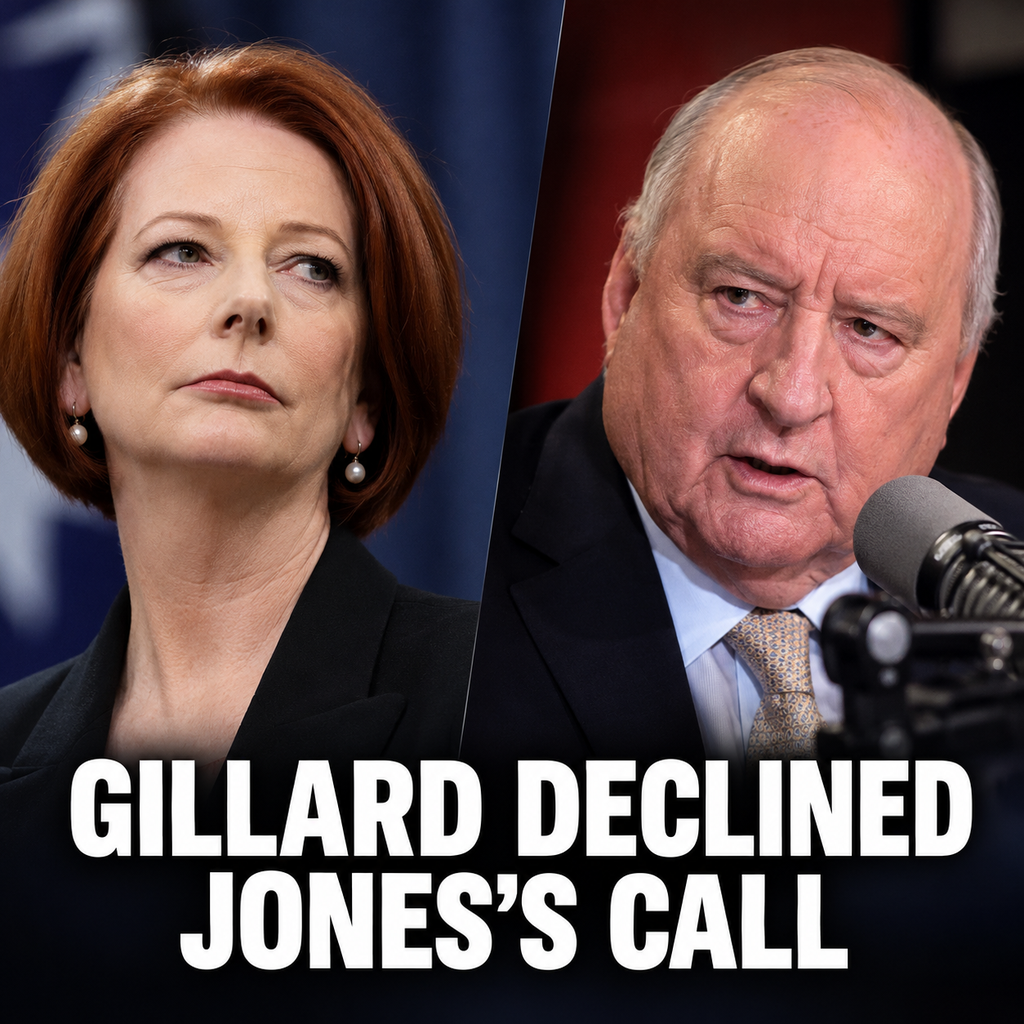
Julia Gillard’s refusal to take a personal apology call from broadcaster Alan Jones turned an offensive political comment into a larger debate about the responsibilities of influential media figures. Jones had told a Liberal-affiliated gathering that Gillard’s late father had “died of shame” because of her political conduct. Jones subsequently acknowledged the hurt his words could cause, but Gillard’s office said she did not want to take the call.
The exchange is part of the documented record of Australian politics and broadcasting, not a fresh confrontation between the two. Its importance lies in the questions that followed: how far political criticism can go before it crosses into a private family’s grief, what an apology can repair, and what role listeners and advertisers play when a high-profile media personality causes outrage.
Jones was one of the country’s best-known talkback hosts, with an audience that made his comments politically influential. Gillard was prime minister, a position that subjected her decisions and leadership to constant scrutiny. Political leaders must be open to sustained criticism of their policies, promises and conduct. But the comment that drew condemnation was not a policy critique. It invoked her father’s death and presented his private feelings as a political weapon, with no basis supplied for claiming to know them.
That is why the distinction between a reported remark and an established fact is especially important here. Jones made the assertion at a fundraising event. The assertion about Gillard’s father should not be repeated as a truthful description of the man’s beliefs. The verifiable facts are that the broadcaster made the remark, later acknowledged that it may have caused distress, and sought to apologise personally.
At a press conference, Jones said any suggestion that he was diminishing a daughter’s grief was unacceptable. He recognised that Gillard’s position as prime minister added another dimension to the episode. His attempted apology was therefore a response to a widely condemned statement, not evidence that Gillard had to accept a private telephone call. Gillard’s office said she did not want to speak with him, and subsequent reporting recorded her refusal to be drawn into an interview with him.
An apology is an act by the person who offers it. Acceptance belongs to the person receiving it. The distinction is frequently blurred when a public controversy becomes a media event of its own. An offender may wish to make amends directly, while the target may prefer not to engage at all. The existence of public pressure does not create an obligation to provide closure on the broadcaster’s terms.
The controversy also drew attention to what happens when comments made at a political gathering spread to a much larger audience. A recording of the remarks reached the news media, creating a connection between remarks made to a partisan room and the responsibilities of a broadcaster whose professional influence depends on public trust. That distinction matters even if the broadcaster did not make the original statement into a live microphone. An audience can reasonably consider the speaker’s professional role when assessing such conduct.
Public reaction extended far beyond the immediate exchange. Businesses advertising on Jones’s program faced criticism, and a substantial number withdrew their advertising. ABC reporting put the figure at more than 70 companies. Macquarie Radio Network suspended advertising on the breakfast program, explaining that it sought to protect sponsors from what it described as a campaign of cyberbullying. The network simultaneously recognised that the original comments were inexcusable. Those positions need to be reported together; describing the decision as a simple admission of wrongdoing would miss the company’s stated concern about pressure on advertisers.
The episode offers an unusually direct example of how brand safety affects a commercial media operation. Advertisers purchase access to an audience, but they may also become associated in consumers’ minds with the content around their messages. When a host becomes embroiled in controversy, the advertiser must decide whether continuing to appear alongside that host creates a reputational risk. Those decisions can be driven by customer expectations, corporate policy and commercial considerations, not only by the personal opinions of executives.
Consumer campaigns add another complication. People can choose not to listen to a program or buy from a business that sponsors it. Others can criticise a business’s advertising decisions. But threats, harassment and intimidation against workers are separate matters and cannot be justified simply by anger at a public statement. The network’s concerns about attacks on advertisers did not make Jones’s remark acceptable; equally, the offensiveness of the remark did not make every response to it legitimate.
These tensions are relevant to news organisations as well as individual presenters. Editors routinely distinguish between a contentious opinion, a statement of alleged fact and a personal insult. An opinion that robustly attacks a government’s budget is different from an unsubstantiated assertion about a deceased relative’s private feelings. The difference matters because the subject cannot meaningfully answer the insinuation and the comment adds little to public understanding of policy.
Australian broadcasting also operates within a framework of standards and complaints processes. The Australian Communications and Media Authority publishes records of investigations into commercial radio, including matters involving accuracy and complaint handling. These regulatory questions are distinct from the public condemnation of the comment about Gillard’s father. It would be inaccurate to infer from the outrage alone that a regulator made a specific legal finding about that particular statement. Ethical criticism and formal legal or regulatory breaches should not be confused.
What made the dispute especially sensitive was its treatment of grief. A public official’s bereavement is real even when political differences are intense. Critics can challenge a prime minister’s record without claiming to speak for a dead parent. That boundary does not protect officeholders from scrutiny; it preserves a basic distinction between democratic accountability and attacks that derive their force from personal vulnerability.
The story also shows how attempts to repair public reputation can prolong a controversy. Jones’s apology became part of the coverage, then Gillard’s refusal became another story, and sponsor decisions produced still more reporting. Every response created a new question about motives, sincerity and consequences. It demonstrates the difficulty of controlling a public controversy once the original statement has entered the wider media system.
For political audiences, the central lesson is not that strong language must disappear from public debate. It is that the power of a broadcaster or political commentator increases the responsibility to distinguish evidence-based criticism from personal cruelty. Jones’s decision to apologise and Gillard’s decision not to take his call were both significant. Neither changes the nature of the original claim, and neither should be exaggerated into a legal outcome the record does not establish.
The episode remains a reminder that public accountability operates through several different mechanisms: journalism, political response, audience judgement, commercial advertising decisions and formal regulation. They can overlap, but none automatically substitutes for the others. A precise account preserves those differences rather than flattening a complicated public dispute into a single confrontation.
Financial consequences for a media business are not necessarily imposed by government regulators. An advertiser can withdraw because it judges that association with a program will damage customer trust, even when no regulator has made a ruling about the remarks in question. A station can also make commercial decisions in an effort to prevent an exodus of clients. The temporary advertising suspension in this case reflected the network’s response to intense pressure on sponsors. Its own explanation framed that pressure as unacceptable, while accepting that the original statement was inexcusable.
The episode showed a basic asymmetry of public speech. Jones had a regular broadcast platform and opportunities to explain his position directly to listeners. Gillard was entitled to decline a personal call without surrendering the ability to criticise his words or have others report her response. Some observers might prefer a public reconciliation; others might see continued distance as appropriate. Neither judgement changes the established sequence of the remark, the apology effort and her refusal to speak to him.
The political setting also matters. Comments at partisan gatherings can receive approval, laughter or protest from those present, but those reactions cannot be assumed to represent the wider electorate. The availability of a recording gave journalists an independent basis to report the words, rather than relying solely on competing recollections. That does not validate the claim about Gillard’s father. It validates reporting that Jones said it. This separation between the existence of a statement and the truth of its content is fundamental to responsible journalism.
The commercial fallout underlines another point: advertisers do not control every remark made by a host they sponsor, but they still face scrutiny about the associations they are willing to maintain. A broadcaster also has responsibilities to protect its staff and clients against threats while managing its own editorial standards. These are competing obligations rather than a single measure of public sentiment. A measured account of the controversy recognises that offensive political speech, organised boycotts, legitimate criticism of advertisers and abusive pressure are not interchangeable categories.






