A new accessibility audit has found that only a small share of hotel rooms in Brisbane, Cairns and the Gold Coast met the study’s accessibility criteria, raising questions about whether Queensland’s accommodation and transport systems are keeping pace with the needs of travellers with disability ahead of the 2032 Olympic and Paralympic Games.
The six-month Games Readiness study, produced by Queenslanders with Disability Network and Urbis, examined 170 hotels across the three cities. That represented about 22 per cent of the more than 750 hotels in the markets surveyed. The researchers found roughly 2 per cent of rooms in Brisbane and Cairns met the criteria, while the figure on the Gold Coast was about 1 per cent.
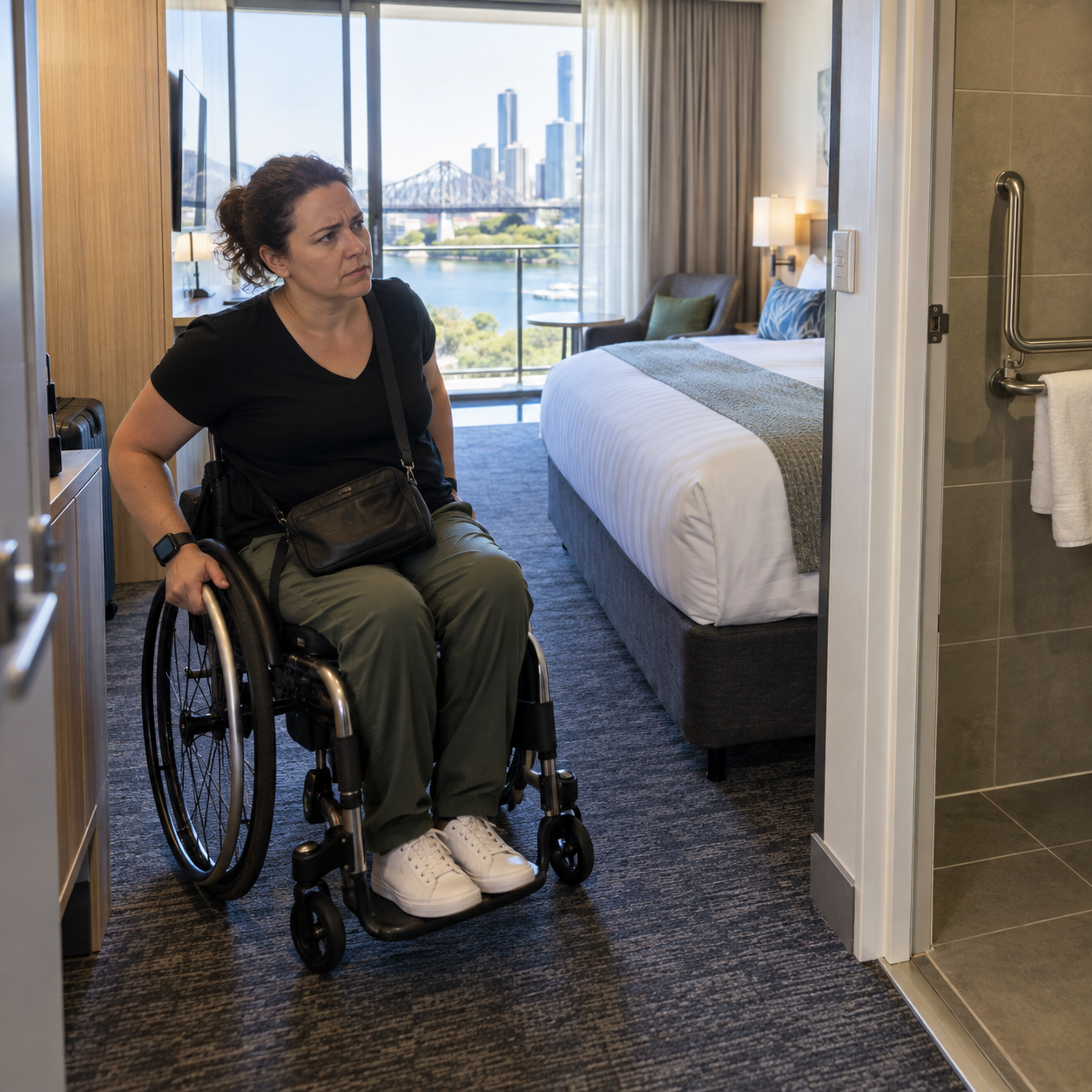
The findings do not mean every hotel room outside those percentages breaches a law or building standard. The report applied its own accessibility criteria across the hotels it audited and used the results to assess how easy it would be for travellers with different access needs to find suitable accommodation.
One of the clearest problems identified by the research was information. The study found accessible rooms were often difficult to identify when people were searching or booking, making it harder for travellers to know in advance whether a room would meet their needs.
The researchers also found that many hotels focused primarily on physical access features associated with wheelchair users. That can leave gaps for people whose access needs relate to vision, hearing, neurological conditions, sensory requirements or assistance animals.
Urbis associate director Kali Marnane said the limited supply identified in the audit was surprising, particularly given the size of the accessible tourism market. She noted that about one in five trips in Australia is taken by someone with a disability or another accessibility need.
That figure is important because accessible tourism is not a niche issue affecting only a small group of visitors. Older travellers, people recovering from injury, families travelling with relatives who have mobility needs and people with permanent disabilities can all rely on clear and usable accessibility information.
The experience of Brisbane resident Natascha Kamp shows why a standard room label can be too narrow. Ms Kamp has Functional Neurological Disorder and travels with a medical assistance dog, Evy, who helps her manage stress and fatigue and reduce the risk of seizures.
For Ms Kamp, an accessible stay involves more than a wider doorway or bathroom rail. She also needs a safe, convenient place near the accommodation where her assistance dog can relieve itself, because travelling several hundred metres outside a hotel can create additional difficulty.
She told the ABC she generally avoids hotels because she does not find them accessible for her circumstances. Her experience illustrates the report’s wider point that accessibility is not a single design feature but a combination of room layout, services, information and the surrounding environment.
The timing of the study gives the issue added importance. Brisbane will host the Olympic and Paralympic Games in 2032, with events and visitors spread across multiple Queensland locations. Large international events place pressure not only on stadiums and transport networks but also on hotels, booking systems and the routes connecting accommodation to venues.
Deputy Premier Jarrod Bleijie said accessibility was part of the Queensland government’s planning and repeated the government’s commitment to delivering what it describes as a Games for all Queenslanders.
The government says it is seeking to encourage new development and investment across the state, including additional hotel accommodation. That matters because the hotel industry expects a significant amount of new supply to be built before 2032, creating an opportunity to improve accessibility in projects that have not yet been constructed.
Queensland Hotels Association chief executive Bernie Hogan said the state would face a broader room shortage if the Games were held today and predicted substantial hotel construction before 2032. He also said awareness of accessible tourism had improved and that newer projects would be shaped by updated standards and growing market expectations.
Hogan argued that the answer is not necessarily to make half of every hotel’s rooms fully accessible. His broader point was that the industry needs a realistic mix of rooms and features that matches demand while ensuring people with accessibility needs have genuine choices rather than only a token number of options.
That distinction is one reason the report focuses on availability and usability rather than a single industry-wide percentage target. Travellers need to be able to find rooms with the particular features they require, compare options and book with confidence that the information provided is accurate.
The study also looked beyond hotel rooms to the public transport links between accommodation and planned Games venues. In Brisbane, about 56 per cent of accommodation providers surveyed could reach five or more venues by public transport within an hour.
But the researchers identified at least four venues in Greater Brisbane that could not be reached by public transport under the conditions assessed. The report said those locations would require network upgrades, extra services, event-specific transport or other complementary travel options to provide reliable return journeys during the Games.
That finding shows why accessible accommodation cannot be considered in isolation. A hotel may have a suitable room, but a visitor can still face major barriers if there is no practical way to travel from that hotel to an event venue or if the available route is difficult to understand.
The report therefore recommends clearer information about both accommodation and transport. Better information would allow travellers to plan around their needs rather than discovering barriers after arrival, when alternatives may be expensive or unavailable.
Queenslanders with Disability Network chief executive Michelle Moss said the state already had important building blocks in place and that the disability community was ready to work with the hotel and transport sectors. The group wants lived experience to be part of planning rather than added late in the process.
That approach matters because the Games are still more than five years away. Major hotel projects, transport upgrades and booking-system changes take time, but the remaining lead time also gives governments and industry a chance to address problems before visitor numbers surge.
The report does not conclude that Queensland is completely unprepared. Marnane described the state as ready in parts but not yet functioning as a fully connected system. That is a more specific finding than saying the entire tourism industry has failed accessibility standards.
For travellers with disability, the practical issue is choice. A small number of suitable rooms can quickly become unavailable during major events, and unclear information can make even existing accessible rooms difficult to find. Increasing supply is one part of the solution, but improving descriptions, booking processes, staff awareness and transport connections is also necessary.
For hotels, accessible tourism is increasingly both a service obligation and a commercial market. As new accommodation is developed ahead of 2032, the industry has an opportunity to design for a broader range of guests from the start rather than relying on later retrofits.
The audit provides an early benchmark rather than a final verdict on Games readiness. Its message is that Queensland has time to improve, but the current level of accessible accommodation identified in the surveyed cities is limited and the gaps extend beyond bedrooms to the wider journey a visitor must make.
The study’s methodology is also relevant when interpreting the percentages. Researchers contacted hotels individually and asked about the number and features of accessible rooms, rather than treating every property in the market as identical. The audit therefore offers a substantial sample across the three cities, but it is still a sample rather than a census of every hotel room in Queensland.
That makes the report most useful as a readiness indicator. It identifies where supply, information and transport connections appear weak enough to deserve attention before 2032, without claiming that every room outside the audited accessible category is unusable for every traveller with disability.
The next few years will show whether planned hotel construction and transport investment close those gaps. Because many new rooms and services have not yet been built, accessibility decisions made during design and procurement now could have a much larger effect than attempting to retrofit the same features shortly before the Games.
Clearer booking information may be one of the fastest improvements available because it helps travellers use rooms that already exist while longer-term construction is still underway. The report’s transport findings point to the same principle: infrastructure matters, but people also need reliable information about how to move between accommodation and venues before they can plan an accessible trip.