‘Don’t come back’: Aussie tourist praised after confronting alleged littering at Indonesia’s iconic Padar Island

An Australian tourist has been widely praised after confronting a fellow traveller accused of littering at one of Indonesia’s most spectacular natural attractions, with the tense exchange captured on video and shared widely across social media.
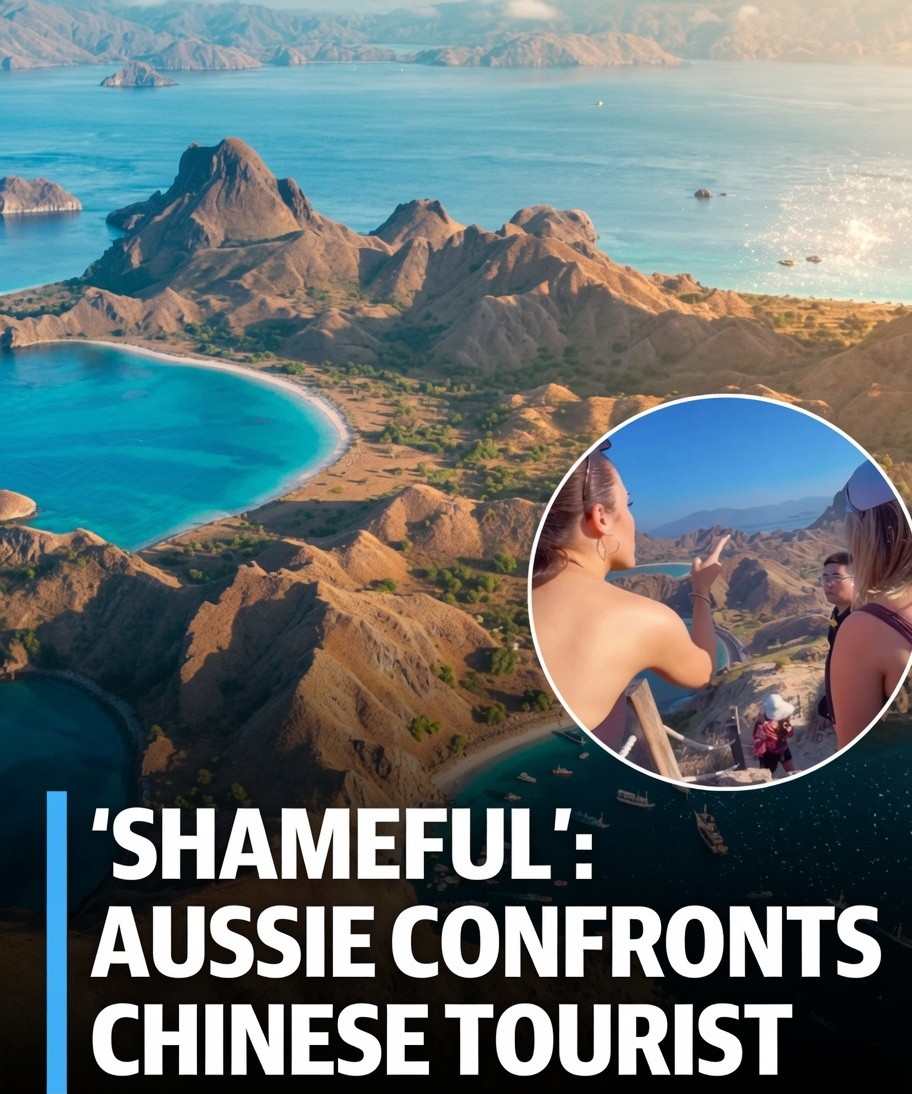
Australian tourist confronts alleged littering incident on Padar Island in Indonesia's Komodo National Park

The confrontation unfolded on Padar Island, part of Indonesia’s world-famous Komodo National Park, where hundreds of visitors each day climb a steep hiking trail to enjoy panoramic views over three distinctive crescent-shaped beaches.

According to witnesses, the incident began after a male tourist was allegedly seen throwing a plastic water bottle onto the ground while walking along the popular trail. An Australian woman immediately picked up the bottle and confronted the man, accusing him of disrespecting one of Indonesia’s most pristine natural environments.

Video of the exchange shows the woman firmly telling the tourist that there was no excuse for littering in such a scenic location.

“I don’t care, you saw the sign. This is beautiful, and you ruin it,” she says in the footage.

She then adds: “Shameful. Shame on you. Don’t come back. I don’t care, don’t litter.”

The man attempts to respond by asking where she is from.

“Australia,” the woman replies without hesitation.

Another female tourist also joins the confrontation, telling the man: “You’re rude. You should go. No one likes you,” before he walks away from the group.

The video has since attracted widespread attention online, with many viewers applauding the Australian tourist for speaking up rather than ignoring behaviour they believed threatened a fragile natural environment.

While opinions differed over the tone of the confrontation, much of the online discussion centred on the broader issue of responsible tourism rather than the nationality of those involved.

Padar Island is one of Indonesia’s most photographed destinations and forms part of the UNESCO-listed Komodo National Park in East Nusa Tenggara Province.

Although many travellers visit the park through Bali, Padar itself lies near the town of Labuan Bajo on Flores Island and requires a boat trip to reach.

The island’s famous summit can typically be reached via a climb of approximately 800 concrete and timber steps, with the hike taking between 30 and 45 minutes depending on conditions.

From the top, visitors are rewarded with sweeping views of three bays, each featuring sand of a different colour, making the location one of Indonesia’s signature tourism images.

Because of its ecological significance and growing popularity, visitors are required to follow strict environmental rules throughout the national park.

Among those regulations are bans on littering, damaging vegetation and disturbing wildlife.

The Komodo National Park Authority said every visitor receives a briefing about maintaining cleanliness before beginning the Padar Island hike.

Following the viral incident, park officials confirmed they would strengthen supervision and continue reminding tourists of their environmental responsibilities while visiting the protected area.

The episode has renewed discussion about the environmental pressures facing some of Southeast Asia’s busiest tourism destinations.

Indonesia has experienced record international visitor numbers as global travel continues to recover, bringing valuable economic benefits but also increasing pressure on national parks, beaches and marine ecosystems.

Environmental groups have long warned that even small amounts of litter can cause lasting damage in protected areas, particularly where wildlife may ingest plastic waste or where rubbish is carried into surrounding marine environments.

Plastic pollution remains one of the most significant environmental challenges across the region.

According to international conservation organisations, discarded bottles, food packaging and single-use plastics frequently find their way into rivers and eventually the ocean, threatening marine life including turtles, seabirds and coral reef ecosystems.

Indonesia has committed to significantly reducing marine plastic pollution through improved waste management, public education campaigns and stricter enforcement in protected tourism areas.

Tourism operators around Komodo National Park have also increased efforts to encourage visitors to carry reusable drink bottles and remove all rubbish before leaving the islands.

Many tour companies now remind guests that there are limited waste disposal facilities on remote islands, making it especially important for visitors to take their rubbish back to the mainland.

The viral confrontation has also highlighted a broader debate over whether fellow travellers should intervene when witnessing irresponsible behaviour.

Some travellers argue that politely challenging littering or vandalism can help protect vulnerable destinations and discourage similar conduct by others.

Others caution that direct confrontations can escalate unpredictably and recommend reporting serious incidents to park rangers or local authorities instead.

Regardless of differing views about how the situation was handled, there was broad agreement online that protected natural areas deserve respect from everyone who visits them.

The incident also serves as a reminder that iconic destinations such as Padar Island depend heavily on visitor cooperation to remain unspoiled.

Komodo National Park is internationally recognised not only for its dramatic scenery but also as the only natural habitat of the Komodo dragon, the world’s largest living lizard.

The park’s terrestrial and marine ecosystems support an extraordinary diversity of wildlife, attracting hundreds of thousands of domestic and international visitors each year.

As tourism continues to grow, Indonesian authorities face the challenge of balancing conservation with economic development.

Measures such as visitor education, increased ranger patrols and stronger enforcement against littering have become central components of that strategy.

For many people who watched the now-viral video, the confrontation ultimately transcended the individuals involved.

Instead, it underscored a simple message shared by many travellers and conservationists alike: spectacular natural places remain beautiful only when every visitor accepts responsibility for protecting them.


Related Posts

Editorial illustration of Steven Miles and David Crisafulli in Queensland politics

Steven Miles Challenges Crisafulli Over Child Safety After Amanda Camm Quits

Queensland Opposition Leader Steven Miles has challenged Premier David Crisafulli to appoint an experienced replacement for Amanda Camm after she announced her decision to step down from the child safety and domestic and family violence portfolios. Miles says the choice will reveal how seriously the government takes services for vulnerable children and families. Crisafulli has praised Camm’s record and defended the reforms initiated during her term. Camm says her decision was personal and followed major surgery and an incomplete recovery. She has also referred to the stress of her ministerial workload and the impact of public harassment. Her resignation should not be portrayed as an admission that the criticism of her administration was correct. The policy dispute and the reasons she has given for leaving office are separate facts.

Editorial illustration of Sharon Freund and Michael Allen with courthouse imagery, not a photograph of proceedings

Judge Sharon Freund Challenges Watchdog Referral Amid Dispute With Michael Allen

NSW Deputy Chief Judge Sharon Freund has taken her challenge to a watchdog referral before the Court of Appeal amid a prolonged dispute involving Local Court Chief Judge Michael Allen. The latest proceedings concern whether decisions and observations arising from a Judicial Commission process were reached and handled lawfully. The legal contest remains unresolved, and the allegations at its centre must not be treated as disciplinary findings against either judge. Published accounts of the Court of Appeal proceedings say Freund’s lawyers have challenged the Attorney-General’s referral of her conduct to the NSW Judicial Commission. The dispute has been linked to questions about the handling of a criminal case involving a judicial colleague’s adult child and to competing allegations about procedural propriety. Those accounts remain contested, and the Court of Appeal’s task is not identical to a final disciplinary inquiry.

Editorial illustration of Angie Bell and Anne Aly, Australian parliamentary debate

Angie Bell Calls Stoning Remarks ‘Regrettable’ After Anne Aly Criticism

Liberal frontbencher Angie Bell has described her earlier parliamentary remarks about Small Business Minister Anne Aly and Prime Minister Anthony Albanese as regrettable, calling them a poor choice of words after a furious public dispute over violent imagery in political debate. Bell says the comment was neither helpful nor planned, and that she withdrew it and tried to rectify the matter with Aly. The new statement follows criticism from Aly, who described the original language as racist and misogynistic. The exchange is significant not because the words have just been spoken, but because Bell has now publicly addressed them. Her expression of regret should be reported accurately without claiming that she accepted every criticism Aly made or that the parties have resolved their disagreement.

Editorial illustration of Nina Taylor and Fishermans Bend urban development

Nina Taylor Defends Fishermans Bend Plans as Rivals Demand Faster Transport

Labor MP Nina Taylor has defended the Victorian government’s approach to Fishermans Bend as rival candidates in the Albert Park electorate demanded faster public transport and better infrastructure for the growing inner-Melbourne precinct. The debate at a local election forum highlighted the gap between plans for a major urban renewal area and the transport connections residents and businesses can already use. Candidates questioned why promised tram and rail links remain distant prospects despite long-running plans to accommodate substantially more homes and jobs. Taylor pointed to recent planning steps, the Metro Tunnel and expanded bus services, while opponents pressed the government to deliver infrastructure earlier. The disagreement concerns priorities, funding and sequencing; a planning announcement should not be confused with a completed railway or tram service.

Editorial illustration of Angus Taylor and Chris Bowen with the Snowy 2.0 hydroelectric project

Angus Taylor Demands Chris Bowen Resign Over Snowy 2.0 Cost Blowout

Opposition Leader Angus Taylor has called for Energy Minister Chris Bowen to resign after Snowy Hydro revised the cost and completion forecast for Snowy 2.0, reviving a political argument over who is responsible for one of Australia’s most expensive energy projects. The company’s updated target is $22.2 billion, with an allowance for a cost of up to $25 billion, while commissioning is now expected in late 2029. The latest assessment is a major test for the Commonwealth-owned company and for governments of both political persuasions. Taylor was energy minister when the project was approved under the Coalition. Bowen, who oversees the project as a shareholder minister under Labor, says the early design and engineering assumptions left a lasting problem. Neither side’s political account changes the figures Australians now need to assess.

Editorial illustration of David Pocock and Anthony Albanese with parliamentary funding documents

David Pocock Challenges Albanese Over Helen Haines Funding Dossier

Independent senator David Pocock has challenged Prime Minister Anthony Albanese’s explanation of a document circulated from his office about fellow independent Helen Haines, drawing a sharp distinction between routine political briefing and material that can cast doubt on an MP’s integrity. Albanese says the file concerned Haines’s requests for funding for her electorate and was not intended as a personal attack. The row has taken on particular sensitivity after the alleged vehicle attack that left Haines critically injured. That incident is the subject of a separate criminal investigation. No established evidence links the circulation of the political document to the alleged attack or identifies political briefing as a motive. Treating the two events as causally connected would go beyond the facts.




