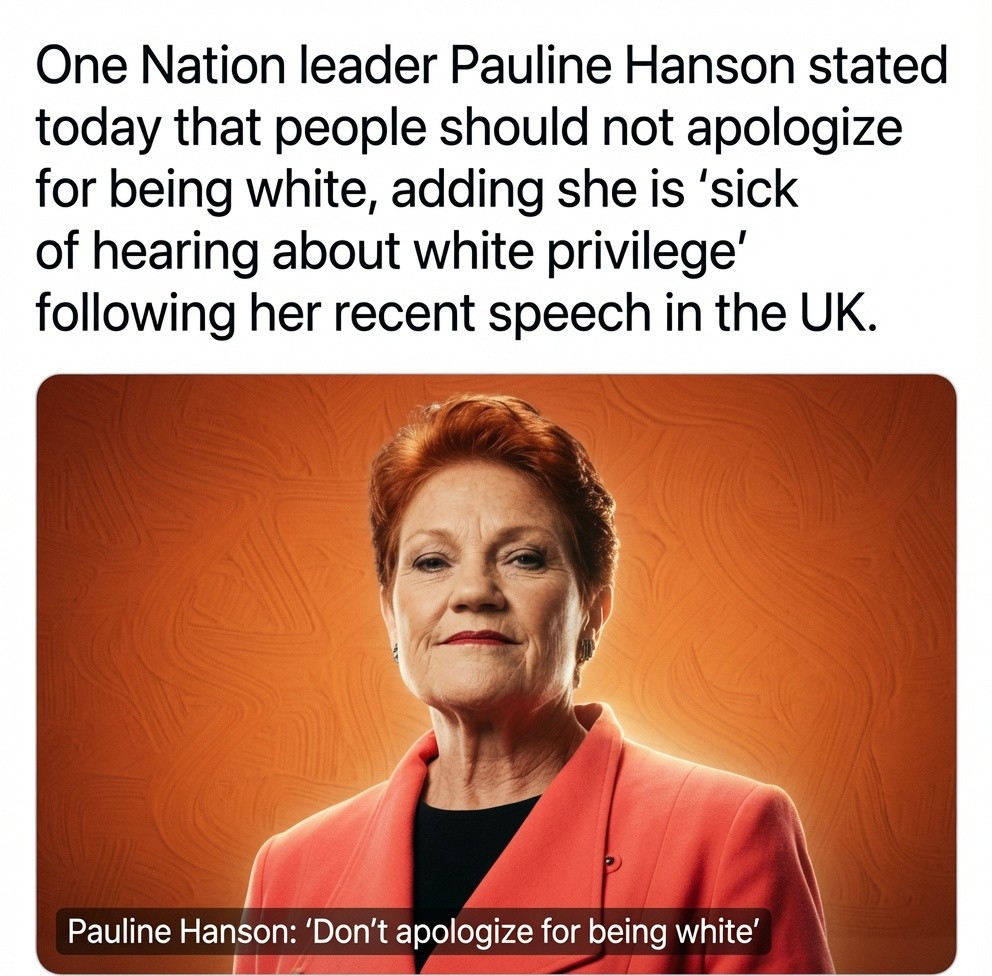
One Nation leader Pauline Hanson has reignited one of Australia’s most divisive political debates after telling a conservative conference in London that people should “not apologise for being white” and declaring she was “sick of hearing about white privilege”.
The remarks were delivered during the inaugural Conservative Political Action Conference (CPAC) Great Britain, where Hanson used her speech to criticise multiculturalism, mass immigration, progressive identity politics and what she described as the spread of “woke” ideology throughout Western democracies.
Speaking to conference attendees, Hanson argued Australians should reject what she described as a culture of guilt based on race.
“Do not apologise for being white. I’m sick of hearing about white privilege,” Hanson said, adding that people should learn from history without “repeating it in reverse”.
The comments have attracted significant political attention in Australia because they come only days after Hanson generated further controversy during a separate interview in Britain discussing immigration, multiculturalism and Australia’s former White Australia policy.
Her latest speech forms part of a broader European tour that has included appearances alongside prominent conservative figures, a meeting with Reform UK leader Nigel Farage and an interview with British anti-immigration activist Tommy Robinson.
Throughout her address, Hanson argued that Australia and Britain face similar challenges arising from high migration levels, claiming she could already see changes occurring in Australian communities that reminded her of parts of London.
She suggested Britain provided a warning for Australia’s future, saying the country was several years ahead in experiencing the social consequences of rapid demographic change.
Immigration has remained the central theme of Hanson’s overseas appearances. She argued infrastructure, housing and public services have struggled to keep pace with population growth while maintaining that Australia’s cultural identity is under increasing pressure.
Her criticism extended beyond immigration to gender identity issues and progressive social policies, with Hanson accusing governments of embracing ideological agendas that she believes conflict with traditional values.
The speech also revived discussion surrounding the concept of “white privilege” — a term commonly used in academic, social and political discussions to describe societal advantages that some researchers argue are associated with being identified as white in certain historical and institutional contexts.
Supporters of the concept argue it examines structural inequalities rather than individual behaviour, while critics contend it unfairly assigns collective responsibility based on race and fuels social division. The phrase has become an increasingly polarising issue in political debates across Australia, the United Kingdom and the United States.
Hanson firmly rejected the concept, arguing that modern societies should judge people as individuals rather than through racial categories.
Her supporters have welcomed that position, while critics argue the comments dismiss ongoing discussions about racial inequality and discrimination.
The London speech followed widespread reporting on Hanson’s appearance on Tommy Robinson’s podcast earlier in the week, during which she criticised Australia’s immigration policies and discussed the historical White Australia policy.
That interview prompted criticism from political opponents after Hanson suggested ending the White Australia policy had contributed to Australia’s migration challenges. She later released a video insisting she has never advocated reinstating the policy and rejecting claims she supported a return to it.
Prime Minister Anthony Albanese has been among those criticising Hanson’s overseas comments, accusing the One Nation leader of undermining Australia’s social cohesion while travelling abroad.
Government ministers have also questioned Hanson’s decision to spend an extended period overseas participating in political events while making critical remarks about Australia.
The controversy has unfolded against a backdrop of renewed political debate over migration, housing affordability and cost-of-living pressures.
Immigration has become one of Australia’s most politically contested issues following several years of elevated net overseas migration after the COVID-19 pandemic, with both major parties facing pressure over housing shortages, infrastructure demand and labour market needs.
One Nation has consistently argued migration levels should be significantly reduced, positioning the issue as central to its electoral platform.
The party has also campaigned for stricter border controls, stronger cultural integration and tighter visa settings, arguing these measures are necessary to preserve Australia’s national identity and improve housing affordability.
Opponents argue such policies risk inflaming racial tensions and oversimplifying complex economic challenges that involve housing supply, planning systems, infrastructure investment and workforce shortages.
Political analysts note that debates surrounding immigration have become increasingly prominent across many Western democracies, particularly as governments grapple with slowing economic growth, demographic ageing and rising housing costs.
Britain has experienced similar political divisions in recent years, making CPAC London an appropriate platform for speakers advocating tougher immigration policies.
Hanson was among several international conservative figures addressing the conference, alongside politicians and commentators promoting nationalist and anti-globalisation themes.
Her appearance also attracted attention because footage from the event suggested attendance was relatively modest compared with larger CPAC gatherings held in the United States, although organisers promoted the conference as the beginning of a broader conservative movement in Britain.
For Hanson, the speech represents another chapter in a political career that has frequently centred on debates about immigration, national identity and multiculturalism since she first entered federal politics in the 1990s.
Those issues remain defining features of One Nation’s political brand and continue to generate both strong support and strong opposition.
Whether Hanson’s latest remarks strengthen her standing with voters or deepen criticism from opponents is likely to become clearer as Australia’s political debate over immigration and national identity continues in the months ahead.






