Deniliquin is feeling the wider economic impact of a cut to rice processing after SunRice shed 68 jobs at its local mill, a significant loss for a regional town of roughly 7,500 people.
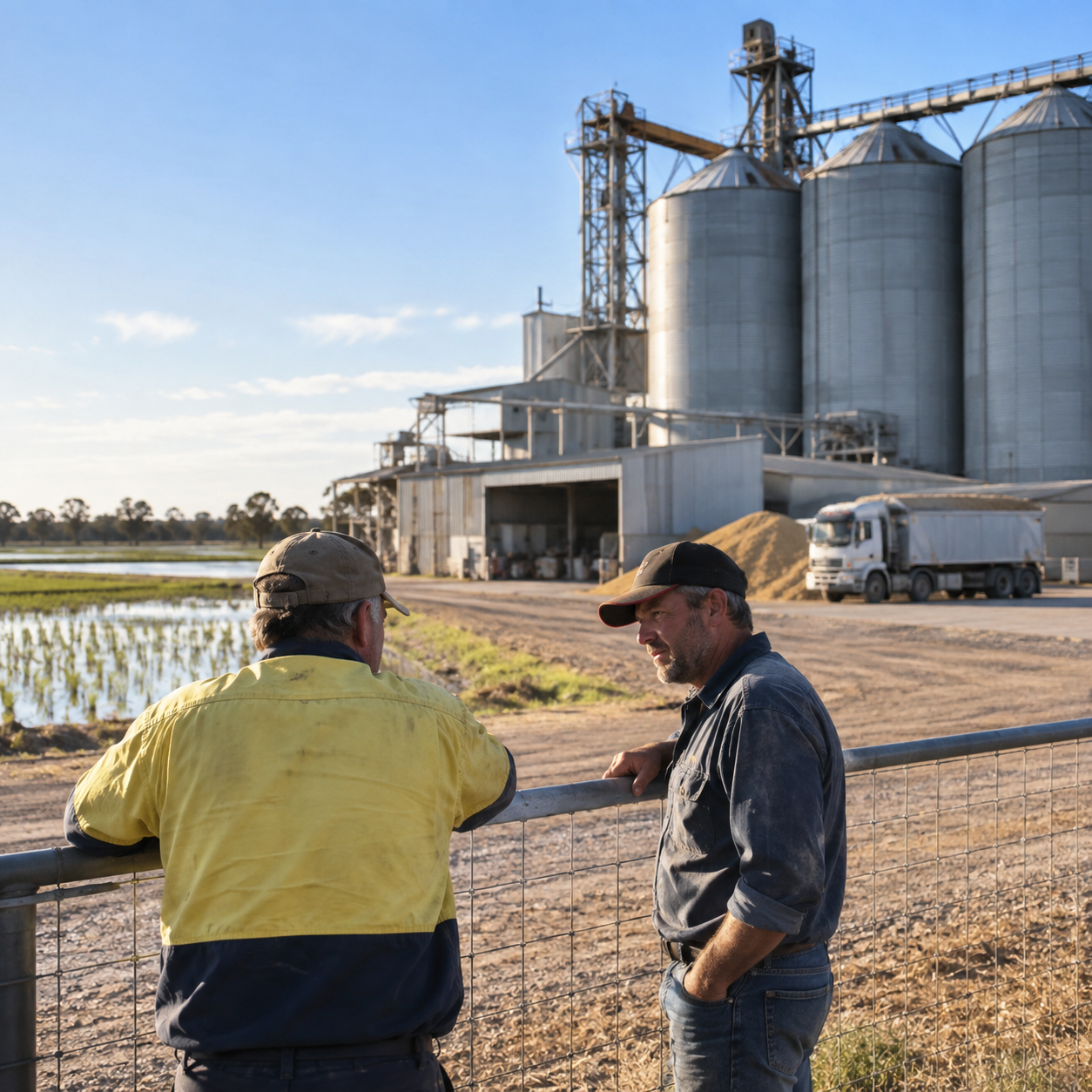
The redundancies were part of a broader reduction in milling activity in southern New South Wales. Another 10 jobs were lost at Leeton, while some employees were redeployed.
SunRice says the decision reflects lower rice production caused by dry seasonal conditions and reduced water availability, including the effect it attributes to government water buybacks in the Murray-Darling Basin.
Those claims form part of a wider and contested water-policy debate. Environmental water purchases are intended to improve river and wetland health, while irrigators and regional businesses argue that reduced consumptive water availability can raise costs and lower production in water-intensive industries.
For Deniliquin, the immediate issue is employment. Sixty-eight jobs represents a meaningful shock in a small labour market where one major employer can support not only its own workforce but contractors, transport operators, shops, landlords and service providers.
Local welfare organisations say the effects are already visible. Some households are struggling with rent and other bills while looking for new work or waiting for government support.
Housing can make the adjustment harder. Regional towns often have fewer rental properties and fewer alternative jobs than capital cities, so losing a stable industrial position can leave workers with difficult choices about retraining, commuting or relocating.
The rice industry has long been central to the Riverina economy. Milling and storage infrastructure links growers, trucking, engineering, machinery maintenance, packaging and food manufacturing.
SunRice’s Deniliquin site has been one of the region’s major processing facilities, and the company’s own harvest information shows the Deniliquin depot was closed for the 2026 season after receiving arrangements were completed.
Rice production is particularly sensitive to water availability because growers decide each season whether rice is financially competitive with other crops given water prices, allocations and seasonal conditions.
When less rice is planted, the effect eventually reaches mills. A facility designed for large volumes becomes more expensive to operate per tonne when the crop is smaller, which can lead companies to consolidate shifts or processing into fewer locations.
SunRice has said lower crop volumes are the reason for the current reduction. It also argues that environmental water buybacks reduce the amount of irrigation water available to agriculture and contribute to higher water prices.
That interpretation is disputed by some environmental and water-policy advocates, who argue the Murray-Darling Basin needs sufficient environmental flows to maintain river health and long-term agricultural sustainability.
The policy question is therefore not simply whether water should go to farms or the environment. Governments have to balance ecological targets, community impacts, agricultural production and the efficiency of water markets.
For workers who have already lost jobs, however, that long-term debate does not solve the immediate problem of income replacement.
The federal government says it is working with the NSW government, the United Workers Union and the local community on support for affected workers.
Practical assistance can include employment services, training, income support and help connecting workers with vacancies in nearby industries, but the value of those measures depends on whether suitable jobs exist within realistic travelling distance.
Some skills from food processing and milling are transferable to warehousing, manufacturing, agriculture and logistics. But wage levels, shift structures and job security can differ, and older workers may face a harder transition after many years with one employer.
The flow-on effect also matters for local businesses. When dozens of households suddenly reduce discretionary spending, the impact can spread to retailers, trades, hospitality and community organisations.
That makes the SunRice decision more than a single-company workforce story. It is a test of how a regional town absorbs a sudden industrial contraction while the underlying agricultural sector is also dealing with drought risk and contested water policy.
Current forecasts cited by the ABC suggest rice production could fall further this summer, which would keep pressure on processing volumes if seasonal conditions do not improve.
Any forecast can change with rainfall, water allocations and planting decisions, so it should not be treated as a guaranteed outcome.
The key facts today are narrower: 68 jobs have been lost at Deniliquin, SunRice attributes the cut to lower rice production, and the community is already reporting financial and social consequences.
The scale of the cut is clearer when the broader Riverina restructuring is included. SunRice removed 68 positions in Deniliquin and 10 in Leeton, while another 13 employees were redeployed. For a large metropolitan labour market those numbers might be absorbed more easily; for a town of 7,500, they are highly visible.
Deniliquin’s mill is a major piece of regional infrastructure, and the local rice industry supports far more jobs than the people directly employed on a production line. Growers buy machinery, fuel and agronomy services; harvested rice needs transport and storage; mills use maintenance contractors, electricians, packaging suppliers and logistics businesses.
That is why local welfare agencies expect the effect to spread. Vinnies staff told the ABC that some households were already struggling to cover rent while looking for another job or waiting for government payments, against a backdrop of limited affordable housing.
There are also family-level effects when employment is concentrated in one industry. The ABC reported cases in which one member of a household retained a job at the mill while another was made redundant. That can soften the immediate income loss but also creates uncertainty about whether further reductions might follow.
The production outlook is central to that concern. Current reporting cites a forecast 22 per cent fall in rice production this summer. If realised, that would reduce the amount of local grain available to keep milling shifts operating, although the final crop will still depend on rainfall, water allocations, planting decisions and market prices.
SunRice chief executive Paul Serra has linked the lower crop to both dry seasonal conditions and government water recovery. He argues that a smaller pool of irrigation water raises water prices and makes crops such as rice less economical in some seasons.
The Commonwealth’s position is that water purchases are one tool used to meet the Murray-Darling Basin Plan’s environmental recovery targets. The Department of Climate Change, Energy, the Environment and Water says current purchase programs are governed by procurement and water-market transparency rules and are intended to recover water for environmental outcomes.
The federal framework also recognises that purchases can have community consequences. Under the Water Act, the minister is required to consider socio-economic impacts when water is purchased, and the government’s Restoring Our Rivers program explicitly includes regional effects in its decision-making framework.
That does not settle the disagreement over impact. A voluntary water purchase may make financial sense for the individual entitlement holder who sells, while businesses elsewhere in the irrigation economy can still argue that a lower pool of productive water affects local activity over time.
Environmental advocates make the counter-case that insufficient river flows also impose economic costs through degraded wetlands, salinity, fish kills, declining ecosystem health and greater vulnerability during drought. The Basin Plan is intended to balance long-term environmental sustainability with consumptive use across multiple states.
For Deniliquin, those national arguments become concrete when a milling shift disappears. The community is not debating water policy in the abstract; it is dealing with fewer pay packets circulating through local shops and service businesses.
Retraining programs can help, but regional labour markets impose practical limits. A worker with decades of milling experience may be able to transfer skills to warehousing, logistics or manufacturing, yet the nearest comparable vacancy may be far enough away to require a long commute or relocation.
Relocation creates another cost for the town because families who leave take school enrolments, retail spending, sporting participation and volunteer capacity with them. That is why regional leaders often focus on replacing stable full-time jobs rather than only counting how many people eventually leave the unemployment register.
The government response will be judged on whether support produces viable local options. Coordination with NSW agencies, the union and the community can identify training and vacancies, but the outcome will depend on actual employers investing or hiring in the district.
The next rice season will also matter. If production rebounds, processing demand could improve; if the crop contracts as forecast, pressure on the existing operating model may continue.
The current evidence supports a careful conclusion: drought, irrigation economics and government water recovery are all part of the argument around the mill cuts, but the exact contribution of each factor is contested. The job losses themselves are not contested, and their effect is already being felt across Deniliquin.
What happens next will depend on water availability, the size of future crops, whether processing demand recovers and how quickly displaced workers can find stable alternatives in or around the region.