Australian Olympic icon Dawn Fraser has sharply criticised Prime Minister Anthony Albanese for not publicly condemning the ABC following the broadcaster’s controversial Race Around the World segment depicting graphic satirical violence involving mining executive Gina Rinehart.
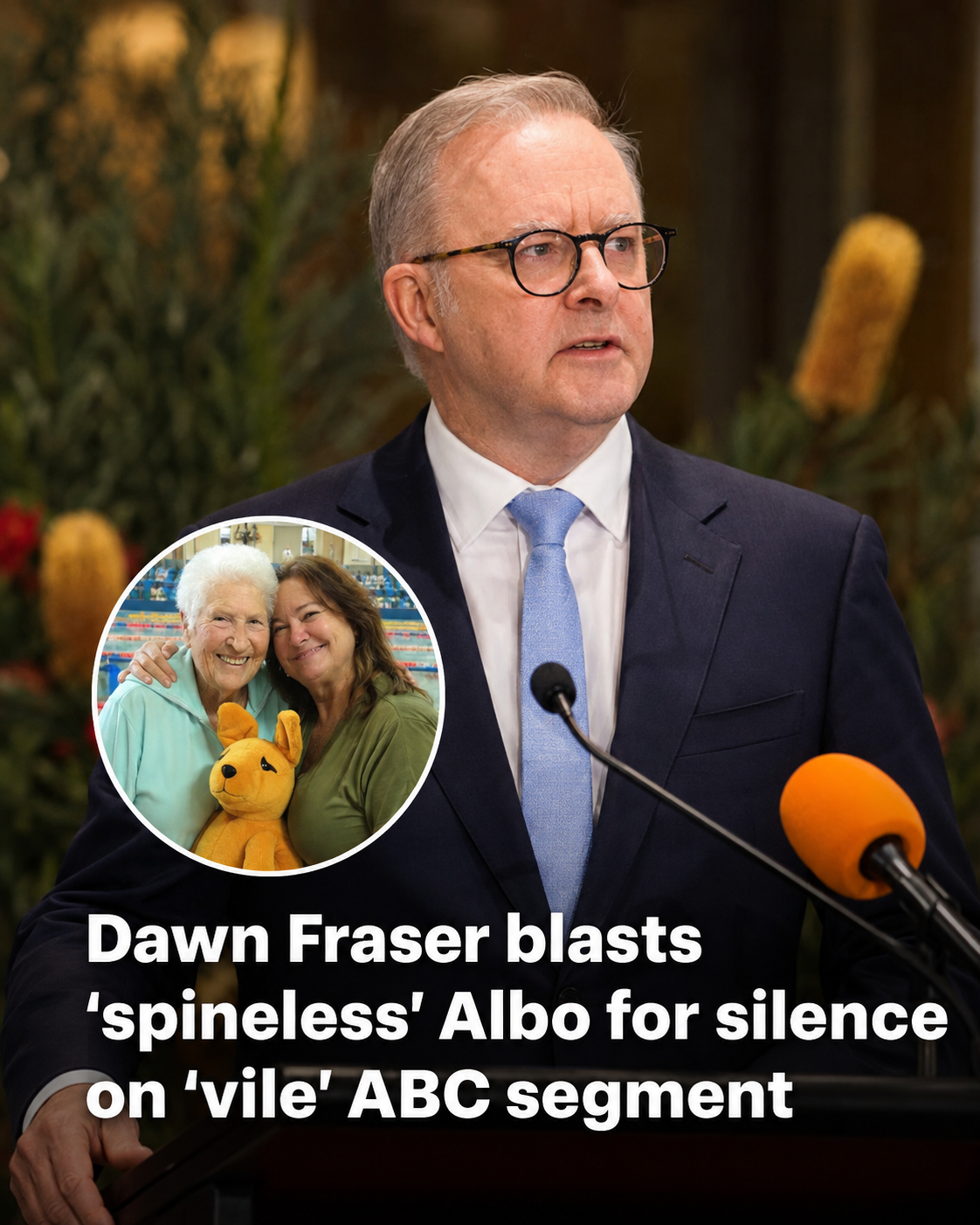
Writing on Facebook, Fraser accused both the national broadcaster and the Prime Minister of failing to stand against content she regarded as deeply offensive.
“I am sick to my stomach to think we have a government-funded network showing vile pieces to air about one of Australia’s greatest supporters, Gina Rinehart, and our vile Prime Minister has not come out and condemned the content,” Fraser wrote.
She went on to describe Mr Albanese as a “spineless imbecile” and criticised what she characterised as his silence over the broadcast.
Fraser’s comments were made after the ABC aired a four-minute satirical film as part of its Race Around the World series on 12 July.
The segment, created by filmmaker Kate McGuinness, concluded with graphic fictional references to violence directed at Gina Rinehart, prompting widespread criticism from politicians, business leaders and public figures.
Hancock Prospecting, chaired by Ms Rinehart, subsequently demanded that the ABC remove the segment, issue a public apology and investigate how it passed editorial approval.
After receiving no substantive response that satisfied the company, Hancock Prospecting commenced legal action against the broadcaster, alleging the publication breached Australian law. The ABC has confirmed it received the legal correspondence and has referred complaints to its independent Ombudsman for review.
The controversy has generated political debate well beyond the legal dispute.
Communications Minister Anika Wells has described the broadcast as “unacceptable” in her personal view but has declined to direct the ABC to apologise, emphasising that the broadcaster’s editorial independence must be respected while the Ombudsman’s investigation proceeds.
Health Minister Mark Butler has also criticised the segment, describing it as “revolting” and questioning why Australians should see such material on television.
At the same time, Butler likewise supported allowing the ABC’s internal review process to continue independently before any further decisions are made.
Prime Minister Albanese has not issued a separate public statement specifically condemning the program.
That absence of direct comment has become a focal point for critics including Fraser, who argue Australia’s national leaders should publicly denounce material depicting violence against identifiable individuals regardless of political views.
Supporters of the government’s approach counter that ministers have already expressed concern while avoiding direct intervention in the ABC’s editorial processes, consistent with the longstanding convention that Australia’s public broadcaster operates independently of government direction.
The ABC has stated that the film was intended as satire and has declined further public comment while the Ombudsman examines complaints.
Filmmaker Kate McGuinness has separately apologised to people offended by the segment, saying her work was intended to be absurd and farcical rather than an endorsement of violence.
However, Hancock Prospecting maintains that neither the filmmaker’s apology nor the broadcaster’s response adequately addresses the seriousness of the broadcast.
Fraser’s intervention has attracted attention because of her longstanding status as one of Australia’s most celebrated sporting figures.
A four-time Olympic gold medallist and one of the nation’s most recognisable athletes, she has maintained a long association with Australian swimming and has previously appeared alongside Gina Rinehart at events supporting elite athletes, although her criticism focused on the ABC broadcast and the Prime Minister’s response rather than broader political issues.
The dispute has also reignited discussion about the limits of satire on publicly funded media.
Supporters of artistic freedom argue satire has long played an important role in political and social commentary.
Critics contend that explicit depictions of violence against identifiable individuals cross an important editorial line, particularly when broadcast by a taxpayer-funded national broadcaster.
The Ombudsman’s review is expected to assess whether the program complied with the ABC’s Editorial Policies.
Separately, the Australian Communications and Media Authority (ACMA) has indicated it will await the outcome of the ABC’s internal complaints process before considering whether any regulatory action is warranted.
For the Albanese Government, the controversy has highlighted the delicate balance between respecting the independence of Australia’s national broadcaster and responding to public concern over controversial programming.
For critics such as Dawn Fraser, however, the issue extends beyond editorial policy to political leadership.
Whether the Prime Minister should have spoken out more forcefully remains a matter of political opinion, but Fraser’s intervention has ensured the debate over the ABC’s handling of the broadcast—and the government’s response to it—continues to attract national attention while legal and internal review processes remain ongoing.






