David Wenham had to steady himself as he tried to explain what Sam Neill had meant to him.
The Australian actor was speaking to the ABC about his late friend, a man he remembered as kind, cheeky and unfailingly supportive, when the emotion of the past few days became impossible to hide.
Neill had died suddenly in Sydney on Monday, July 13, aged 78.
Wenham had seen him only weeks earlier.
At the time, there was no sense that the meeting would become a final memory.
Wenham believed his friend had more years ahead of him.
Now, looking back, the significance of that encounter had completely changed.
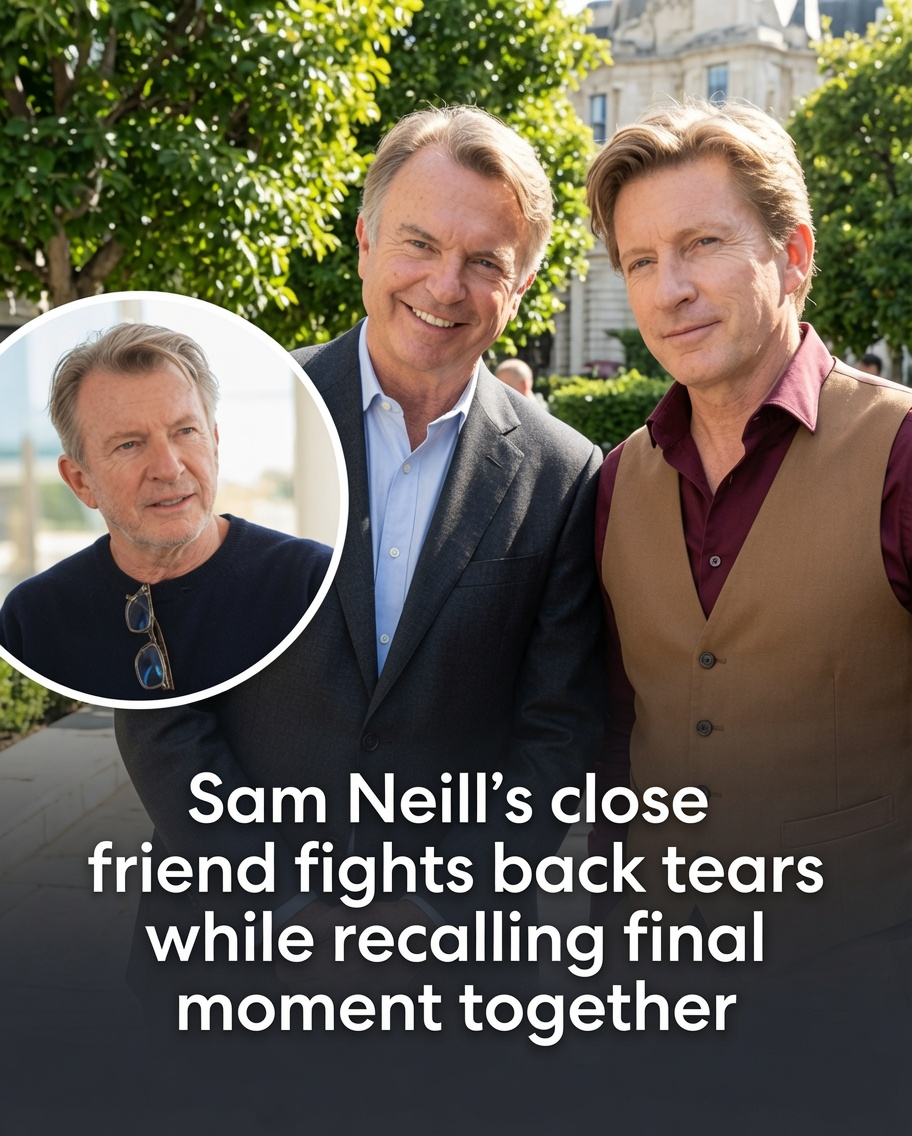
They had been given one last chance to spend time together.
It was the sort of realisation that can make even a veteran performer struggle for words.
Wenham, known internationally for roles in The Lord of the Rings films and at home for a long career across Australian film, television and theatre, was visibly moved as he remembered Neill during an ABC interview.
His grief was personal rather than ceremonial.
This was not simply one actor paying tribute to another famous performer.
Wenham was remembering a friend.
He thought Sam Neill had much more time
The shock surrounding Neill’s death has been intensified by its timing.
Earlier this year, the Jurassic Park star had publicly shared extraordinary news about his health.
After years of treatment for stage three angioimmunoblastic T-cell lymphoma, a rare form of blood cancer, Neill said a scan had found no cancer in his body.
His previous chemotherapy treatment had stopped working.
He subsequently received CAR T-cell therapy through an Australian clinical trial.
In April, Neill was openly delighted by the result.
For friends, colleagues and fans who had followed his cancer story, the news appeared to offer hope that another frightening chapter had passed.
Wenham’s recollection reflects that optimism.
He told the ABC he had thought Neill still had many more years ahead of him.
That expectation makes their recent meeting harder to process.
There was no carefully planned farewell.
No knowledge that every word needed to carry the weight of a final conversation.
They were simply two friends spending time together.
Only afterwards did it become something else.
One of the final memories Wenham would have of a man he deeply admired.
Neill’s family said his death was “sudden and unexpected”.
They also emphasised that he remained cancer-free.
He died in Sydney surrounded by family and, in their words, with the dignity that had characterised his whole life.
The family expressed its gratitude to the team at St Vincent’s Private Hospital for caring for him.
The precise cause of Neill’s death has not been officially announced by his family.
That distinction is important because his recent cancer history has inevitably shaped public discussion of his death.
But the family’s statement was explicit: Neill remained cancer-free.
Wenham remembered a ‘truly good man’
In the days since Neill’s death, the same qualities have appeared repeatedly in tributes from people who knew him.
Kind.
Funny.
Generous.
Dryly witty.
Supportive.
Completely down to earth.
Wenham described his friend as a truly good man who looked for the good in other people.
It is a deceptively simple tribute.
Actors are often remembered publicly through their most famous characters.
For Neill, that means Dr Alan Grant.
The hat.
The rain.
The first stunned sight of a living dinosaur in Steven Spielberg’s Jurassic Park.
For another audience, it is his work in The Piano, Dead Calm, My Brilliant Career, The Hunt for Red October or Peaky Blinders.
His career stretched across more than five decades and connected the New Zealand and Australian screen industries with Hollywood.
Yet the people who actually worked with him have spent remarkably little time talking about box office figures or celebrity.
They keep talking about the man.
Wenham’s words fit that pattern.
His public tribute to Neill described him as the kindest, cheekiest, most generous and supportive friend.
Speaking to the ABC, he again returned to Neill’s character.
For Wenham, the quality that mattered was not simply that Neill was a great actor. It was that he was a good person.
Steven Spielberg saw the same man behind Dr Alan Grant
Steven Spielberg’s tribute offered an unusually revealing insight into the distance between Sam Neill and his most famous character.
Spielberg directed Neill as palaeontologist Dr Alan Grant in the original Jurassic Park.
Grant begins the film distinctly uncomfortable around children.
According to Spielberg, that quality required Neill to stretch as an actor because it was so far removed from the person he knew.
The filmmaker remembered Neill as a loving father and said the actor was exceptionally collaborative in creating Grant.
Spielberg also spoke of the enduring “Jurassic family” formed by Neill, Laura Dern and Jeff Goldblum.
For millions of viewers, the trio are permanently connected through one of the most influential blockbusters in cinema history.
For the actors themselves, the relationship lasted long after filming.
Dern called Neill her beloved lifetime friend.
She remembered his loyalty, protectiveness and love, always accompanied by the driest wit.
Goldblum shared a photograph of the three together on the Jurassic Park set.
These were not distant professional acknowledgements issued because a famous co-star had died.
They were messages from people mourning someone who had remained in their lives for decades.
Nicole Kidman met him when she was just 18
Nicole Kidman’s tribute carried another version of the same story.
Kidman worked with Neill on the 1989 psychological thriller Dead Calm.
She was only 18 when they met.
Neill was already an established actor.
Kidman said he took her under his wing and that they remained friends for life.
She remembered him as charming, kind, funny and intelligent.
It is difficult to miss the pattern.
Wenham remembered a supportive friend.
Kidman remembered an older actor who helped her at the beginning of her career.
Dern remembered loyalty and protection.
Spielberg remembered a collaborative performer and loving father.
Jimmy Barnes remembered food, wine, laughter and long conversations at Neill’s winery.
The tributes describe different relationships, but remarkably similar versions of Sam Neill.
That consistency helps explain the extraordinary reaction to his death across Australia, New Zealand and the international film industry.
Neill was a globally recognised actor.
But he was not remembered as someone consumed by his own fame.
Even after Jurassic Park turned Dr Alan Grant into one of cinema’s most recognisable characters, Neill maintained a public persona that was often gently self-mocking.
He appeared far more comfortable talking about animals, wine and the absurdities of acting than presenting himself as a Hollywood legend.
His farm became part of the Sam Neill people felt they knew
Away from film sets, Neill found a different life in Central Otago.
His Two Paddocks winery and farm became an important part of his public identity.
Fans followed his posts about pigs, ducks and other animals.
He named animals after famous friends and colleagues.
The humour was understated and unmistakably his.
ABC’s Life Matters remembered Neill as a man who found his greatest peace on his beloved New Zealand farm.
It was a striking contrast with the scale of his screen career.
This was an actor who had worked with some of the biggest directors and stars in the world.
He had appeared in blockbusters, prestige dramas and television series watched by global audiences.
Yet the image many people carried of Neill in his later years was of a man outdoors in New Zealand, surrounded by animals and apparently amused by almost everything.
That informality made him unusually accessible for a star of his stature.
His social media presence did not feel like a carefully managed celebrity brand.
It often felt like Sam Neill had simply found another place to tell a story or make himself laugh.
Wenham’s description of him as cheeky makes immediate sense to anyone who followed that side of his life.
Cancer forced Neill to confront death, but he refused to let it become his identity
Neill first publicly revealed his blood cancer diagnosis in 2023 while discussing his memoir, Did I Ever Tell You This?
He had noticed swollen glands while promoting Jurassic World Dominion in 2022.
Doctors diagnosed stage three angioimmunoblastic T-cell lymphoma.
The disease was serious.
Treatment became part of his life.
But Neill repeatedly resisted being reduced to a cancer story.
He was far more interested in acting, family, friends, his farm and whatever project came next.
The thought of retirement horrified him.
When one treatment stopped working, Neill entered a clinical trial and underwent CAR T-cell therapy.
The result he announced in April 2026 was extraordinary.
His scan showed no cancer.
Neill used the moment not only to celebrate but to advocate for wider access to the treatment for blood cancer patients in Australia and New Zealand.
That context makes the shock expressed by Wenham easier to understand.
His friend had fought through years of cancer treatment.
He had recently received remarkable news.
He was still working.
He was still appearing in public.
Then, suddenly, he was gone.
The final meeting was ordinary — until it wasn’t
Grief has a way of changing the meaning of recent memories.
A conversation that seemed routine becomes the last conversation.
A meal becomes the last meal.
A goodbye that carried no special significance becomes the final goodbye.
That is what made Wenham’s recollection so affecting.
He and Neill had managed to see each other only a few weeks before the actor’s death.
Wenham could not have known the opportunity was closing.
Neither man appears to have treated the meeting as a farewell.
There is something painful in that.
There is also something comforting.
They did see each other.
They had that time.
Wenham did not have to remember a meeting repeatedly postponed until it was too late.
He had a final encounter with his friend, even if he understood its significance only afterwards.
That “last chance” is now part of the memory he carries.
For many people who have lost someone suddenly, the experience is instantly recognisable.
The mind returns to the last meeting and searches it.
What did they say?
How did the person look?
Was there anything unusual?
Could anyone have known?
Often, the answer is no.
Life did not announce that the moment was important.
Its importance arrived later.
Neill’s death has united two countries that both considered him their own
Sam Neill’s identity never fitted neatly inside a single national box.
He was born in Northern Ireland and raised in New Zealand.
His career was deeply connected to Australian cinema.
He became an international star.
Australia and New Zealand both claimed him with affection.
Political leaders from both countries paid tribute after his death.
Australian Prime Minister Anthony Albanese remembered Neill as a national treasure and a familiar presence across generations of screen work.
New Zealand leaders reflected on a man whose contribution extended beyond acting into the cultural life of the country.
His filmography explains part of that connection.
My Brilliant Career placed him inside a defining work of Australian cinema.
Dead Calm connected him with a young Nicole Kidman.
The Piano became an internationally acclaimed New Zealand story.
Jurassic Park made him globally famous.
Peaky Blinders introduced him to another generation of viewers.
But the reaction to his death suggests audiences felt something beyond familiarity with his roles.
People liked Sam Neill.
They liked the dry humour.
They liked the apparent absence of Hollywood self-importance.
They liked the animals.
They liked the wine.
They liked the sense that the man playing one of cinema’s most famous palaeontologists was probably more interested in a good conversation than being recognised.
David Wenham’s tears explain why the tributes feel different
Celebrity deaths often produce an immediate wave of public statements.
There are career summaries.
Photographs from red carpets.
Clips from famous films.
Colleagues issue tributes.
Within days, attention moves elsewhere.
The reaction to Neill has contained all the expected elements.
But the words chosen by his friends have been unusually personal.
They are not simply saying he was talented.
They are saying he was kind.
They are saying he helped them.
They are saying he made them laugh.
They are remembering meals and wine.
They are remembering loyalty.
They are remembering friendship.
Wenham’s difficulty holding back tears gave those tributes a human centre.
He did not need to explain Sam Neill’s place in film history.
Millions of people already know Dr Alan Grant.
Wenham was trying to explain the person behind the roles.
A kind, cheeky and supportive friend.
A man who looked for good in others.
A man Wenham expected to know for years longer.
And a friend he was fortunate enough to see one final time, only weeks before a death nobody around him appeared ready for.
Sam Neill spent more than five decades creating characters audiences will continue to watch.
But as his closest friends say goodbye, his greatest legacy may be found in the striking similarity of their memories.
The films are different.
The countries are different.
The friendships began at different points across a remarkable career.
Yet again and again, the same Sam Neill emerges.
Funny.
Generous.
Loyal.
Supportive.
Good.
David Wenham thought his friend had many more years left. The pain in his voice made clear just how much those missing years will now be felt.






