NSW Premier Chris Minns has delivered one of his strongest retrospective criticisms of the handling of Sydney’s controversial October 2023 pro-Palestinian protest, saying the policing strategy that allowed demonstrators to continue from Town Hall to the Sydney Opera House was “bullshit” and had taught him a “bitter lesson”.
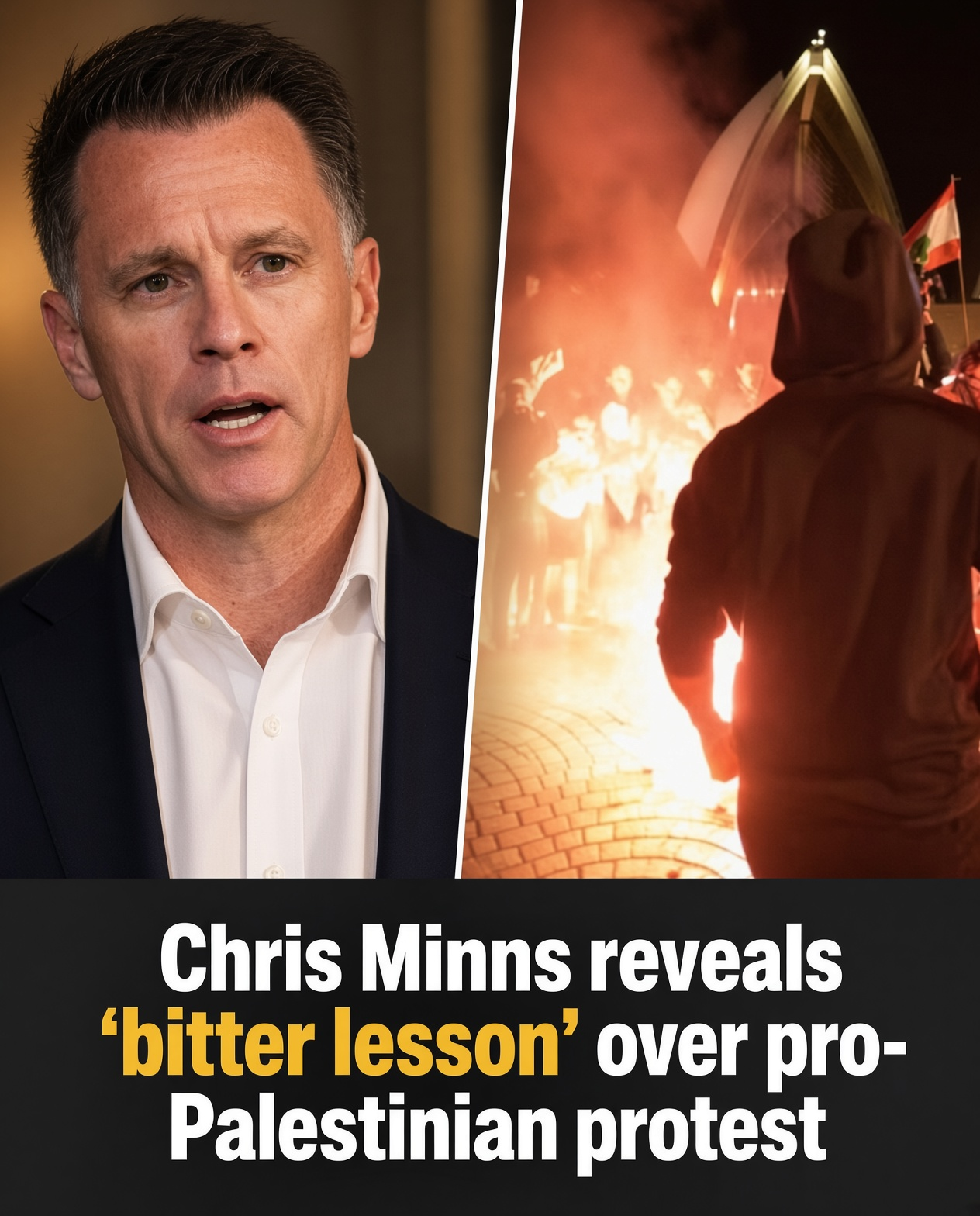
Minns made the remarks in an interview for the forthcoming book Bondi Terror, revisiting the events of October 9, 2023, when hundreds of protesters moved through central Sydney towards the Opera House just two days after the Hamas attacks in Israel.
The Premier said he had accepted advice from police that allowing the group to move through the city was a way of managing the crowd without unnecessarily escalating tensions.
His description of that approach more than two years later was emphatic.
“It’s bullshit. It doesn’t work,” Minns said, arguing that allowing an angry crowd to continue marching did not necessarily calm participants or reduce hostility.
He also described himself at the time as a “baby Premier”, saying he was still relatively new in the job and had relied heavily on the advice being provided to him by experienced law-enforcement officials.
The comment is likely to reignite debate over one of the most politically charged nights of Minns’ premiership and over how governments should balance public safety, freedom of assembly and the risk of community tensions during highly emotional international events.
Minns says he accepted police advice
According to Minns’ account, the advice he received was based on a long-standing crowd-management philosophy: police could reduce the risk of confrontation by allowing demonstrators to continue moving for a limited distance rather than attempting to stop them abruptly.
The theory, as Minns described it, was that protesters could release some of their anger, avoid a direct confrontation with police and eventually disperse.
He now says he believes that assumption was wrong.
Minns argued that the march did not simply dissipate harmlessly. Instead, he said the atmosphere became increasingly hostile as the group moved towards the Opera House, where offensive and antisemitic language was heard among sections of the crowd.
For the Premier, that night appears to have become a defining moment in his thinking about protest management. He said the experience influenced the government’s subsequent approach towards demonstrations where authorities believed there was a serious risk of intimidation, disorder or community conflict.
It is also important to understand what Minns meant when he called himself a “baby Premier”. He had been sworn in as the 47th Premier of New South Wales on March 28, 2023, after Labor’s state election victory. The Opera House protest took place on October 9, meaning he had been Premier for a little more than six months.
His latest comments therefore amount not only to criticism of the strategy used that evening, but also to an admission that he did not challenge the operational advice as forcefully as he now believes he should have.
A night that immediately became a national controversy
The October 9 protest occurred in an extraordinarily tense atmosphere.
The NSW Government had arranged for the sails of the Sydney Opera House to be illuminated in blue and white in solidarity with Israel following the October 7 Hamas attacks. At the same time, pro-Palestinian demonstrators gathered at Town Hall before moving towards the harbour.
The rally included Palestinian flags, flares and loud chanting. Images from the Opera House forecourt quickly spread around Australia and internationally, generating intense political condemnation and fear within parts of Sydney’s Jewish community.
On the following morning, Minns described the scenes as “abhorrent” and said Jewish people in New South Wales had every right to expect to be safe in their own city.
NSW Police subsequently established Strike Force Mealing to investigate alleged offences connected with the protest and the movement of demonstrators between Town Hall and the Opera House.
Parliamentary records also show that police deployed 110 resources to the October 9 gathering. Later demonstrations attracted significantly larger police operations, with some subsequent Sydney protests involving more than 1,000 police resources.
The events rapidly became a political test for the newly elected Minns government. Opposition MPs questioned why the protest had been allowed to reach the Opera House and whether authorities had adequately protected members of the Jewish community.
Police said at the time that their operational priority had been public safety and crowd management.
What police later established about the chants
One of the most important factual developments came several months after the protest and remains essential to any accurate account of the night.
Videos circulating immediately after the rally were widely presented as showing participants chanting “gas the Jews”. That claim was repeated internationally and became one of the most disturbing allegations associated with the event.
However, in February 2024, NSW Police said forensic examination of significant amounts of audio and video material had found no evidence that the phrase was captured in the recordings.
An independent expert engaged by police concluded with what Deputy Commissioner Mal Lanyon described as overwhelming certainty that the words recorded in the relevant footage were “where’s the Jews”, rather than the phrase originally reported.
Police also said they had obtained witness statements from people who said they heard the more extreme phrase at the protest, but investigators were unable to attribute those accounts to a particular individual.
That finding did not mean the event was free of antisemitic abuse. Police said other offensive and unacceptable statements were present, and footage documented hostile language directed towards Jewish people.
The distinction matters because the October 9 rally has often been discussed through competing political narratives. Accurately separating what was recorded, what witnesses later reported and what investigators were able to establish is essential when revisiting the event.
From caution to a tougher protest stance
Minns’ latest comments also help explain the evolution of his government’s approach to public demonstrations.
In his telling, the Opera House experience convinced him that simply allowing a volatile demonstration additional space in the hope that tensions would naturally subside could have the opposite effect.
Over the following years, Minns increasingly positioned his government in favour of stronger police powers and tighter limits in circumstances where officials believed demonstrations could threaten public order or community safety.
That approach eventually produced a major constitutional confrontation.
Following the December 2025 Bondi Beach terrorist attack, the NSW Parliament was recalled for an emergency sitting on Christmas Eve and passed legislation expanding police powers to restrict authorised public assemblies in designated areas.
The Police Commissioner subsequently used those powers to restrict protests across Greater Sydney, with declarations later narrowed to parts of the CBD and eastern suburbs.
The laws remained controversial from the moment they were introduced. Civil liberties groups and protest organisations argued that the measures placed an excessive burden on political communication and peaceful assembly.
In April 2026, the NSW Court of Appeal ruled the expanded provisions unconstitutional. The court found they impermissibly burdened the implied constitutional freedom of political communication.
Minns nevertheless defended the government’s decision, arguing that the measures had been introduced during an exceptional period of community fear and heightened tensions following the Bondi terrorist attack.
His newly revealed reflections on October 2023 show that the government’s later protest policies were not formed in isolation. For Minns personally, the Opera House protest appears to have been an early turning point.
The political debate is far from settled
Supporters of a tougher approach are likely to see Minns’ admission as confirmation that authorities were too cautious on October 9 and should have acted earlier to prevent an angry crowd from reaching one of Australia’s most recognisable public landmarks.
Critics will draw a different conclusion. Civil liberties advocates have repeatedly argued that governments should not treat controversial or offensive political expression as sufficient justification for broad restrictions on peaceful assembly.
The 2026 Court of Appeal ruling strengthened that argument by establishing constitutional limits on how far the state can go in suppressing public assemblies in the name of social cohesion.
There is also a fundamental distinction between managing criminal behaviour and restricting an entire protest. Police can investigate threats, violence, property offences and unlawful hate speech, while peaceful participants retain significant rights to political expression.
That tension sits at the centre of Minns’ latest comments.
He is not arguing that every protest should be stopped. His criticism is directed at a particular policing theory that, in his view, relied too heavily on the assumption that allowing a heated crowd to continue moving would reduce rather than intensify the situation.
The remarks are unusually frank for a serving premier because they openly question advice provided by police during a major public-order event while also acknowledging his own responsibility for accepting it.
They also underline how dramatically the political environment in New South Wales has changed since October 2023.
The Opera House protest took place barely six months after Minns entered office. Since then, the state has experienced repeated demonstrations connected to the Middle East conflict, intense debates over antisemitism and Islamophobia, legal challenges over protest rights and an unprecedented terrorist attack at Bondi Beach.
Against that backdrop, Minns’ description of himself as a “baby Premier” is more than a throwaway line. It is an acknowledgement that one of his earliest major public-order crises shaped the way he would govern through the much more difficult confrontations that followed.
Whether Australians agree with the lesson he drew from that night remains deeply contested. But Minns has now made his own conclusion unmistakably clear: the strategy he accepted on October 9, 2023 is one he would not accept again.






