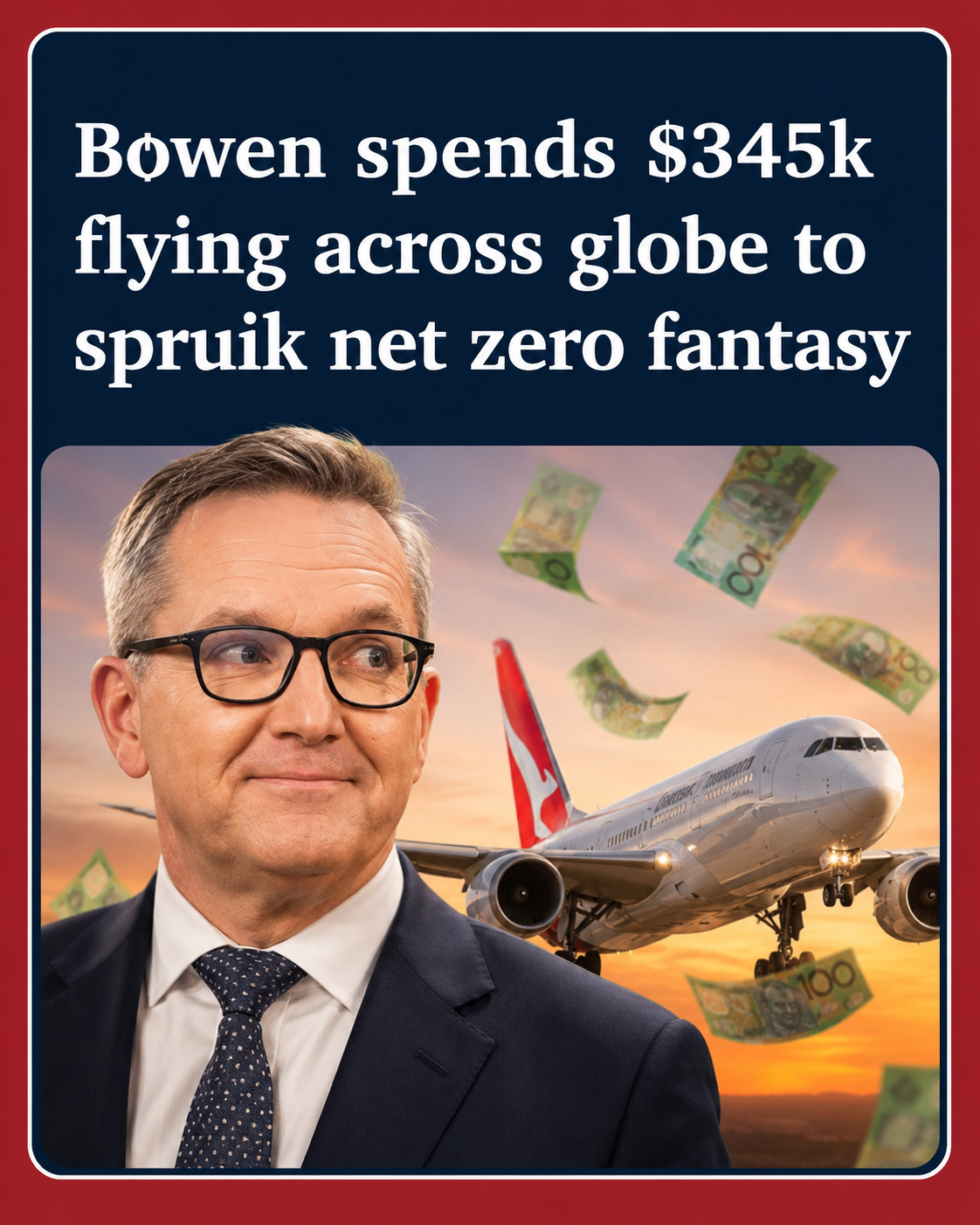
Climate Change and Energy Minister Chris Bowen has come under renewed political scrutiny after newly released expense records revealed taxpayers funded more than $345,000 in international travel during the 2025–26 financial year, reigniting debate over the cost of Australia’s global climate diplomacy.
The expenditure has attracted criticism from opponents who argue the extensive overseas travel sits uneasily alongside the government’s message on emissions reduction and fiscal responsibility. The controversy intensified after Mr Bowen delivered a major speech at the National Press Club without explicitly referring to the term “net zero”—a policy long associated with his climate agenda.
According to travel expenses published by the Independent Parliamentary Expenses Authority (IPEA), Mr Bowen and his staff spent more than $345,000 on international travel over the course of the financial year.
The records show the minister spent 46 days overseas across multiple official visits, travelling an estimated 167,800 kilometres—equivalent to circling the globe more than four times.
The itinerary included:
- A six-day visit to Germany and Singapore costing approximately $41,443.
- A six-day trip to Denmark, Finland and Singapore costing about $45,052.
- An 11-day visit to Brazil and Chile costing roughly $79,233.
- A nine-day mission through the United States costing approximately $118,030.
- A seven-day tour covering China, Hong Kong, India and Sri Lanka costing around $50,843.
- Additional travel through Fiji, the Marshall Islands, Palau, Samoa and Tuvalu, along with a short visit to New Zealand.
Combined, the overseas engagements averaged around $7,500 per day, according to analysis based on the published expense reports.
The spending has become a political flashpoint because it coincides with growing public concern over household energy bills and the cost of Australia’s transition towards lower-emissions energy.
Critics argue Australians struggling with rising living costs are entitled to ask whether such extensive overseas travel represents value for money.
The issue gained further attention after Mr Bowen’s National Press Club address, where he focused heavily on renewable energy investment, rooftop solar expansion and Australia’s international climate leadership.
Despite being widely regarded as the architect of Labor’s net zero agenda, observers noted that Mr Bowen did not use the phrase “net zero” during the speech.
Instead, he emphasised reducing household electricity bills, strengthening energy security and expanding renewable generation.
“Suburbs across Australia are pleased with the part they are playing in reducing emissions and tackling climate change,” Mr Bowen said while outlining plans to increase solar installations on commercial, industrial and agricultural rooftops.
The omission immediately attracted criticism from conservative commentators.
Institute of Public Affairs research fellow Saxon Davidson argued the government was deliberately distancing itself from the language of net zero because of growing political sensitivity surrounding energy prices.
He claimed the absence of the term reflected internal polling rather than any change in climate policy.
Davidson also criticised Mr Bowen’s broader energy strategy, arguing Australia’s ageing coal-fired power stations were becoming less reliable primarily because of investment uncertainty rather than technical limitations.
Those views reflect longstanding criticism from opponents of Labor’s renewable energy policies, who contend the transition is contributing to higher electricity costs and increased pressure on the national power grid.
Shadow Energy Minister Dan Tehan also questioned whether every overseas visit had been necessary.
He argued Australians deserved an explanation of how the travel expenditure had helped reduce electricity prices or improve energy affordability.
Tehan suggested some meetings could potentially have been conducted via videoconferencing, reducing both costs and travel-related emissions.
“Chris Bowen also needs to explain why a Zoom call or the use of Teams could not have done just as good a job,” he said.
The minister’s office has defended the travel program, saying international engagement is an essential part of Australia’s economic and diplomatic strategy.
A spokesperson said Australia is seeking to position itself as a renewable energy superpower capable of attracting a greater share of rapidly expanding global clean-energy investment.
The office argued that while virtual meetings are used wherever appropriate, face-to-face engagement remains necessary for many high-level negotiations and international partnerships.
Officials also noted that Mr Bowen serves as Australia’s President of Negotiations for the proposed COP31 climate summit, a role involving extensive engagement with foreign governments and international organisations.
During his National Press Club speech, Mr Bowen highlighted Australia’s ambition to become a major exporter of clean energy and renewable technologies.
He announced an expansion of government incentives designed to reduce the cost of installing rooftop solar on commercial, industrial and agricultural buildings.
According to the minister, many large industrial rooftops remain underutilised despite possessing significant technical potential for solar generation.
He argued expanding commercial solar capacity could improve energy security while lowering long-term electricity costs for businesses.
Mr Bowen also emphasised Australia’s international climate role, arguing the country is helping shape negotiations covering the overwhelming majority of global greenhouse gas emissions.
He said Australia’s partnership with Pacific nations in preparations for COP31 demonstrated the country’s commitment to regional leadership on climate issues.
The broader debate reflects increasing political scrutiny of government spending as Australia continues balancing climate commitments with persistent cost-of-living pressures.
Supporters of Labor’s approach argue international engagement is essential for securing investment, strengthening diplomatic relationships and expanding export opportunities in renewable industries.
Critics counter that overseas travel should deliver measurable domestic benefits, particularly when taxpayers are facing rising electricity prices and broader economic pressures.
The controversy also illustrates the increasingly contested politics surrounding climate policy.
While both major parties acknowledge the importance of reducing emissions, they continue to disagree over the pace of Australia’s energy transition, the role of renewable generation, future investment in gas and the long-term contribution of traditional energy sources.
As Parliament prepares to resume, Mr Bowen’s international travel expenditure is likely to remain part of the wider political contest over energy policy, government spending and Australia’s climate ambitions.
Whether voters view the overseas engagements as necessary diplomatic investment or excessive taxpayer-funded travel may ultimately depend on whether the government can demonstrate tangible economic and energy benefits from its international climate agenda in the years ahead.






