Diplomatic tensions between Australia and China have escalated after Beijing accused Canberra of “inciting confrontation” in the Indo-Pacific, following criticism from Foreign Minister Penny Wong over China’s recent military activities and an alleged violent confrontation involving Chinese and Philippine maritime forces in the South China Sea.
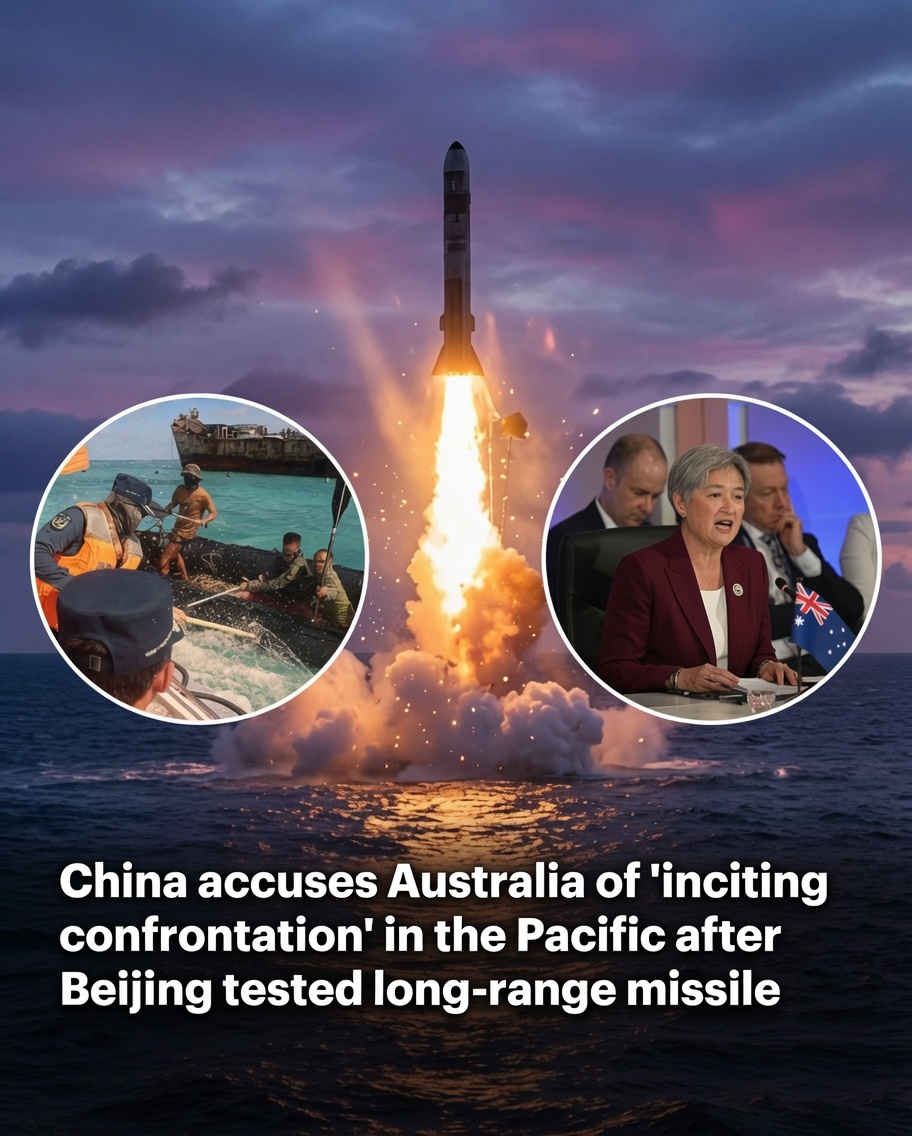
The latest exchange highlights the increasingly fragile relationship between the two countries as regional security concerns continue to dominate diplomatic discussions across Southeast Asia.
Speaking during a visit to Manila, Senator Wong said Australia remained deeply concerned by what she described as China’s “aggression” and “destabilising conduct” in the South China Sea, warning that recent incidents carried serious implications for regional peace and stability.
Her remarks followed an incident earlier this week involving the China Coast Guard (CCG) and members of the Armed Forces of the Philippines (AFP).
According to Philippine authorities, Chinese coast guard personnel confronted Philippine naval personnel operating in disputed waters, with Manila alleging that one Filipino sailor was struck on the head with a wooden paddle after the vessels came into contact during an encounter involving inflatable boats.
The Philippines maintains that the Chinese vessel entered waters where Manila exercises jurisdiction, while Beijing disputes that characterisation and accuses the Philippines of provoking the confrontation.
Addressing reporters in the Philippine capital, Wong said the incident, together with China’s recent long-range missile test in the Pacific, raised legitimate concerns for countries throughout the Indo-Pacific.
“These incidents are concerning because they contribute to instability in a region where all countries have a strong interest in maintaining peace, security and freedom of navigation,” she said.
China responded swiftly.
Foreign Ministry spokesperson Lin Jian rejected Australia’s criticism, accusing Canberra of distorting the facts surrounding the South China Sea dispute.
“Whenever there is the slightest disturbance at sea, the same small handful of countries rush to the forefront to oppose China without regard for the facts,” Lin said during a regular media briefing in Beijing.
He urged Australia and other countries to stop “exaggerating tensions and inciting confrontation” and instead respect efforts by regional nations to maintain peace and stability in the South China Sea through dialogue and consultation.
The sharp diplomatic exchange came only days after China conducted a long-range missile test that attracted close attention from governments across the Pacific.
Although Chinese officials described the launch as a routine military exercise conducted in accordance with international practice, Australia expressed concern over both the limited advance notification and the broader implications of China’s expanding military capabilities.
Prime Minister Anthony Albanese and Senator Wong have both said transparency surrounding major military exercises is essential to maintaining confidence and reducing the risk of miscalculation in the region.
The South China Sea has become one of the world’s most strategically important waterways, with an estimated one-third of global maritime trade passing through the region each year.
China claims sovereignty over most of the sea through its so-called “nine-dash line”, a claim that overlaps with the exclusive economic zones claimed by the Philippines, Vietnam, Malaysia, Brunei and Taiwan.
In 2016, an international arbitral tribunal established under the United Nations Convention on the Law of the Sea (UNCLOS) ruled that China’s expansive historical claims had no legal basis. Beijing rejected the ruling and has continued to assert its claims while expanding coast guard patrols, artificial islands and military infrastructure throughout disputed areas.
Australia is not a claimant in the South China Sea disputes but has consistently argued that international law, including UNCLOS, should govern maritime rights and that all countries should resolve disputes peacefully.
Canberra has repeatedly expressed support for freedom of navigation, freedom of overflight and the peaceful settlement of disputes.
Those positions have increasingly placed Australia at odds with Beijing as China’s maritime activities have expanded across the Indo-Pacific.
Relations between Canberra and Beijing have improved in some areas since diplomatic ties stabilised following several years of trade disputes.
However, significant differences remain over national security, military transparency, cyber security, human rights, Taiwan and maritime security.
The latest disagreement illustrates how strategic competition continues despite efforts by both governments to maintain constructive economic relations.
Australia has strengthened defence and security cooperation with regional partners including Japan, the United States, India and the Philippines through initiatives designed to support what Canberra describes as a free, open and stable Indo-Pacific.
The Philippines has also deepened defence ties with Australia in recent years through expanded joint military exercises, maritime cooperation and reciprocal training arrangements.
Those partnerships have become increasingly significant as Manila reports more frequent confrontations with Chinese coast guard and maritime militia vessels in disputed waters.
China, meanwhile, argues that outside powers are unnecessarily internationalising regional disputes.
Beijing maintains that disagreements in the South China Sea should be managed directly between China and the claimant states through bilateral dialogue rather than external intervention.
Chinese officials have frequently criticised Australia, the United States and several European countries for commenting on incidents in waters where they are not claimants, arguing that such statements increase tensions rather than reduce them.
For Australia, however, the issue extends beyond territorial claims.
Successive governments have argued that freedom of navigation, adherence to international law and regional stability are fundamental Australian interests because of the country’s dependence on open sea lanes for trade and security.
Speaking in Manila, Wong emphasised that countries across Southeast Asia now face important decisions about how they respond to increasingly assertive behaviour in contested waters.
She said recent events were not isolated incidents but formed part of a broader pattern requiring careful regional attention.
The diplomatic exchange unfolded during ASEAN-related foreign ministers’ meetings, where maritime security, strategic competition and regional stability have featured prominently on the agenda.
Several governments, including Canada and the European Union, have also expressed concern over the latest confrontation between Chinese and Philippine personnel while calling for restraint from all parties.
Analysts note that while Australia and China continue to cooperate economically in many areas, security issues remain the principal source of friction in the bilateral relationship.
Each new maritime incident, military exercise or diplomatic disagreement has the potential to test efforts made over recent years to rebuild political dialogue between Canberra and Beijing.
As investigations into the latest South China Sea encounter continue and regional governments assess China’s recent missile activities, the exchange between Penny Wong and Beijing underscores the delicate balance facing Indo-Pacific nations—maintaining diplomatic engagement with China while responding to actions they believe could affect regional peace, international law and freedom of navigation.