Melbourne’s central business district is facing the deepest office vacancy crisis in Australia, with almost one in every five offices now sitting empty as debate intensifies over Victoria’s proposed work-from-home laws.
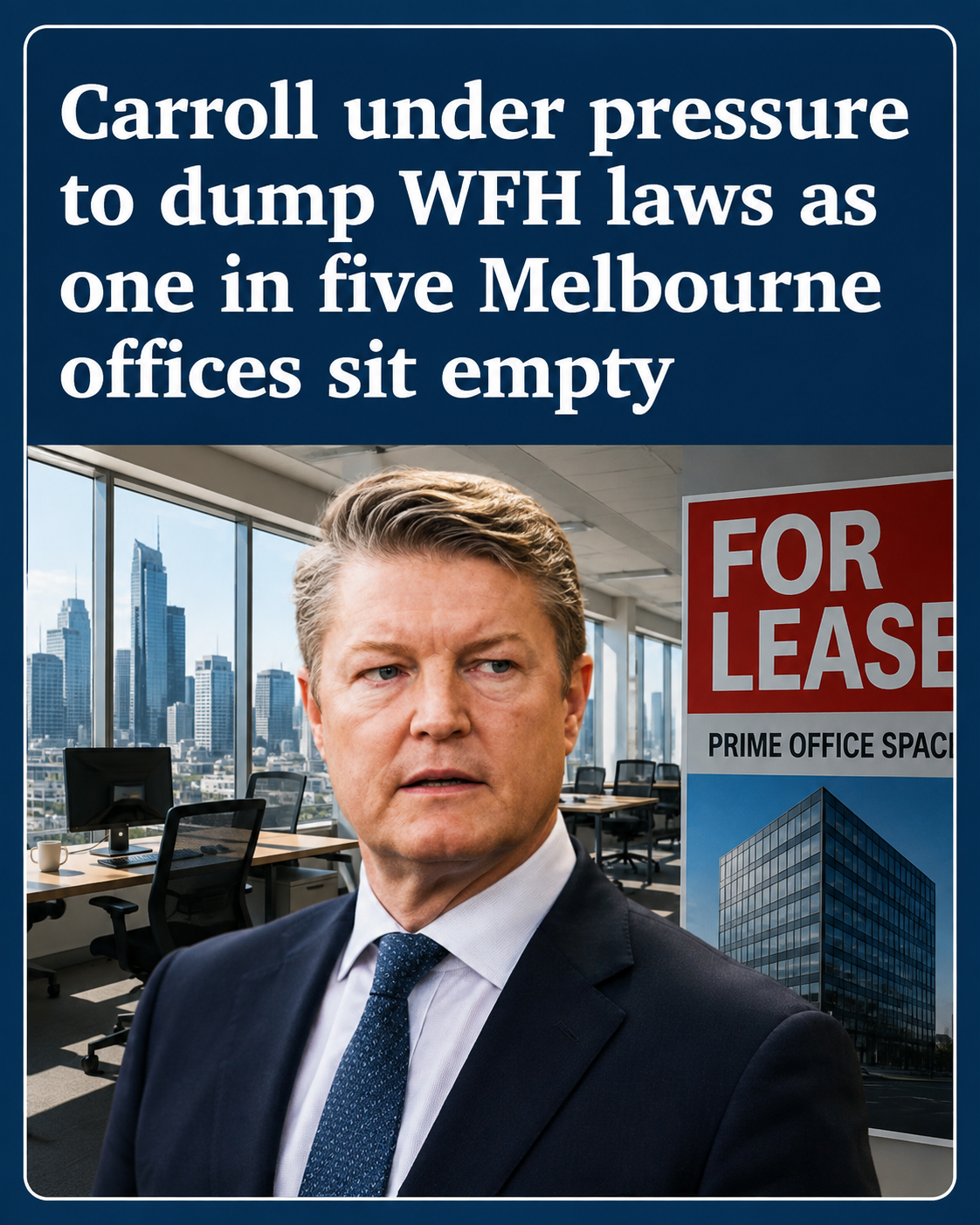
Fresh industry figures show Melbourne now has the highest office vacancy rate of any capital city in the country, with nearly 19 per cent of CBD office space lying vacant. The total unused floor area exceeds one million square metres — roughly equivalent to almost 50 Melbourne Cricket Ground ovals.
The figures have intensified pressure on Premier Ben Carroll as business groups call on the Victorian Government to reconsider legislation that would give many employees a legal right to work from home for up to two days each week where their role allows.
Property owners, retailers and employer organisations argue the proposal risks further reducing weekday foot traffic through Melbourne’s CBD at a time when the city is still attempting to recover from years of changing workplace habits following the COVID-19 pandemic.
According to the latest Property Council of Australia office market data, Melbourne’s CBD vacancy rate sits at approximately 18.9 per cent, well above Sydney’s 13.3 per cent and Brisbane’s 10.2 per cent. The gap leaves Victoria with the weakest office occupancy performance among Australia’s major commercial centres.
Industry leaders say the situation extends well beyond landlords. Empty offices mean fewer customers for cafes, restaurants, retailers, convenience stores, transport operators and countless small businesses that depend on office workers during weekdays.
Many argue the health of the CBD economy is closely tied to the number of workers travelling into the city each day, making office attendance an issue that affects thousands of businesses rather than simply commercial property owners.
The Victorian Government’s proposed workplace reforms would require employers to accommodate eligible requests to work from home for up to two days per week unless reasonable business grounds exist to refuse. Supporters argue the changes provide certainty for workers while recognising the flexibility that became commonplace during the pandemic.
Business groups, however, contend that turning hybrid work into a legal entitlement could discourage companies from expanding office footprints or relocating staff back into Melbourne’s CBD.
The Property Council of Australia has argued that continued uncertainty surrounding workplace legislation is already weighing on investment decisions and commercial leasing activity. Property industry representatives say investor confidence remains fragile after several years of elevated vacancies, rising interest rates and subdued office demand.
Commercial property analysts note that Melbourne’s office market has experienced a prolonged adjustment since the pandemic, with many businesses adopting permanent hybrid work arrangements instead of returning to five-day office attendance.
While premium office buildings continue attracting tenants through modern facilities and higher-quality amenities, older secondary buildings have struggled to fill vacant space, widening the gap between different segments of the market.
Research from Knight Frank has shown that demand has increasingly shifted toward premium-grade buildings, while many older offices continue experiencing significantly higher vacancy levels despite some improvement in overall leasing activity during 2025.
The challenge is particularly significant for Melbourne because of the size of its office market and the concentration of employment within the CBD. A sustained decline in office attendance affects not only landlords but also public transport usage, hospitality revenue and the broader economic activity generated by daily commuters.
Some economists argue that hybrid work has permanently altered demand for office space and that governments should focus on adapting CBDs rather than attempting to recreate pre-pandemic workplace patterns.
Others believe encouraging more regular office attendance remains essential to supporting city economies, especially where thousands of small businesses rely on office workers for much of their customer base.
The debate has become increasingly political as Victoria prepares to implement one of Australia’s most far-reaching workplace flexibility policies.
Critics say legislating work-from-home arrangements removes flexibility from employers and may unintentionally disadvantage businesses whose operations require greater in-person collaboration.
Supporters counter that flexible work has become an important recruitment and retention tool, particularly for parents and carers, while reducing commuting costs and improving work-life balance for many employees.
Several large employers have already adopted hybrid work models voluntarily, although office attendance expectations vary widely between organisations.
Internationally, governments and major corporations continue experimenting with different workplace models. Some companies have introduced mandatory office attendance several days each week, while others have embraced permanent remote or hybrid arrangements.
The Victorian proposal has attracted attention because it would embed aspects of hybrid work into legislation rather than leaving arrangements entirely to individual employers.
Business organisations have warned that smaller employers may face particular compliance challenges if the legislation proceeds without significant amendments.
Reports indicate Premier Ben Carroll has already signalled a willingness to consider changes, including potential exemptions for some smaller businesses, following sustained lobbying from industry groups.
Meanwhile, broader economic indicators continue adding pressure to the debate.
Victoria has faced slowing business investment alongside ongoing concerns about commercial property values, with office transaction volumes remaining well below previous market peaks. Industry representatives argue that policy certainty will be important in encouraging fresh investment into Melbourne’s commercial property sector.
Despite the elevated vacancy rate, there have been some positive signs within Melbourne’s office market. Premium buildings have continued attracting tenants, net office absorption improved during 2025, and several major leasing transactions have been completed as companies relocate into higher-quality space.
However, analysts caution that these improvements have not yet translated into a meaningful reduction in overall vacancy because significant amounts of refurbished and newly completed office space continue entering the market.
With more commercial developments scheduled for completion, the pace of tenant demand will remain a critical factor in determining whether Melbourne’s vacancy rate begins falling over coming years or remains among the highest in the country.
As Parliament continues considering Victoria’s work-from-home legislation, the future of Melbourne’s CBD has become a broader debate about how cities should adapt to changing workplace expectations while protecting economic activity in their traditional business centres.
Whether policymakers ultimately prioritise employee flexibility, business competitiveness or attempt to balance both objectives is likely to shape the next chapter of Melbourne’s post-pandemic recovery.






