Canberra’s Big Splash water park remains closed more than two years after shutting its gates, with the ACT Government now examining new options for the site as another promised reopening date looks unlikely to be met.
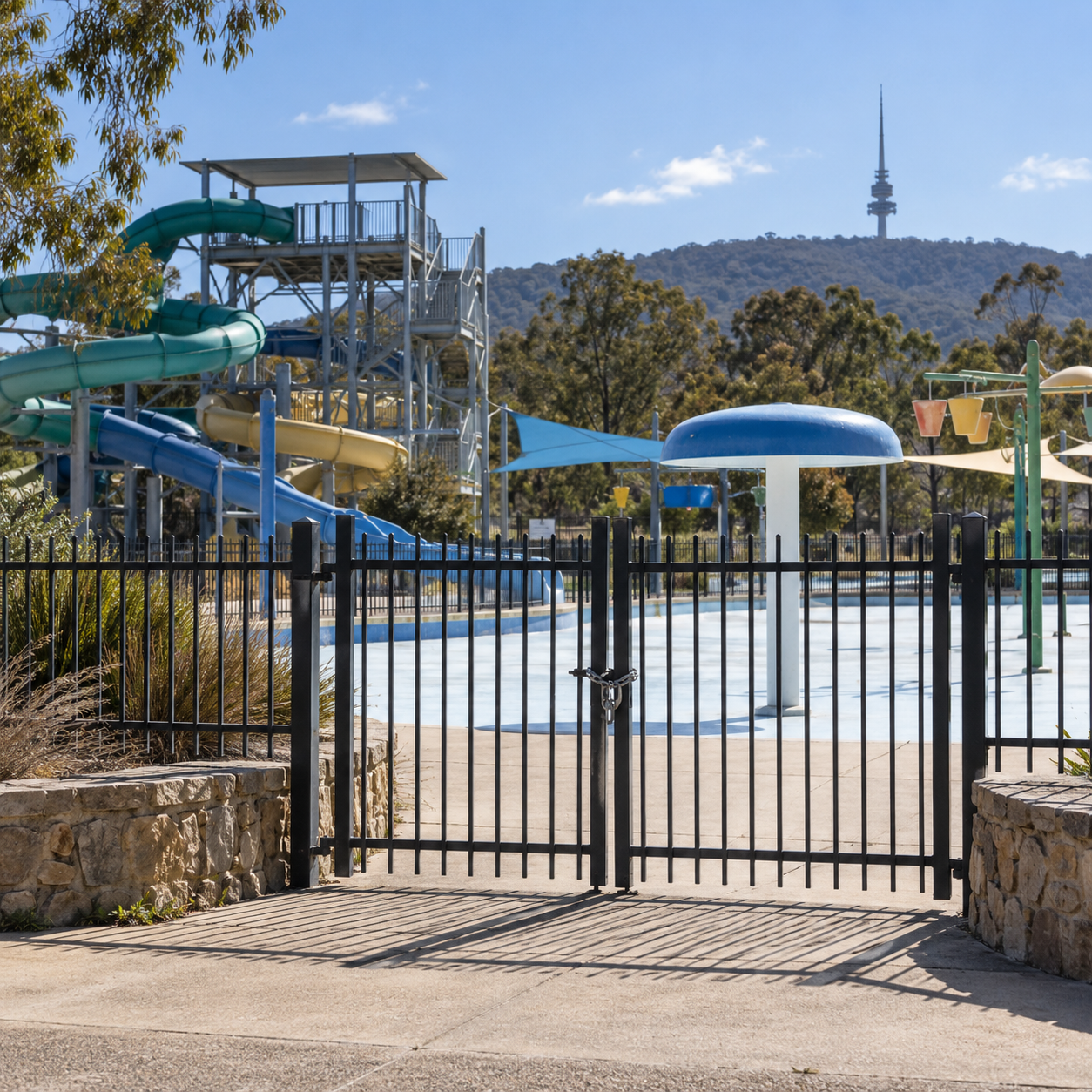
The privately owned Macquarie facility has become a test case for how the Territory enforces Crown lease conditions when a long-standing community recreation site falls into disrepair.
Big Splash has been closed since the beginning of 2024. The site was once Canberra’s only outdoor water park, built around a 50-metre pool and a network of water slides that became a familiar summer attraction for generations of local families.
The current leaseholder took over the site in 2021. The land is held under a long-term Crown lease, as is common in the ACT, and the lease restricts the permitted uses.
Government documents say the land can be used for an aquatic and indoor sports and recreation centre or an unlicensed family restaurant. It is not simply an unrestricted private development site.
That legal detail is why the continued closure has drawn government attention. A Crown lease gives a private operator rights over the site but also requires the land to be used and maintained according to its lease purpose and planning rules.
Access Canberra began formal regulatory action earlier this year. In January it notified the lessee that the Territory Planning Authority was considering terminating the Crown lease over alleged non-compliance.
Lease termination is a serious enforcement step and is not automatic. The lessee was entitled to respond and explain why the lease should not be terminated.
In April, Access Canberra decided not to proceed with termination after inspecting the site and considering work that had been undertaken. At the time, the owners told the regulator they intended to reopen the 50-metre pool by 1 November 2026.
The regulator said it would continue inspections and monitor progress. That decision did not permanently rule out future enforcement if the site again failed to meet lease requirements.
By September, the ACT Government said it no longer believed the operator was on track to meet the November reopening commitment.
A sale process had also failed to produce an acceptable buyer. The mortgagee had put the property on the market, but the government said the sale had not succeeded in resolving the site’s future.
Planning Minister Chris Steel then announced a comprehensive options analysis covering the practical cost of reopening pools, restoring slides and other amenities, land value and possible commercially viable models for an aquatic facility.
The government says the review will include community input and information intended to help potential buyers, the existing leaseholder and policymakers assess what can realistically operate on the site.
Importantly, the ACT Government says it is not planning to rezone the land for residential development. The site remains within a recreation-focused zone and the government’s stated preference is for an aquatic facility to return.
That does not mean the government has committed to buying and operating the park itself. Officials have repeatedly said their preference is for the facility to remain privately operated if a viable owner can be found.
The ownership and financing structure has also changed. Local political representatives have said financiers who lent money against the property are now more directly involved in decision-making after the original operator’s plans failed to deliver a reopening.
The latest twist is a proposal to satisfy the Crown lease through a different permitted use. The owners have indicated they may operate an unlicensed family restaurant on the site, potentially beginning with a temporary food van.
Because an unlicensed family restaurant is one of the uses allowed under the lease, that could address a narrow compliance question without reopening the pools or slides.
That possibility has frustrated residents who see the lease as being fundamentally connected to the site’s history as a swimming and recreation facility.
However, whether a restaurant satisfies the legal requirements is different from whether it satisfies community expectations. Regulators have to apply the wording of the lease and planning law rather than enforce a preferred business model that is not legally required.
The ACT Government has also faced criticism over how long it has taken to intervene. An Assembly committee examining planning enforcement has raised concerns about the limited use and transparency of controlled activity orders and has cited Big Splash among sites attracting community concern.
Controlled activity orders are one of the planning system’s enforcement tools. Access Canberra also has powers that can include penalties or, in serious cases, action against a Crown lease.
But enforcement decisions are constrained by statutory process. Regulators have to identify a breach, give the lessee procedural fairness and consider whether the response is proportionate to the conduct and the steps being taken to remedy it.
That explains why the January termination warning did not automatically lead to the government taking over the site.
The site’s long closure also illustrates the difficulty of restoring ageing recreational infrastructure. Water parks require specialist plant, filtration, structural inspections, insurance, staffing and ongoing maintenance. Reopening a pool is not the same as unlocking a gate after a temporary closure.
The condition of Big Splash’s slides and other structures has been a particular issue. Earlier proposals included removing damaged slide infrastructure while retaining the 50-metre pool.
For families in Canberra’s north, the consequence is straightforward: another summer may pass without the city’s only traditional outdoor water park operating.
For the government, the problem is more complicated. It wants the site reactivated, but it must decide how far public money or regulatory powers should be used to rescue a privately owned business on public leasehold land.
The options analysis is intended to put costs and viable operating models behind that debate rather than relying only on promises to reopen.
There are now several possible paths. A new buyer could acquire the business and invest in an aquatic facility. The existing controllers could open a permitted restaurant use while longer-term plans continue. Regulators could take stronger enforcement action if lease obligations are not met. The government could also consider a more direct role, although it has not committed to that course.
What is not supported by the current evidence is a claim that the lease has already been terminated or that residential redevelopment has been approved. Neither has occurred.
The next important date is November, when the earlier reopening commitment was supposed to be met and when the proposed restaurant use may emerge.
If the site remains inactive, pressure on Access Canberra to explain its enforcement response is likely to grow. If a temporary food operation begins, the legal compliance issue may shift even though the community debate over the future of the water park continues.
Big Splash’s history adds to the community frustration. The site began as a public swimming facility before private operators expanded it into a water park with slides. For many Canberrans, the debate is therefore about the loss of an established recreational use rather than the failure of a newly proposed attraction.
The property covers about 13,000 square metres and its Crown lease runs for decades. That long tenure increases the importance of lease-purpose rules because the public planning system relies on them to ensure land reserved for recreation is not simply left unused indefinitely or converted without approval.
The failed sale process has complicated the government’s preferred solution. A new private owner could potentially bring fresh capital, but an expressions-of-interest campaign did not produce an acceptable transaction.
That leaves financiers, the existing lease structure and regulators trying to find a workable path while the physical condition of the facility continues to deteriorate.
The ACT’s new options analysis is intended to address that commercial reality. It will look not only at what residents want but at the likely cost of pools, slides and amenities and whether a viable operator can earn enough revenue to maintain them.
Public consultation will matter because the final model could range from a traditional water park to a more limited aquatic facility combined with other permitted recreation uses.
The government’s refusal to rezone the land for housing narrows the commercial options but preserves the recreation purpose that community groups have been campaigning to protect.
At the same time, the restaurant clause creates an unusual regulatory pathway. A relatively modest food operation could technically bring the site back into a permitted use even if the pools remain closed, creating a gap between legal compliance and the outcome many residents expect.
That gap is likely to remain the centre of the debate through November: whether the lease is being complied with, whether stronger enforcement is justified, and what form of recreation can realistically survive on the site in the long term.
Big Splash is therefore no longer only a story about broken slides and an empty pool. It has become a broader question about Crown leases, planning enforcement, private investment and how Canberra preserves land set aside for community recreation.