A parliamentary argument about Pacific energy supplies turned personal when Climate Change and Energy Minister Chris Bowen rebuked Angus Taylor and other Coalition MPs over criticism of ceremonial clothing worn on an official visit to Fiji. Taylor interjected in response, making the exchange about political respect as well as climate policy.
Bowen accused his opponents of showing contempt for Pacific neighbours by treating an official visit and its clothing traditions as material for mockery. 'Fiji is not Hawaii,' he told the chamber, rejecting the description of the clothing as Hawaiian shirts. Taylor fired back during the exchange, while questions about diesel-powered energy systems remained unresolved in the shouting.
The immediate policy challenge came from shadow energy minister Dan Tehan. He asked about a pre-COP meeting in Tuvalu, including whether diesel generators supplied electricity and whether Australian taxpayers supported the event. Bowen initially answered by discussing the Fijian energy system, prompting opposition MPs to point out that the question concerned Tuvalu rather than Fiji.
Bowen then broadened his reply, saying Fiji, Tuvalu and Palau relied significantly on diesel and were trying to change that dependence. He argued that the underlying facts were widely known and that the point of Australia's engagement was to help Pacific partners change their energy mix, not pretend fossil fuels had already been removed from the region.
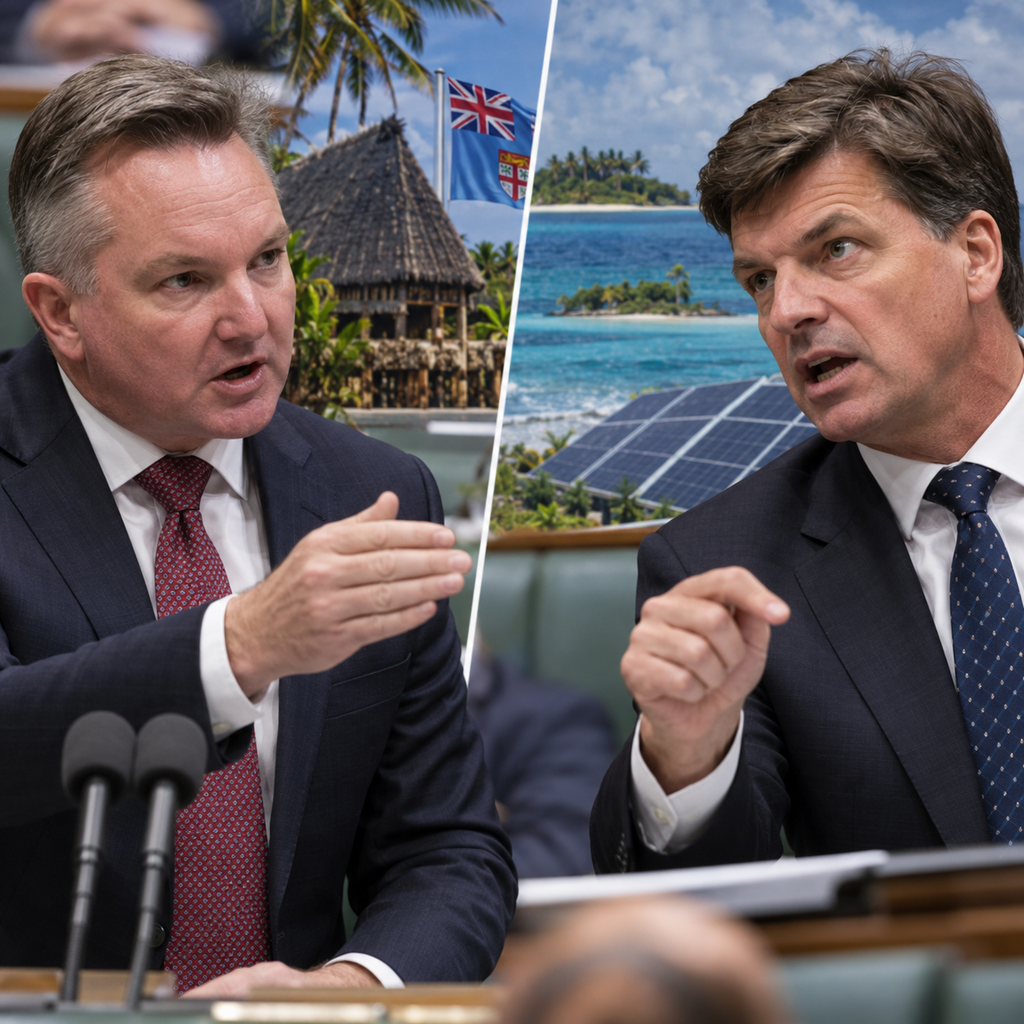
It was against that background that the minister turned to Taylor and Tehan's criticism of official dress on the Fiji trip. Bowen said the pair had described clothing worn at the request of the Fijian government as Hawaiian shirts. His answer drew a distinction between what Australians might casually call a brightly patterned shirt and the cultural significance attached to an outfit worn at a diplomatic event.
Bowen treated the clothing remark as a slight against the host country rather than a harmless fashion joke. Officials and visiting leaders sometimes wear garments chosen for ceremonial or diplomatic occasions. Whether an Australian minister should have attended a regional climate gathering is a separate question from whether it was appropriate to mock clothing provided by the hosts. The distinction mattered because Bowen argued that respect for Pacific partners is part of maintaining productive regional relationships.
Taylor interjected 'utter contempt for you', a retort aimed at Bowen rather than at Fiji. The exchange was recorded in parliamentary reporting as a direct interjection. This was an argument inside Australia's Parliament, not a formal bilateral dispute with Fiji or a confrontation between Australian politicians and Pacific leaders.
Tehan's original question should not be lost in that drama. Electricity systems in smaller Pacific countries are heavily shaped by geography. Islands may depend on imported fuel because there are limited alternatives for providing continuous generation across dispersed communities. Transporting diesel comes with costs, exposure to international fuel prices and a reliance on supply chains that can be disrupted by storms and other events.
Renewable power offers potential ways to reduce some of that dependence, but its adoption involves technical and financial challenges. Storage, grid stability, maintenance expertise and the ability to withstand severe weather are central questions. A promise to install clean energy technology is not the same as guaranteeing reliable power for households, businesses and essential services.
Dan Tehan's question carried a legitimate public-spending point. He sought an explanation for an event associated with diesel-powered electricity while governments were discussing cleaner energy. Bowen's reply was that dependence on imported fuel was precisely the problem Pacific partners wanted to tackle. The inquiry should not end at either soundbite: it calls for a breakdown of the conference's costs, the energy used at the venue and the investments proposed to reduce dependence on diesel across island grids.
The spending figures give Tehan's question a sharper financial dimension. Bowen acknowledged in a government-published press conference that reported costs of roughly $20 million for the Pacific pre-COP gathering were in the right range. He added that the final accounts still needed reconciliation. The $20 million estimate is therefore not a final, audited total or an exact invoice for one minister's travel.
Bowen described the event as part of a broader $147 million budget allocation for greater Pacific engagement on climate issues. The two figures are different in scope. The larger allocation covers a wider commitment, while the estimated conference expense relates to the gathering itself. Treating them as two separate costs for the same conference, or claiming that the entire $147 million was spent on Fiji accommodation, would give Australians a false picture of the financial arrangements.
The minister also said some accommodation bookings involved amounts expected to be recovered from participating countries. That makes reimbursement another question worth following. Booking expenditure, gross event expenditure and the eventual net cost to Australian taxpayers may not be identical. Until final reconciled figures are available, the extent of recoveries cannot safely be stated as a confirmed saving. A serious assessment of public spending must distinguish the cost initially incurred from the cost ultimately borne by the Commonwealth.
The public cost should be judged on evidence rather than on a comparison between the price of a summit and a household power bill. The government needs to identify expenditure, reimbursements, contracts and any commitments made to participating countries. Criticism that Australians are entitled to expect value for money is distinct from a claim that the same funds could automatically have been redirected to lower retail electricity prices. Budget allocations have specific purposes and conditions.
Pacific energy infrastructure is a separate, more tangible part of the same policy debate. Australia's Department of Foreign Affairs and Trade identifies financing for solar generation, battery storage and off-grid power through the Australian Infrastructure Financing Facility for the Pacific. One initiative, REnew Pacific, is valued at $75 million and aims to bring electricity solutions to communities that would otherwise face expensive or unreliable supply. That program is not the pre-COP conference budget, and its project results cannot be assumed merely because a minister attended the gathering.
The financing model matters to Australian taxpayers too. Some regional investments are grants; others involve lending, technical support or partnerships. Their value depends not simply on announcements but on project completion, operating costs, procurement oversight and who is responsible for maintaining equipment. A solar installation that cannot be repaired or paired with adequate storage may have less value than its initial announcement suggests. Successful systems, by contrast, can reduce dependence on shipped diesel and improve the reliability of essential services.
Consider what unreliable electricity means in a remote island community. A power interruption can affect food refrigeration, healthcare equipment, water pumping and telecommunications as well as the ordinary costs of running a shop. Those consequences make the choice between diesel supply and renewable infrastructure a question of practical economic security, not a contest over whether a generator can be photographed at a climate event. The relevant public records describe renewable projects serving schools, healthcare facilities and isolated communities across the Pacific.
Australia's practical role in Pacific energy projects provides a useful test of the rhetoric. DFAT describes financing for a solar-and-battery facility in Palau, intended to replace some imported diesel generation. Its published project description specifies a solar capacity of 15.28 megawatts peak and battery storage of 12.9 megawatts. Those are project specifications, not evidence that every target has already been met. They show the kind of infrastructure against which regional promises can be assessed.
The financial structure also matters. The Australian Infrastructure Financing Facility for the Pacific uses financing arrangements for infrastructure, and the terms of a loan are not interchangeable with those of a grant. Australians should be able to distinguish money spent staging diplomatic meetings from funds invested in power stations, storage facilities or ports. An event may help negotiate cooperation, but the value of the resulting investment must still be tested through procurement, delivery and operating performance.
Bowen made that argument when he said Pacific nations were trying to move away from diesel. His response framed the existing fuel dependence as an obstacle to be addressed, not evidence that regional climate engagement is hypocrisy. Critics may still test whether individual programs achieve their aims, but that demands project-specific evidence rather than a joke about clothing.
Pacific leaders have linked cleaner electricity and climate resilience with fuel security, infrastructure and the cost of running essential services. In island communities, the reliability of power can affect hospitals, water pumps, communications and refrigerated goods. Those risks are not a licence for blank cheques: they are reasons to ask whether Australian-funded projects suit local operating conditions, can be maintained and reduce exposure to expensive imported fuel.
Bowen's response defended a regional relationship and contested the opposition's description of it. Tehan's challenge raised spending and technology questions. Taylor's interjection made the chamber dispute more personal. Those strands should remain separate: the parliamentary row did not itself establish that a summit was wasteful, that Pacific clean-energy work had failed or that Fiji and Australia were in a diplomatic dispute.
The most striking feature of the clash is how quickly those separate questions became entangled. Tehan raised Tuvalu and diesel. Bowen first referred to Fiji, then corrected and widened his explanation. Discussion of the meeting became an argument about attire at a different official engagement. Taylor responded as the personal criticism escalated. Collapsing all of that into a single claim about a Fiji meeting powered by diesel would distort what was actually asked.
The dispute leaves two distinct standards for judging the politicians' conduct. The government should be able to account for the practical value of Australia's Pacific energy commitments. The opposition should be able to challenge those commitments without treating regional partners or their traditions dismissively. The parliamentary exchange shows those standards can be asserted simultaneously, even when the participants choose barbs over detailed answers.
Nothing in the exchange establishes that Pacific transition efforts have succeeded or failed. It establishes that politicians disagreed about how to discuss them. The useful question is not which side delivered the sharper insult, but whether Australians can get reliable evidence about the benefits, costs and diplomacy of working with Pacific neighbours.






