Barnaby Joyce has made an admission rarely heard from a political party polling within reach of the government benches.
One Nation, he says, has not yet established sufficient credibility on economics.
That is a remarkable problem for a party now attracting more than a quarter of the national primary vote and openly discussing the possibility of forming government.
Joyce’s proposed response begins with one of Australia’s most powerful economic institutions: the Reserve Bank.
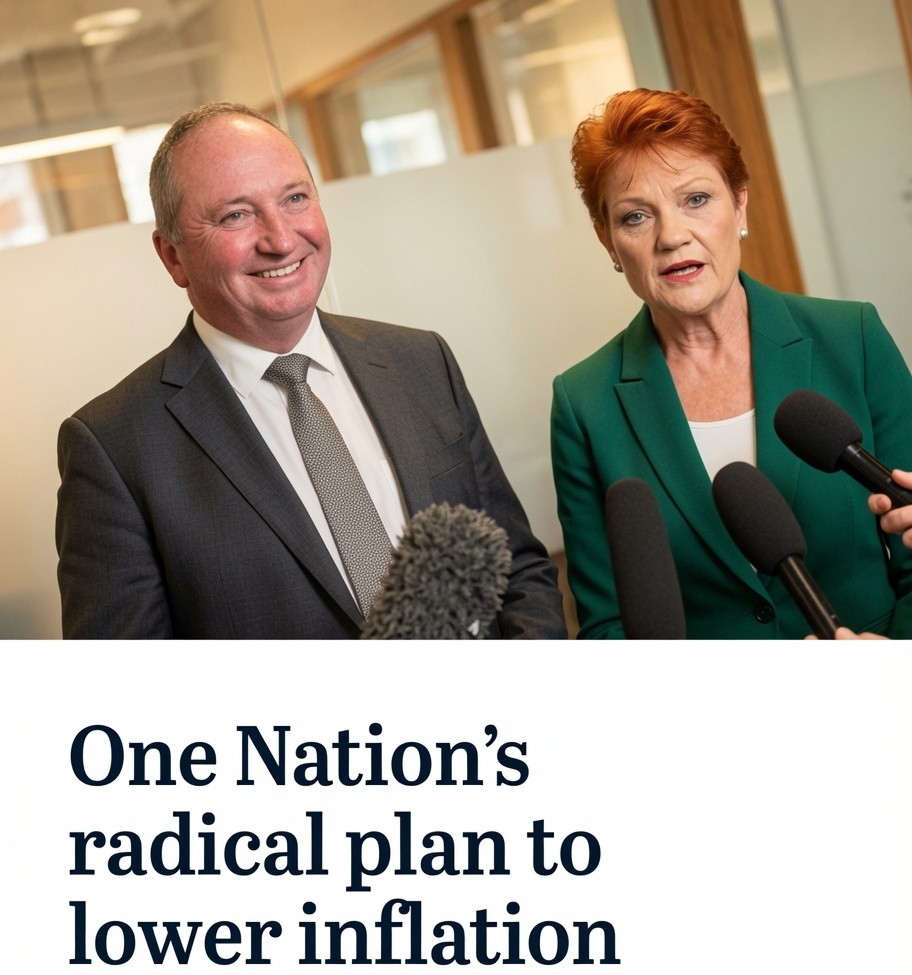
The former deputy prime minister and One Nation treasury spokesman wants the party to examine how the RBA operates, arguing the central bank should be more independent and more willing to publicly identify government spending as a source of inflationary pressure.
His central complaint is that the bank is handed a single brutal tool to deal with a much more complicated economic problem.
Interest rates.
When inflation is too high, the RBA lifts the cash rate. Banks pass higher borrowing costs to households and businesses. Mortgage repayments rise. Investment becomes more expensive. Consumers have less money to spend.
Demand slows.
Eventually, inflation is supposed to ease.
Joyce describes that tool as a hammer.
His argument is politically potent: if reckless government spending contributes to inflation, why should mortgage holders carry so much of the punishment when the Reserve Bank tries to bring prices under control?
It is a question millions of Australians with home loans will understand.
It is also where One Nation’s economic credibility test becomes much harder.
The Reserve Bank has just been through the most significant overhaul of its governance and monetary policy arrangements in decades.
The Albanese government commissioned an independent review of the RBA in 2022.
The final report was delivered in March 2023 after examining Australia’s monetary policy arrangements, the bank’s governance, its decision-making and its culture.
The review produced 51 recommendations.
Twenty-four were directed to the RBA, 17 to the federal government and 10 required joint action.
The changes that followed were substantial.
Amendments to the Reserve Bank Act took effect on March 1, 2025.
A new Monetary Policy Board was created with responsibility for monetary policy and the RBA’s contribution to financial system stability.
A separate Governance Board was established to oversee the management of the institution.
The Payments System Board retained responsibility for payments policy.
The RBA itself describes the changes as its most significant reforms since the 1990s.
The current Statement on the Conduct of Monetary Policy also explicitly says the governor, deputy governor and Monetary Policy Board are afforded substantial independence under the Reserve Bank Act.
The government has committed to upholding that independence.
That creates an immediate problem for Joyce’s pitch.
What exactly does “more independent” mean?
If One Nation believes the existing RBA remains too constrained by government, it needs to identify the constraint.
Does Joyce want the Treasurer to lose existing statutory powers?
Does he want board appointments changed?
Does he want the RBA to publish formal assessments of federal budgets?
Should the governor publicly criticise individual spending programs?
Should the bank have a formal role in fiscal policy?
Or does Joyce simply want central bankers to speak more bluntly about the inflationary consequences of government decisions?
Those are very different reforms.
The distinction matters because the Reserve Bank and Treasury have different jobs.
The RBA conducts monetary policy.
Its current monetary policy framework aims to keep consumer price inflation between 2 and 3 per cent while also focusing on full employment.
The federal government controls fiscal policy.
It taxes.
It spends.
It borrows.
It determines welfare settings, infrastructure programs, defence expenditure and the size of major Commonwealth programs.
The interaction between those two arms of economic policy can become politically uncomfortable.
A government may spend heavily to support households or fund election promises at the same time the Reserve Bank is attempting to reduce demand.
The result can resemble two drivers fighting over the same car.
One foot presses the accelerator.
The other presses the brake.
Mortgage holders feel the engine strain.
Joyce wants the RBA to be more willing to say so.
There is a reasonable argument for greater public clarity.
Australians frequently hear that interest rates are necessary to fight inflation without receiving a simple explanation of how government spending can affect the same battle.
When a budget injects additional demand into an economy already operating under price pressure, monetary policymakers must consider the consequences.
That does not mean every dollar of government spending causes an interest rate rise.
The composition, timing and economic circumstances matter.
Spending that increases productive capacity can have very different long-term effects from a broad cash transfer designed to stimulate immediate consumption.
Tax changes can alter household demand.
Infrastructure investment can initially add pressure while later improving supply.
Energy subsidies may temporarily lower measured prices without permanently solving the underlying cost problem.
Economics becomes difficult precisely because these effects are not identical.
Joyce’s challenge is to turn his “hammer” analogy into a policy capable of dealing with that complexity.
One option would be to require or encourage the RBA to publish a more explicit assessment of fiscal policy.
The bank already analyses government decisions when forming its economic forecasts.
Its public statements discuss government consumption, public demand and broader economic conditions.
But an RBA governor standing before cameras and declaring that a specific federal budget was making the inflation fight harder would be a different political event.
It could improve transparency.
It could also drag the central bank directly into partisan combat.
Imagine an election-year budget.
The government announces tax relief and new household assistance.
The opposition calls it reckless spending.
The RBA governor publicly warns the package is adding to inflation.
Within minutes, every opposition advertisement would feature the governor’s words.
The government would accuse the bank of interfering in the election.
Ministers would challenge its forecasts.
Central bank board appointments would suddenly receive even greater political scrutiny.
The RBA could become a participant in the political fight it is designed to sit apart from.
That does not make Joyce’s proposal automatically wrong.
It means the consequences require much more thought than saying the bank should speak its mind.
Central bank independence is valuable partly because monetary policy decisions are unpopular.
Politicians face elections.
Central bankers do not.
If inflation requires higher interest rates shortly before polling day, an independent bank can make that decision without asking whether mortgage holders will punish the government.
That separation is imperfect.
Governments appoint senior central bank figures.
Parliament writes the legislation under which the RBA operates.
The Treasurer and Monetary Policy Board maintain a formal statement setting out their common understanding of the monetary policy framework.
But operational independence is intended to protect interest-rate decisions from short-term political pressure.
The 2023 RBA review did not conclude that this principle should be abandoned.
It found Australia’s monetary policy framework was broadly fit for purpose and retained the core model of an operationally independent central bank with a flexible inflation target centred on 2 to 3 per cent.
The review instead focused heavily on improving how decisions were made.
It sought stronger expertise.
More rigorous challenge.
Clearer governance.
Better communication.
Greater accountability.
The new Monetary Policy Board was a direct result.
One Nation is therefore proposing another examination of the central bank while the previous overhaul is still relatively fresh.
Joyce will need to explain what the last review missed.
That question has become more urgent because of his own admission about One Nation’s economic credibility.
The party is under growing pressure to show that its rapidly expanding political support is matched by serious economic policy.
Opposition Leader Angus Taylor has launched an aggressive attack on One Nation’s spending and tax promises.
He claims four major commitments could cost the federal budget as much as $1 trillion over a decade.
One Nation disputes that figure.
But Joyce has struggled to provide a comprehensive alternative set of costings.
He has also declined to guarantee that every One Nation election policy will be submitted to the Parliamentary Budget Office for independent analysis.
His explanation is resources.
One Nation has a small federal parliamentary team compared with Labor and the Coalition.
Joyce says he is doing a significant amount of economic work himself.
The problem is that voters do not lower the standard for a party because it has fewer MPs.
Not when that party is talking about government.
If One Nation wants control of the Commonwealth budget, Australians are entitled to know how its promises add up.
That includes the party’s proposed cuts to fuel excise.
Its tax policies.
Its migration agenda.
Its defence commitments.
Its housing proposals.
And any reform of the Reserve Bank.
A government cannot tell financial markets that it is still working through the numbers because its parliamentary team is small.
Treasury cannot prepare a federal budget around a political slogan.
The Department of Finance cannot identify savings from a general promise to eliminate waste.
The Reserve Bank cannot set interest rates based on a party’s intention to develop credibility later.
This is the transformation One Nation is now experiencing.
For most of its history, the party has been rewarded for identifying grievances.
High immigration.
Government waste.
Expensive energy.
Political correctness.
Distrust of major institutions.
Voters did not necessarily expect Hanson to produce an alternative federal budget.
One Nation was a protest vehicle.
Its current polling has changed the contract.
A party attracting 26 to 29 per cent in major national surveys cannot ask to be treated as a minor political operation when convenient and a government-in-waiting when discussing its electoral ambitions.
It must choose.
Joyce’s appointment as treasury spokesman was intended to help One Nation make that transition.
He brings experience no other senior figure in the party can easily replicate.
Joyce has served as deputy prime minister and sat in cabinet.
He has held major portfolios.
He has participated in government budget processes and understands the machinery of the Commonwealth.
He also trained as an accountant.
That makes his admission about One Nation’s economic credibility unusually significant.
It is not an accusation from Labor.
It is not a Liberal attack line.
It is an acknowledgment from the man responsible for helping the party develop its economic case.
Joyce appears to understand the size of the task.
His instinct is to link One Nation’s economic policy to a frustration already felt by Australian households.
Why are mortgage holders repeatedly asked to absorb the cost of controlling inflation?
Why does the cash rate do so much of the work?
Why can governments spend while the RBA tightens?
Why does the public debate so often treat monetary and fiscal policy as separate stories?
Those are legitimate questions.
The answers are uncomfortable for every political party.
Labor must defend its spending decisions.
The Coalition must explain which spending it would actually cut.
One Nation must show that its own expensive promises would not add to the inflationary pressure it blames on others.
That final point is particularly important.
Joyce cannot criticise the RBA for being forced to use interest rates against inflation while simultaneously developing a One Nation program that dramatically increases government spending or reduces revenue without credible offsets.
If fiscal policy adds demand, the pressure on monetary policy can increase.
A more outspoken Reserve Bank would not solve that contradiction.
It might simply describe it more loudly.
One Nation’s economic challenge is therefore larger than the central bank.
The party needs to decide what kind of economic movement it wants to be.
Is it a low-tax party?
Is it a high-spending economic nationalist party?
Is it committed to balanced budgets?
Would it accept larger deficits to fund defence and household relief?
Does it want cheaper credit?
How would it respond if inflation remained above target?
Would it cut spending?
Raise taxes?
Accept higher interest rates?
There is no version of government in which those choices disappear.
Anger at the Reserve Bank can be politically useful because the bank makes decisions that cause immediate household pain.
But the RBA does not write the federal budget.
It does not set migration policy.
It does not approve government spending programs.
It does not determine tax rates.
It has a powerful monetary policy tool and a mandate set in law.
Joyce is right that the cash rate is a blunt instrument.
The RBA itself has never pretended otherwise.
The deeper question is why Australian governments so often leave the central bank carrying such a visible part of the inflation fight.
If One Nation can answer that question with detailed, costed policy, Joyce may help give the party the economic credibility he admits it lacks.
If the party merely promises another RBA review, the criticism will be obvious.
Australia completed an independent review three years ago.
The resulting reforms took effect only last year.
The new Monetary Policy Board is still operating within a recently redesigned system.
Before reopening the central bank, One Nation needs to identify the precise failure it wants to fix.
Joyce has started with a strong political question.
Why should mortgage holders be hit with the hammer when government spending contributes to the problem?
Now comes the economic credibility test he has set for his own party.
One Nation has to produce an answer that is more than another hammer.






