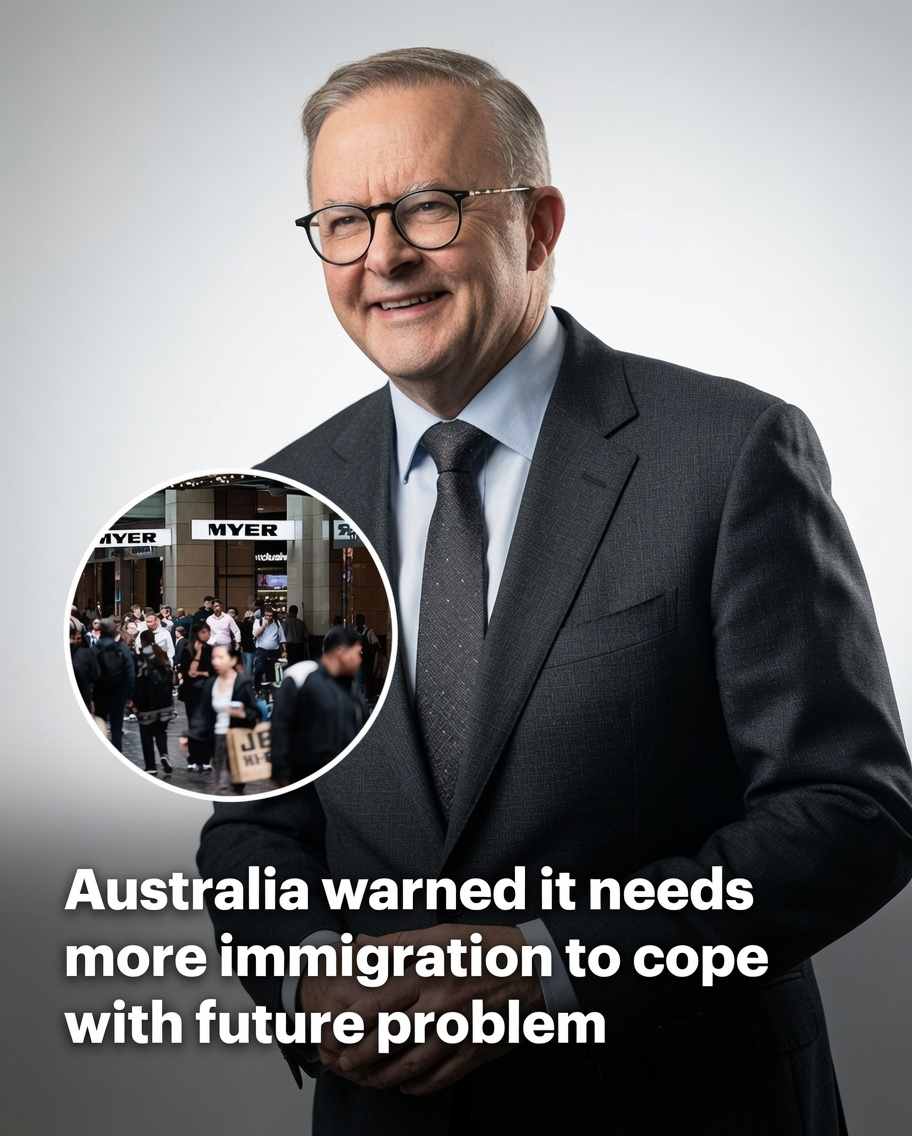
Australia has been warned that dramatically cutting immigration could create a long-term economic problem as the nation’s fertility rate sinks to a record low and the population grows increasingly dependent on arrivals from overseas.
The warning comes from Professor Roger Wilkins, deputy director of the Melbourne Institute and co-director of the long-running Household, Income and Labour Dynamics in Australia Survey.
His concern is rooted in a number that should command the attention of every Australian government.
Australia’s total fertility rate has fallen to 1.481 births per woman.
That is the lowest rate recorded by the Australian Bureau of Statistics and is far below the level required for a population to replace itself over the long term without migration.
“It’s going to be very hard to turn around,” Wilkins told Bloomberg while discussing the demographic shift.
He argued government policy might influence birth rates at the margins, but said Australia’s longer-term economic interests were tied to maintaining a “healthy immigration program”.
The warning immediately collides with one of the most politically explosive debates in Australia.
Housing is painfully expensive.
Rents have placed enormous pressure on households.
Infrastructure is struggling to keep pace in parts of the country.
Cost-of-living pressures remain intense.
And Pauline Hanson’s One Nation has built much of its recent political momentum around demands to end what it calls “mass migration”.
Yet the demographic numbers point to a second problem developing at the same time.
Australians are not having enough children to sustain the population at anything close to replacement level.
That leaves the country confronting an uncomfortable question.
Can Australia sharply reduce immigration without accepting a smaller, older workforce and greater pressure on the taxpayers expected to support an ageing population?
Or has the country become so dependent on migration that governments are using overseas arrivals to compensate for deeper failures on housing, family formation and the cost of raising children?
The birth rate has fallen to a record low
The latest detailed ABS births data recorded 292,318 registered births in Australia during 2024.
That was an increase in the number of births compared with the previous year.
But the total fertility rate still fell to 1.481 births per woman.
The distinction matters.
The raw number of babies born can rise as the population grows while the average number of births per woman continues to fall.
Fertility rates are therefore a more useful measure when examining long-term demographic change.
Australia’s rate is now roughly 25 per cent below its 2008 peak.
It is also well below the commonly used replacement benchmark of about 2.1 births per woman.
Replacement fertility is the approximate level at which one generation replaces itself over time in the absence of migration.
A country can remain below 2.1 for years without suddenly losing population.
Population momentum, longer life expectancy and migration all affect the final outcome.
But persistently low fertility eventually changes the age structure of a country.
There are fewer children relative to older people.
The proportion of working-age adults can decline.
The population ages.
And governments face increasing pressure to fund health care, aged care and retirement-related spending from a relatively smaller workforce.
ABS population projections illustrate the scale of that challenge.
Depending on the projection scenario, the proportion of Australians aged 65 and over is projected to rise from 17 per cent in 2022 to between 25 and 27 per cent by 2071.
At the same time, the working-age share of the population aged 15 to 64 is projected to fall from 65 per cent to about 59 or 60 per cent.
Those projections are not predictions of an unavoidable future.
They are scenarios based on demographic assumptions.
But they demonstrate why economists and governments care so deeply about fertility and migration.
Why are Australians having fewer children?
There is no single explanation for Australia’s fertility decline.
Changing social attitudes are part of the story.
Australians are forming relationships later.
Women have greater educational and career opportunities than previous generations.
Some adults simply do not want children.
Others want smaller families.
But economics has become impossible to ignore.
Housing is one of the most obvious pressures.
For many young Australians, buying a home now requires years of saving for a deposit while paying high rents.
Couples who once might have started families in their twenties are delaying major life decisions into their thirties.
That delay can reduce the number of children a family ultimately has, even when the couple originally wanted a larger family.
The cost of raising children also matters.
Childcare.
Housing.
Food.
Transport.
Education.
Lost income during periods away from work.
Families do not necessarily calculate every future dollar before deciding to have a baby.
But people do assess whether their lives feel stable enough to support a child.
For a growing number of Australians, stability appears to be arriving later.
This creates an uncomfortable contradiction in the migration debate.
Australia is told it needs migration partly because Australians are having fewer babies.
But many Australians say housing shortages and cost-of-living pressures are among the reasons they are delaying children.
Rapid population growth can intensify demand for housing and infrastructure when supply fails to respond quickly enough.
The policy system can therefore begin to resemble a demographic loop.
Low fertility increases the economic case for migration.
Migration increases population growth.
Population growth adds to housing demand.
Housing pressure makes family formation harder for some young Australians.
And fertility remains low.
Migration accounted for nearly three-quarters of Australia’s population growth in 2025
The latest ABS population figures provide important context to Wilkins’ warning.
Australia’s population increased by 412,500 people during the year to 31 December 2025.
Natural increase — births minus deaths — contributed 111,500 people.
Net overseas migration added 301,000.
In other words, approximately 73 per cent of Australia’s population growth during the year came from net overseas migration.
That is why calls for a dramatic migration cut carry significant demographic consequences.
Remove a large share of migration and population growth slows sharply unless fertility rises or another component of population change shifts substantially.
For some Australians, slower population growth is precisely the objective.
One Nation argues that migration has run far ahead of housing and infrastructure capacity.
The party has linked high immigration to rental pressure, congestion and competition for services.
Pauline Hanson used her recent National Press Club address to attack “mass migration” and argue that Australians should be placed first.
The political appeal is obvious.
A voter struggling to find a rental is unlikely to be reassured by an economist explaining the dependency ratio in 2050.
A commuter dealing with congestion wants infrastructure now.
A family unable to buy a home may reasonably ask why population growth should continue faster than housing supply can accommodate.
But demographic policy operates across decades.
That is the tension.
The immediate costs of rapid population growth are visible.
The consequences of population ageing arrive more slowly.
‘More immigration’ is not the same argument as unlimited immigration
One of the weaknesses in Australia’s migration debate is the tendency to reduce every position to two extremes.
Support immigration and you are accused of demanding endless population growth.
Question migration levels and you are accused of wanting to close Australia to the world.
Neither position accurately describes the policy choices available.
Wilkins called for a “healthy immigration program”.
That phrase leaves an enormous number of questions unanswered.
How many migrants?
What age profile?
What skills?
Which visa categories?
Where will new arrivals live?
How quickly can housing be built?
Does migration increase the supply of workers in occupations where Australia genuinely faces shortages?
Are infrastructure investments tied realistically to population growth?
Those questions matter because migration affects both sides of the economic equation.
Migrants are consumers of housing, transport and services.
They are also workers.
They build homes.
They work in hospitals.
They provide aged care.
They establish businesses.
They pay taxes.
A younger migrant can improve the age profile of the population, at least initially.
But migrants also age.
Immigration cannot permanently stop population ageing by itself unless migration continues indefinitely at sufficient scale.
That is why demographers generally treat migration as one component of population policy rather than a magical cure for low fertility.
The composition and management of the program matter enormously.
Could Australia pay people to have more babies?
Wilkins has suggested there may be merit in revisiting policies that provide large cash payments around the time of a child’s birth.
Australia has tried this before.
The federal baby bonus was introduced in the early 2000s and evolved into a direct payment for eligible families following the birth or adoption of a child.
The value of the payment increased over time before the scheme was eventually replaced as family support and paid parental leave arrangements changed.
The policy became closely associated with then-treasurer Peter Costello’s famous encouragement for Australian families to have “one for mum, one for dad and one for the country”.
Australia’s fertility rate subsequently increased and reached a modern peak around 2008.
But establishing exactly how much of that rise was caused by the baby bonus is difficult.
Economic conditions, the age structure of women, timing decisions and other family policies can all influence birth rates.
A cash payment may also change when a family has a child without substantially changing how many children it ultimately has.
Wilkins nevertheless argued that large payments around birth may be easier for prospective parents to factor into their decisions than childcare subsidies.
The logic is straightforward.
A couple considering whether they can afford a baby understands an immediate cash payment.
The future value of childcare subsidies can be more complicated, particularly before parents know their work arrangements or childcare needs.
But the cost of raising a child extends for decades.
A one-off payment cannot solve housing affordability.
It cannot guarantee access to childcare.
It cannot make secure employment available.
And it cannot create the time required to raise a family.
If governments genuinely want Australians to have more children, the policy challenge may be much larger than restoring a cheque at birth.
Australia’s ageing problem will not wait for the political argument to end
Low fertility has become a defining demographic challenge across much of the developed world.
Australia is not alone.
Countries across Europe and East Asia have spent years attempting to encourage higher birth rates.
Some have offered cash payments.
Others have expanded parental leave, childcare and housing support.
The results have often been modest.
Once fertility becomes deeply embedded below replacement level, reversing the trend can be extraordinarily difficult.
That is the basis of Wilkins’ warning.
Australia cannot assume a policy announcement will suddenly return the country to two or three children per woman.
The ABS projections show what an older population could mean.
By 2071, between one-quarter and 27 per cent of Australians could be aged 65 or older under the agency’s projection scenarios.
The proportion aged 85 and over could rise from 2.1 per cent in 2022 to between 5.2 and 6.4 per cent.
That has profound implications for the workforce.
Health spending.
Aged care.
Tax revenue.
And the number of workers available to provide labour-intensive services to an older population.
Migration can help by adding younger workers.
Higher productivity can help by allowing fewer workers to produce more economic output.
Longer workforce participation can help.
Technology can help.
Higher fertility could help over the long term.
There is no single lever.
The political fight is becoming harder because both sides are pointing to real problems
Australians who want lower migration are not imagining the pressure on housing.
Australia has experienced extremely rapid population growth in recent years, and housing construction has struggled to keep pace with demand.
Infrastructure does not appear overnight when a visa is issued.
Schools, hospitals, roads and public transport require planning and capital investment.
Governments deserve scrutiny when population policy is disconnected from infrastructure delivery.
At the same time, economists warning about low fertility and population ageing are not inventing a distant theoretical threat.
The fertility rate is 1.481.
The replacement benchmark is about 2.1.
The working-age share of the population is projected to decline.
Natural increase contributed only 111,500 people to Australia’s population growth in 2025.
Migration contributed 301,000.
Those numbers demonstrate how dependent Australia’s recent population growth has become on overseas migration.
The argument should therefore not be reduced to whether migration is “good” or “bad”.
The more useful question is whether Australia’s population policy is coherent.
If governments believe high migration is economically necessary, they must explain how housing and infrastructure will keep pace.
If political parties want migration cut dramatically, they must explain how Australia will manage a rapidly ageing population and a shrinking share of working-age residents.
If Canberra wants Australians to have more children, it must confront the reasons young adults say family formation feels increasingly unaffordable.
Simply telling people to have babies is not a population policy.
Neither is using migration as a substitute for fixing every domestic structural problem.
Australia may need immigrants — but it also needs to ask why Australians are having fewer children
Professor Wilkins may be right that the fertility decline will be extremely difficult to reverse.
History across other developed countries provides little reason to believe a quick solution exists.
A well-designed migration program can support Australia’s workforce and soften some of the economic consequences of an ageing population.
But the record-low fertility rate also carries a warning of its own.
Australians are making decisions about children in an environment shaped by housing costs, economic insecurity and delayed family formation.
If the policy response to low fertility is simply to import more people, governments risk avoiding the question that matters to millions of younger Australians.
Why does starting a family feel harder than it used to?
The latest ABS figures show Australia added 412,500 people in 2025.
Nearly three-quarters of that growth came from net overseas migration.
At the same time, fertility remains at a record low of 1.481 births per woman.
Those two statistics now sit at the centre of Australia’s population debate.
One explains why economists warn against slashing immigration.
The other helps explain why political pressure to cut migration continues to grow.
Australia can keep arguing over which side is right.
Or it can acknowledge the more difficult reality.
The country has a migration problem, a housing problem and a fertility problem at the same time — and solving one without considering the others may simply make the next crisis worse.






