Prime Minister Anthony Albanese has announced a sweeping overhaul of how Australia will govern artificial intelligence, unveiling a new Office of AI inside the Department of the Prime Minister and Cabinet to coordinate national policy across all levels of government.
The announcement represents one of the most significant changes to Australia’s technology policy in recent years, signalling that artificial intelligence is no longer being treated as an issue confined to individual departments but as a national priority requiring central leadership.
Speaking at the University of Sydney, Mr Albanese said Australia needed a coordinated response as AI rapidly transforms industries, workplaces and everyday life.
“Every country on Earth is grappling with these challenges,” the Prime Minister said while outlining plans for what the government describes as a single national framework designed to balance innovation with public confidence.
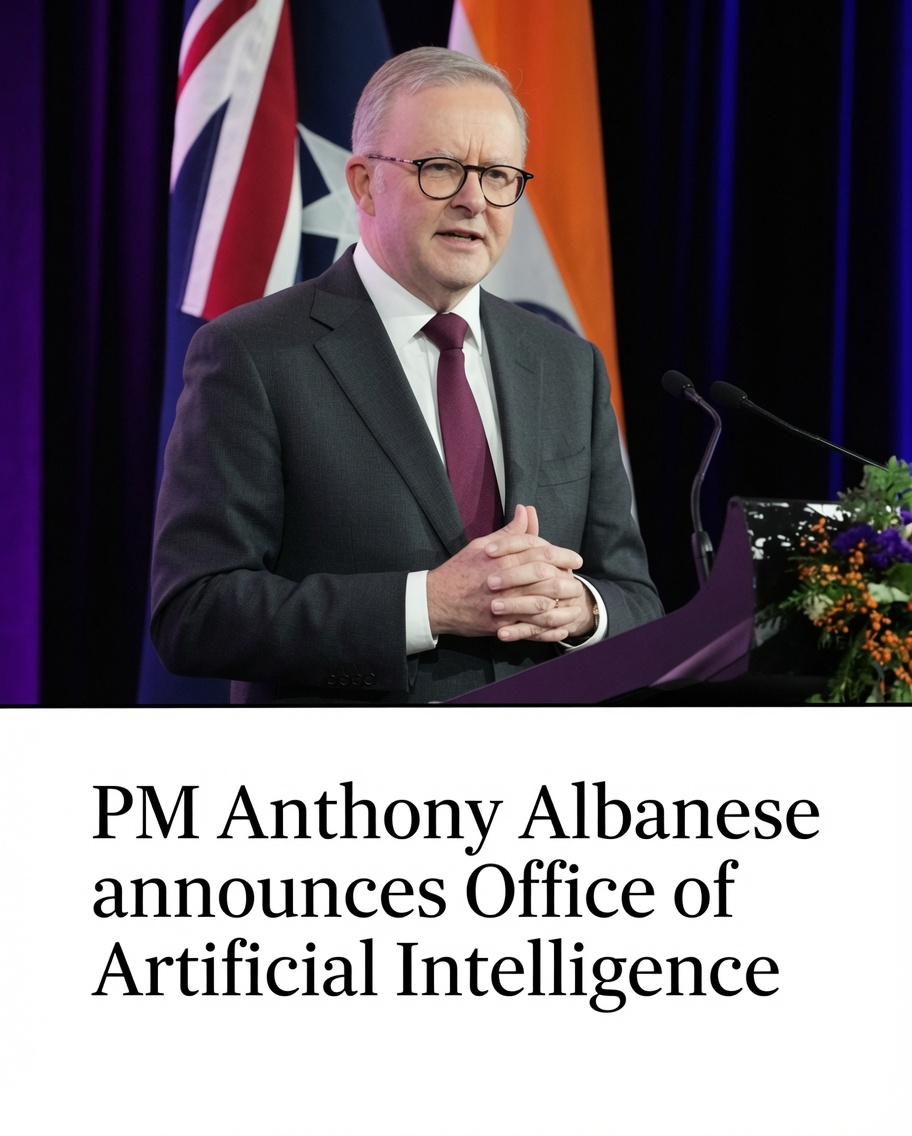
The newly created Office of AI will immediately begin operating within the Prime Minister’s department. Its role will be to coordinate work already underway across multiple portfolios while developing a consistent national approach that involves federal, state and territory governments.
The government also plans to introduce a new set of Australian Standards for AI that will become the foundation for future regulation covering the development, deployment and supporting infrastructure of artificial intelligence.
Unlike previous approaches that addressed AI through separate policy areas such as privacy, consumer protection or workplace regulation, the new framework aims to bring these issues together under one coordinated strategy.
One of the government’s priorities will be creating greater consistency between states, particularly as Australia experiences a rapid expansion of large-scale data centres that power modern AI systems.
Different jurisdictions currently apply different planning rules, approval processes and environmental requirements, creating uncertainty for investors while raising concerns among local communities about electricity demand, water consumption and land use.
Under the proposed framework, Canberra intends to work more closely with state and territory governments through National Cabinet to establish clearer expectations for future AI infrastructure.
Large data centre operators are expected to face stronger obligations regarding energy supply, electricity connections and water efficiency.
The government says operators should be responsible for funding additional electricity capacity needed to support their facilities rather than allowing those costs to flow through to households.
Future standards are also expected to encourage facilities to reduce electricity demand during periods of pressure on the national grid while improving water efficiency in regions where resources are already under strain.
Mr Albanese argued that creating nationally consistent standards would improve Australia’s attractiveness for international investment by providing greater certainty while ensuring community interests remain protected.
Artificial intelligence has become one of the fastest-growing areas of global investment, with technology companies committing hundreds of billions of dollars worldwide to develop increasingly powerful AI models and the infrastructure needed to operate them.
Australia has emerged as an attractive destination for new data centres due to its political stability, skilled workforce and renewable energy potential.
However, rapid growth has also triggered debate over environmental impacts, electricity prices and whether local communities should bear the cost of supporting large technology projects.
The government’s proposal attempts to address both sides of that equation by encouraging investment while establishing clearer expectations for industry.
Another major element of the framework focuses on protecting Australian creators, journalists, artists and publishers as AI companies increasingly rely on vast amounts of online material to train their systems.
Mr Albanese reiterated that Australian creative works should not be used without appropriate permission or compensation, describing copyright protection as an essential part of maintaining trust in AI development.
The government has rejected calls for broad copyright exemptions that would allow technology companies to freely use copyrighted Australian content for AI training.
Instead, Labor says Australia’s copyright framework should continue recognising the rights of creators while allowing innovation to develop through appropriate licensing arrangements.
The issue has become one of the most contentious debates surrounding artificial intelligence worldwide.
Governments across Europe, North America and Asia are grappling with questions about whether existing copyright laws adequately address AI training and whether creators deserve compensation when their work contributes to commercial AI systems.
Australia now appears set to pursue one of the stronger copyright positions among developed economies.
Employment is another area receiving increased attention.
Artificial intelligence promises significant productivity improvements across industries ranging from healthcare and education to manufacturing, mining, finance and professional services.
At the same time, many Australians remain concerned about automation replacing existing jobs or fundamentally changing the nature of work.
The Albanese Government says future AI policy will seek to encourage technologies that improve productivity while supporting workers through economic transition rather than simply replacing human labour.
Business groups have generally welcomed the government’s decision to provide greater regulatory certainty, although some have cautioned against introducing overly complex rules that could discourage investment.
Technology companies have broadly supported efforts to establish clearer national standards, arguing that predictable regulation is preferable to a fragmented system across multiple jurisdictions.
Industry observers say companies investing billions of dollars into AI infrastructure value certainty around planning approvals, environmental requirements and compliance obligations.
At the same time, unions and worker representatives have been calling for stronger safeguards to ensure AI deployment does not undermine employment conditions or workplace rights.
The government’s new framework attempts to accommodate both perspectives by promoting innovation while strengthening public oversight.
The creation of an Office of AI also reflects the growing recognition that artificial intelligence affects almost every area of government policy.
Questions surrounding national security, education, healthcare, consumer protection, taxation, infrastructure, defence and economic development increasingly intersect with AI technologies.
Rather than allowing separate departments to develop independent approaches, the new office will coordinate policy across government and provide central leadership from within the Prime Minister’s own department.
Internationally, governments are taking different approaches to AI governance.
The European Union has adopted comprehensive legislation through its AI Act, establishing risk-based obligations for developers and users of artificial intelligence.
The United States has generally favoured sector-specific regulation while encouraging private-sector innovation, although several individual states have introduced their own AI laws.
Australia’s proposed framework sits somewhere between those models, aiming to establish nationally consistent standards without introducing a standalone AI Act at this stage.
Supporters argue that a coordinated national framework will allow Australia to respond more quickly as AI technology continues evolving.
Critics, however, suggest much will depend on the detailed legislation and regulatory powers that follow the initial announcement.
Key questions remain about enforcement mechanisms, compliance obligations and how future standards will apply across different industries.
The government has indicated legislation supporting the broader framework will be developed following consultation with states, territories, industry, researchers and community stakeholders.
National Cabinet is expected to play an important role in aligning state planning systems with the new federal approach, particularly regarding future data centre developments.
Mr Albanese described the reforms as an opportunity for Australia to shape artificial intelligence according to national values rather than simply reacting to decisions made elsewhere.
He said the objective was to ensure AI delivers economic growth, attracts investment and supports innovation while protecting Australian workers, communities and creators.
As artificial intelligence becomes increasingly embedded in daily life, the establishment of a central Office of AI signals that Canberra intends to place the technology alongside other nationally significant policy challenges requiring coordinated leadership from the highest level of government.






