Prime Minister Anthony Albanese suffered an awkward but harmless scare after an escalator suddenly stopped beneath him moments before he delivered the keynote address at the Australian Labor Party’s 50th National Conference in Adelaide, with the incident quickly attracting widespread attention online.
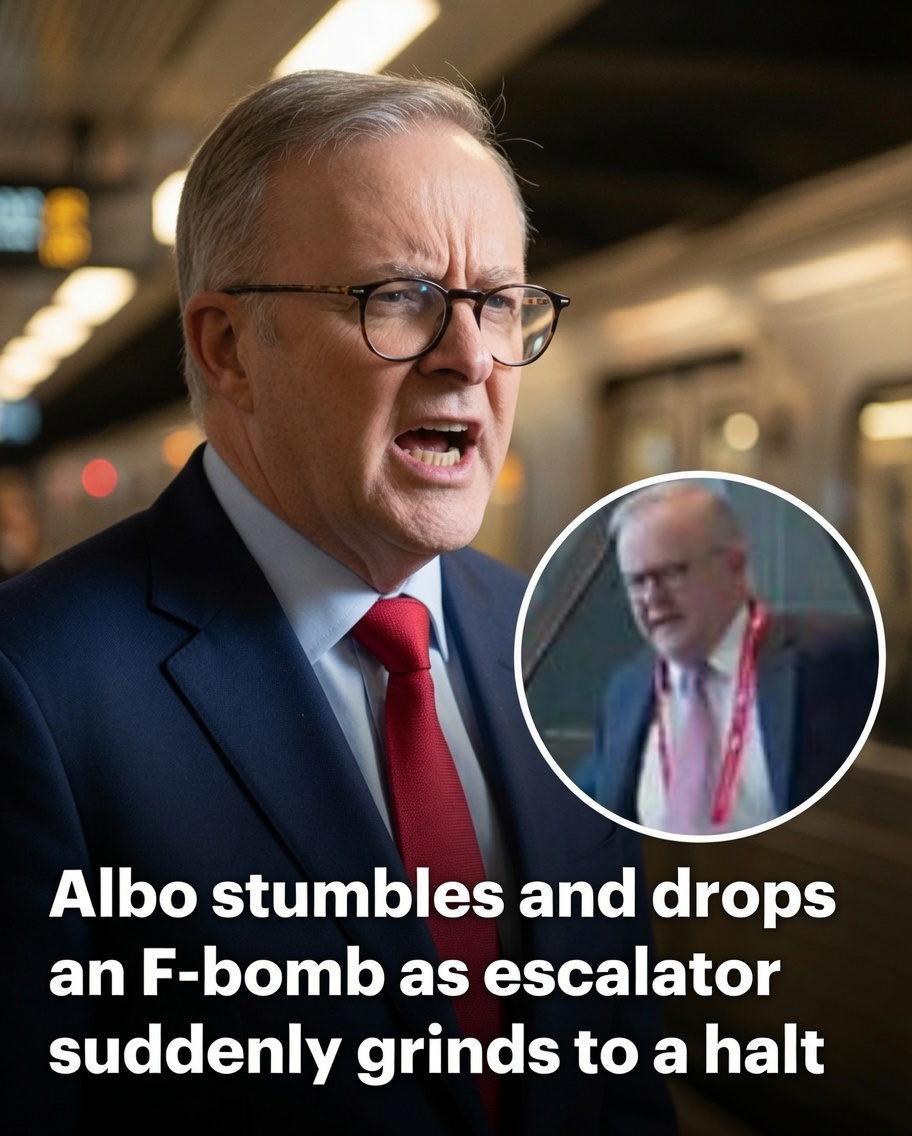
The unexpected malfunction occurred as Mr Albanese arrived at the Adelaide Convention Centre on Thursday morning to open Labor’s landmark national conference, one of the party’s most significant gatherings since its re-election to government.
Video of the incident shows the Prime Minister descending on an escalator when it abruptly came to a halt, causing him to lurch forward and briefly lose his balance.
Mr Albanese instinctively grabbed both handrails to steady himself before continuing down the stationary escalator without assistance. Footage appeared to show him uttering an expletive before turning to look back towards members of his entourage.
Although visibly surprised, the Prime Minister was not injured and proceeded directly to the conference venue, where he delivered his scheduled address without delay.
The brief incident was widely shared across television broadcasts and social media platforms within minutes, prompting speculation among some online users about why the escalator had stopped so suddenly.
Several social media posts suggested someone may have deliberately activated the emergency stop mechanism, while others questioned whether the stoppage resulted from a technical fault.
However, no evidence has emerged publicly to indicate that the incident involved sabotage or intentional interference.
Officials have not suggested any malicious activity, and the Prime Minister was inside a secure area of the convention centre that was subject to extensive security arrangements for the conference.
Reports indicated the escalator remained out of service for some time following the incident, although authorities have not publicly disclosed the cause of the malfunction.
The episode inevitably drew comparisons with a similar incident involving United States President Donald Trump during a visit to United Nations headquarters in New York in 2025.
On that occasion, President Trump also stumbled after an escalator unexpectedly stopped while he and First Lady Melania Trump were descending.
The White House subsequently called for an investigation into whether the stoppage had been deliberate, although United Nations officials later indicated that a built-in safety mechanism may have been triggered accidentally by camera equipment accompanying the presidential delegation.
While the similarities prompted discussion online, there is no indication that the circumstances surrounding Mr Albanese’s experience were connected in any way.
After recovering from the surprise, the Prime Minister shifted his focus to politics, delivering a keynote speech that outlined Labor’s policy priorities and sought to draw clear distinctions between the government and its political opponents.
The conference marks the official opening of Labor’s 50th National Conference, where delegates from across Australia are gathering to debate policy proposals covering workplace relations, energy, taxation, housing, artificial intelligence, national security and foreign affairs.
Addressing hundreds of delegates, Mr Albanese argued that effective governments should be judged not simply by identifying problems but by offering practical solutions.
“A list of problems only counts for something if it comes with solutions,” he told delegates.
Without dwelling extensively on individual opponents, the Prime Minister used part of his address to criticise Pauline Hanson and One Nation, accusing the party of focusing on grievances and division rather than constructive policy alternatives.
His remarks formed part of a broader argument that Labor intended to concentrate on long-term reforms addressing cost-of-living pressures, healthcare, employment and economic productivity.
The conference also provided the Prime Minister with an opportunity to announce several significant policy initiatives.
Among the headline measures was an expansion of the Commonwealth’s Paid Prac program, extending financial support to students undertaking mandatory placements across additional frontline health professions.
The government also confirmed plans to establish a new Fair Work Court designed to resolve workplace disputes more efficiently and improve access to justice for underpaid workers.
Mr Albanese acknowledged that many Australians continue to face financial pressures despite improving economic indicators.
He argued that while inflation has eased from its post-pandemic peak, many households still feel the economy is not delivering the opportunities they expect.
The speech framed Labor’s agenda around easing cost-of-living pressures while investing in future economic growth through workforce participation, education and productivity reforms.
Beyond domestic policy, delegates are expected to debate a wide range of issues over the course of the conference.
These include proposals relating to Australia’s energy transition, taxation of natural resources, housing affordability, migration, artificial intelligence and aspects of Australia’s foreign policy.
Several motions concerning international affairs have also attracted attention, reflecting Labor’s ongoing efforts to balance domestic priorities with Australia’s strategic role in the Indo-Pacific.
The Labor National Conference is held every three years and serves as the party’s highest policy-making forum.
Delegates representing state branches, affiliated unions and party organisations debate policy positions that help shape Labor’s long-term platform.
While conference resolutions do not automatically become government policy, they frequently influence future legislation and election commitments.
As Australia’s governing party, Labor’s conference attracts close attention from business groups, unions, industry representatives and political observers because of its influence on national policy development.
This year’s gathering comes as the Albanese Government enters a new parliamentary term following its election victory, with ministers seeking to outline priorities for the years ahead.
Although the escalator incident briefly overshadowed the opening moments of the conference, it ultimately had little impact on proceedings.
The Prime Minister quickly recovered from the unexpected interruption and completed his address as scheduled, with attention soon returning to the government’s policy announcements and the political debates expected to dominate the remainder of the conference.
For many observers, the incident became one of those unscripted moments that frequently accompany major political events—widely shared online but ultimately secondary to the policy discussions unfolding inside the conference hall.