Prime Minister Anthony Albanese’s latest vision for Australia’s artificial intelligence industry has reignited one of the country’s most contentious policy debates, with critics arguing that Labor’s continued opposition to nuclear power sits uneasily alongside its ambitions to attract some of the world’s most electricity-intensive industries.
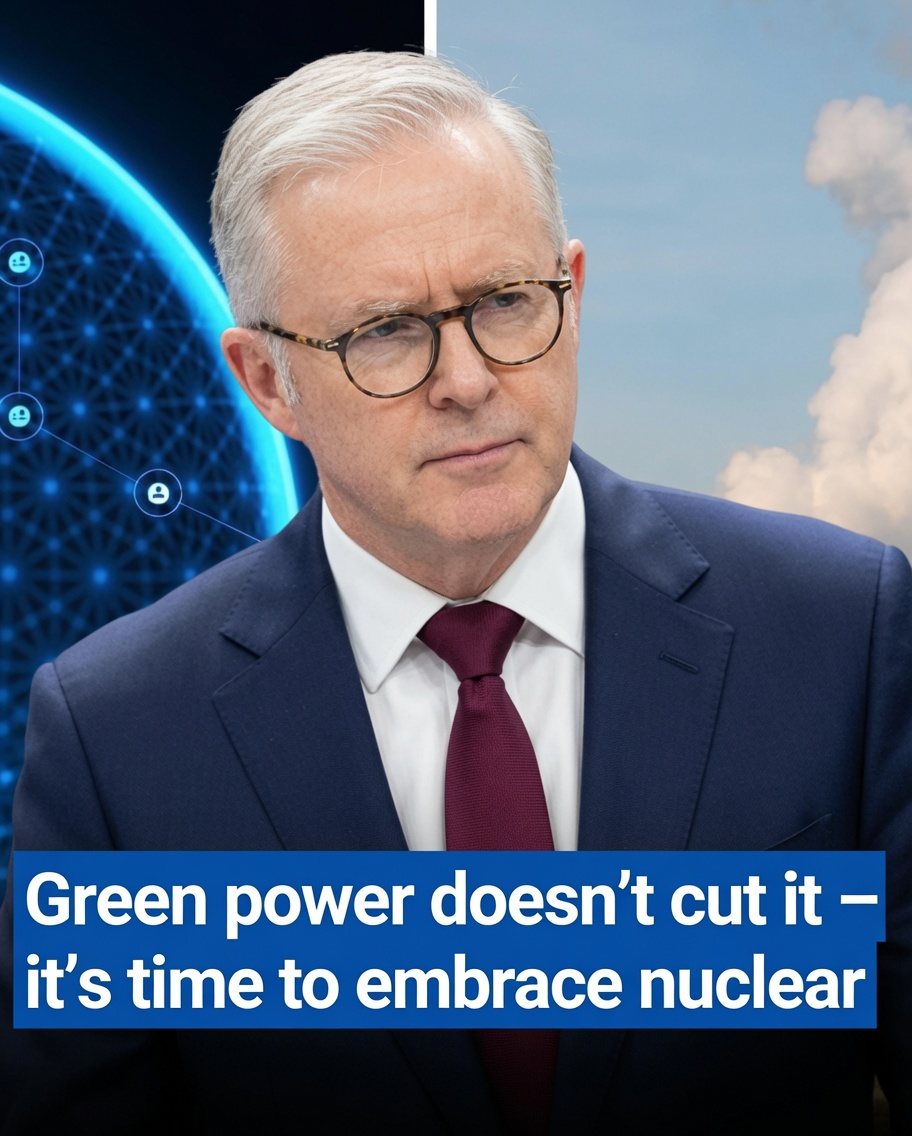
The renewed controversy followed the Prime Minister’s announcement of a new framework for artificial intelligence that would require the next generation of large-scale AI data centres to fund their own additional electricity generation while meeting strict environmental standards.
Speaking as part of the government’s broader AI strategy, Albanese said Australia wanted to become a destination for advanced artificial intelligence investment while ensuring new facilities contributed to, rather than strained, the national electricity system.
Under the proposed approach, major AI data centres would be expected to underwrite new power supplies, pay the full cost of connecting to the electricity grid and minimise water consumption, ensuring households and existing businesses were not left subsidising the rapid expansion of the sector.
However, the announcement immediately prompted criticism from supporters of nuclear energy, who argued that artificial intelligence requires large volumes of reliable, around-the-clock electricity that intermittent renewable generation alone cannot consistently provide.
One prominent opinion article described Labor’s anti-nuclear position as increasingly difficult to defend, arguing that Australia risks discouraging investment in advanced technologies by limiting the range of available energy sources.
Artificial intelligence has become one of the fastest-growing sources of electricity demand worldwide.
Modern data centres train increasingly sophisticated AI models while simultaneously processing billions of user requests each day. Those facilities consume enormous quantities of electricity, with some of the largest campuses requiring as much power as a medium-sized Australian city.
Unlike many industrial users, AI infrastructure generally operates continuously.
Interruptions to electricity supply can have significant operational and financial consequences, making reliability a critical consideration alongside energy cost and carbon emissions.
That reality has increasingly influenced investment decisions by global technology companies.
Several of the world’s largest technology firms—including Amazon, Google, Microsoft and Meta—have announced major investments in nuclear energy projects in the United States as they seek dependable zero-emission electricity to support rapidly expanding AI operations. These investments include agreements involving existing reactors as well as next-generation nuclear technologies.
Supporters of nuclear power argue these developments demonstrate that advanced economies increasingly view nuclear generation as an important complement to renewable energy, particularly for industries requiring constant electricity supply.
Critics of Australia’s current policy contend that preventing private companies from developing nuclear-powered facilities could reduce the country’s competitiveness as technology firms decide where to build future AI infrastructure.
Australia, however, has taken a different policy direction.
The Albanese Government maintains that renewable energy, supported by batteries, pumped hydro storage and other forms of firming capacity, can provide reliable electricity while helping Australia achieve its legislated emissions reduction targets.
Rather than permitting nuclear generation, Labor continues to prioritise large-scale investment in solar, wind, transmission infrastructure and electricity storage.
The Prime Minister’s latest AI announcement is consistent with that broader strategy.
Instead of prescribing a particular technology, the government proposes requiring developers to provide additional electricity generation for new AI facilities while ensuring projects do not increase costs for existing consumers. It also intends to introduce national AI standards and establish an Office of AI to oversee implementation of the broader regulatory framework.
Energy policy has become one of the defining political differences between Australia’s major parties.
Labor argues renewable energy represents the fastest and most cost-effective pathway towards decarbonising the electricity system.
The Coalition, by contrast, continues to advocate for the eventual introduction of nuclear power alongside renewable generation, arguing that a balanced electricity mix would improve long-term reliability while supporting industries with substantial energy requirements. :
Australia remains one of the few developed nations with significant uranium resources but no commercial nuclear power stations.
Although the country exports uranium to overseas nuclear industries, domestic nuclear electricity generation remains prohibited under current federal legislation.
That long-standing policy has repeatedly become the subject of political debate, particularly as countries including the United States, France, Canada and the United Kingdom continue operating or expanding nuclear generation as part of their low-emissions energy mix.
Opponents of nuclear energy argue that the technology remains expensive to build, requires lengthy development timeframes and would not address Australia’s immediate energy transition challenges.
Supporters counter that the rapid growth of artificial intelligence, advanced manufacturing and data processing is changing electricity demand in ways that make highly reliable low-emissions generation increasingly valuable.
The debate has intensified because AI is expected to become one of the most electricity-intensive industries over the coming decade.
Governments around the world are now weighing how to encourage investment while balancing energy security, affordability and environmental objectives.
Australia’s proposed AI framework reflects an attempt to achieve those competing goals by requiring developers to finance additional electricity generation and grid infrastructure rather than shifting costs onto existing consumers.
Business groups and technology companies have generally welcomed the government’s engagement with the AI sector, although industry participants continue to debate the practical implications of the proposed electricity requirements and broader regulatory settings.
The latest disagreement therefore extends beyond a simple argument about nuclear power.
At its centre lies a broader question confronting many advanced economies: how to provide enough reliable, affordable and low-emissions electricity to support rapidly growing artificial intelligence industries without compromising national climate objectives.
Whether Australia ultimately maintains its renewable-focused strategy or eventually broadens its energy mix to include nuclear generation will remain a significant policy question.
For now, however, the government’s commitment remains unchanged.
Labor continues to argue that Australia can become an AI leader while relying on renewable energy supported by firming technologies, whereas critics maintain that excluding nuclear power unnecessarily limits the country’s options as global competition for AI investment accelerates.






