ABC Chair Kim Williams has firmly rejected accusations that Australia’s national broadcaster operates with either a left-wing political agenda or an anti-Israel editorial bias, while acknowledging he made an inappropriate personal comment earlier this year when referring to Israeli Prime Minister Benjamin Netanyahu.
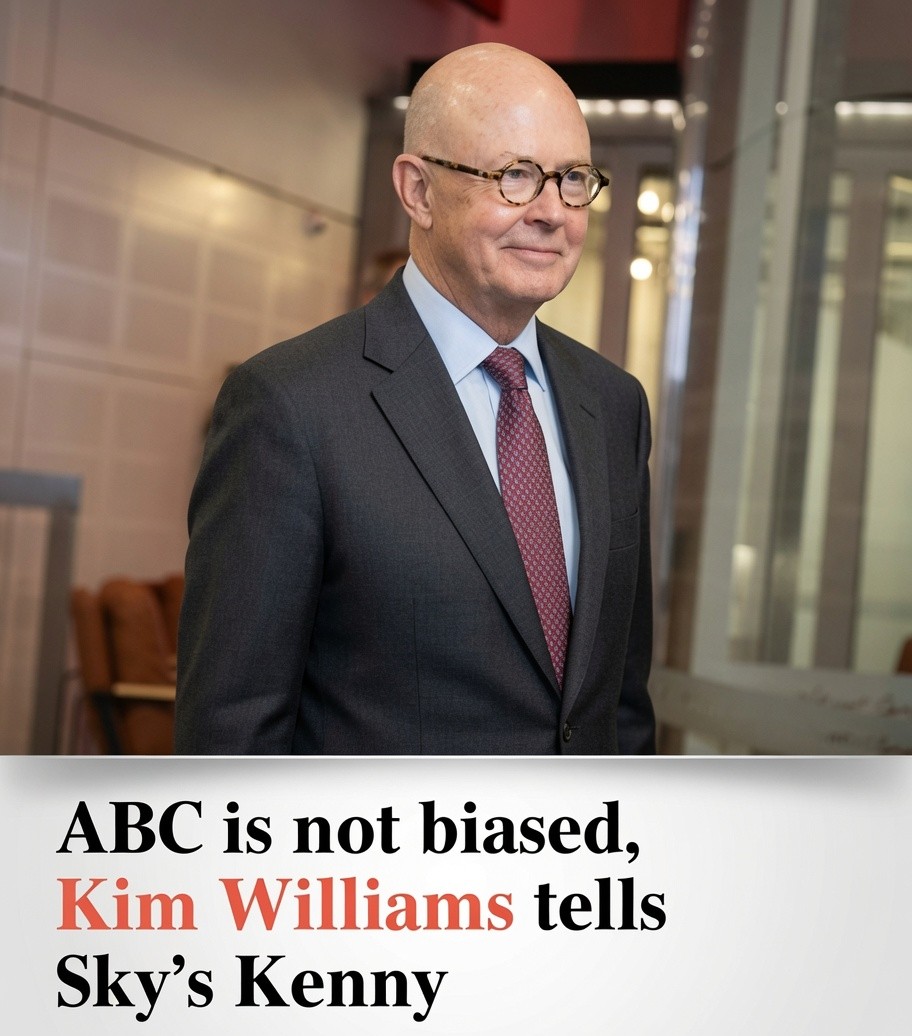
In a wide-ranging interview that touched on political neutrality, public trust and the ABC’s coverage of the Middle East, Williams insisted the broadcaster remained committed to impartial journalism despite facing sustained criticism from politicians, commentators and advocacy groups across the political spectrum.
“We are not biased,” Williams said, rejecting suggestions that the publicly funded broadcaster had become institutionally left-leaning or hostile towards Israel.
However, the ABC chairman also used the interview to apologise for remarks he made earlier in 2026 when he described Benjamin Netanyahu as an “aberrant” figure during a newspaper profile.
Williams said the comment was inappropriate given his position as chair of Australia’s national broadcaster.
“That was a very inappropriate thing for me to say and I shouldn’t have said it,” he acknowledged, while maintaining that his personal assessment of Netanyahu’s political legacy had been expressed in the wrong forum and by the wrong person.
The apology comes as the ABC finds itself under unprecedented scrutiny over its reporting of the Israel-Gaza conflict.
Since the Hamas attacks on Israel on 7 October 2023 and the subsequent war in Gaza, the broadcaster has received thousands of audience complaints alleging bias. Critics from within Australia’s Jewish community and several politicians have argued the ABC’s reporting has at times unfairly portrayed Israel or failed to adequately reflect Israeli perspectives.
At the same time, other audiences have accused the broadcaster of being overly sympathetic to Israel, illustrating the highly polarised nature of the conflict and the difficulty faced by news organisations covering it.
According to figures released by the ABC, complaints relating to the Middle East became the single largest source of editorial complaints received by the organisation over the past two years.
The broadcaster says that during the second half of 2025, 51 per cent of complaints alleged its coverage was broadly pro-Palestinian, while 47 per cent claimed it was broadly pro-Israel.
ABC executives argue those near-even figures suggest perceptions of bias are being driven largely by strongly held opposing views rather than systematic editorial favouritism.
Williams strongly defended that position.
He said he had seen no evidence that the ABC as an institution had adopted either a left-wing political ideology or an anti-Israel editorial culture.
He also rejected suggestions that journalists’ personal political views were influencing newsroom decisions, arguing that the corporation’s editorial systems, standards and oversight mechanisms were designed specifically to ensure impartiality regardless of individual opinions.
The comments were made during a rare television appearance in which Williams was questioned directly about longstanding criticism of the ABC’s political balance.
Among the issues raised were claims that conservative voices receive less prominence than progressive perspectives and allegations that coverage of Indigenous affairs, climate policy and the Israel-Gaza conflict has reflected a consistent ideological direction.
Williams dismissed those assertions, describing the ABC as “a force for impartiality and objective journalism.”
The timing is particularly significant because the ABC recently appeared before the Royal Commission into Antisemitism and Social Cohesion, where senior executives were questioned about allegations that aspects of the broadcaster’s Middle East reporting had contributed to community tensions.
In submissions to the commission, the ABC categorically rejected claims that its journalism had fuelled antisemitism or social division.
The broadcaster said its reporting had consistently been evidence-based, fair, impartial and fully consistent with its Charter obligations as Australia’s independent national broadcaster.
The ABC also acknowledged that its Ombudsman had identified a small number of editorial breaches involving Middle East reporting, primarily relating to factual accuracy.
However, it said no complaints alleging political bias in ABC News’ Middle East coverage had been upheld by the Ombudsman.
The corporation argued that while individual errors had occurred, they should not be interpreted as evidence of institutional bias.
Williams’ apology regarding Netanyahu has attracted attention because of the ABC chair’s normally limited public commentary on political figures.
When he originally made the remarks earlier this year, Williams sought to distinguish between his longstanding support for Israel as a nation and his personal assessment of Netanyahu’s political leadership.
Nevertheless, he has since accepted that expressing such a view publicly risked undermining confidence in the broadcaster’s neutrality, regardless of whether the opinion related to editorial decisions.
The controversy also highlights the increasingly difficult position occupied by public broadcasters covering one of the world’s most divisive conflicts.
Since the outbreak of the Israel-Hamas war, media organisations internationally have faced intense criticism from opposing audiences, with accusations of bias frequently arising from the selection of stories, language, sourcing and contextual framing rather than factual inaccuracies alone.
For the ABC, the challenge is compounded by its statutory obligation to remain impartial while also serving a diverse Australian audience with widely differing political and cultural perspectives.
Williams has overseen a period of significant change at the ABC since becoming chair in 2024, including organisational restructuring and editorial reforms aimed at strengthening public confidence in the broadcaster.
He has repeatedly argued that maintaining trust depends not on avoiding criticism altogether but on ensuring editorial decisions continue to be guided by evidence, verification and the corporation’s editorial policies rather than political pressure from any side.
Critics, however, remain unconvinced.
Some conservative commentators argue the ABC has failed to acknowledge longstanding concerns about ideological diversity within its newsroom, while several Jewish organisations have continued calling for greater scrutiny of the broadcaster’s reporting on Israel and the Middle East.
Others argue the volume of complaints coming simultaneously from pro-Israel and pro-Palestinian audiences demonstrates the inherent difficulty of satisfying all sides during a deeply polarised international conflict.
Williams’ public apology over his Netanyahu remark may not end that debate, but it represents an unusual acknowledgment from the chair of Australia’s national broadcaster that even personal comments can affect perceptions of editorial independence.
As the ABC continues facing political scrutiny, parliamentary criticism and public examination through the Royal Commission, questions surrounding impartiality are likely to remain central to the national conversation about the role of publicly funded journalism in Australia.






