A cardboard box from Bunnings, a wildlife rescuer in full protective equipment and a crowd of curious beachgoers standing behind orange cones.
For a few hours, the scene at Noosa Main Beach looked both strangely Australian and deeply unsettling.
A sick migratory seabird had come ashore at one of Queensland’s most famous tourist destinations.
It was behaving unusually.
Australia had only recently confirmed the arrival of the serious H5 strain of avian influenza in wild seabirds.
And nobody on the beach could tell by looking at the animal whether Queensland was about to record another detection.
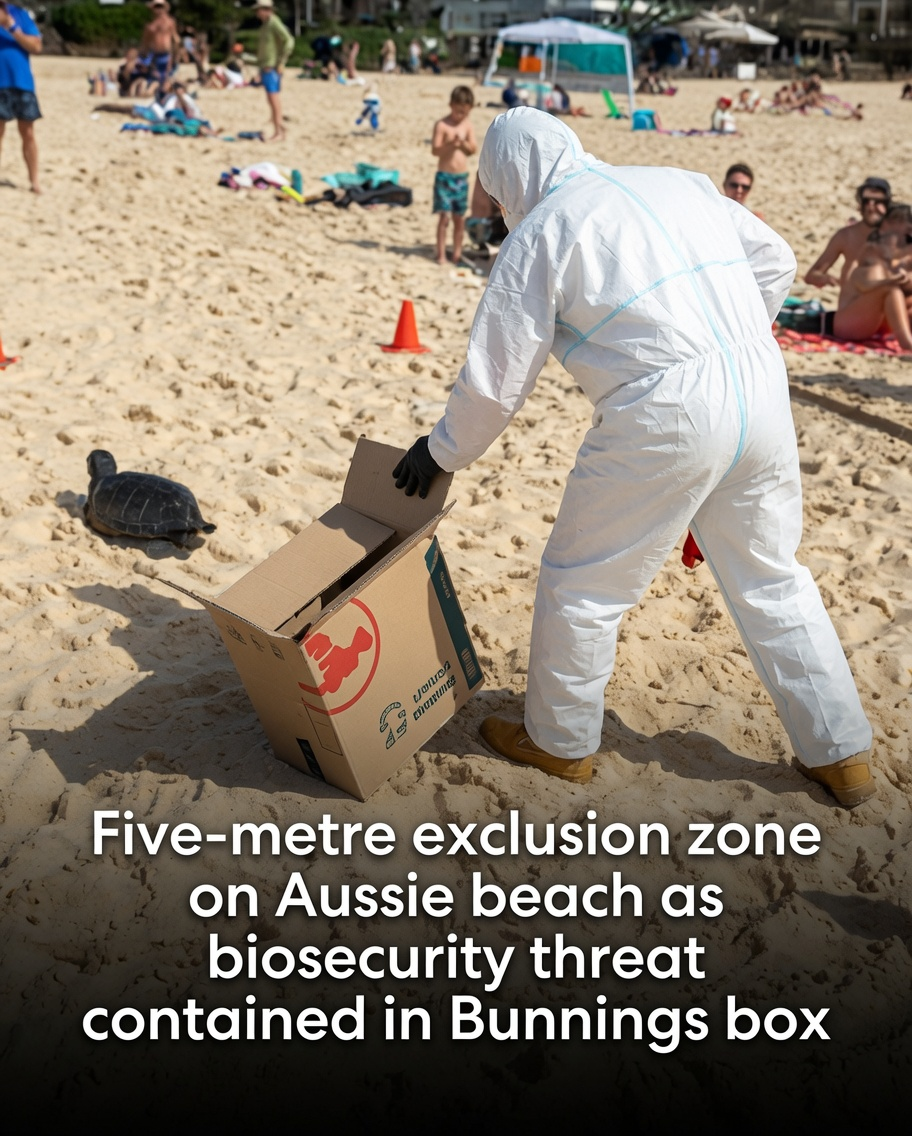
So lifeguards kept people back.
A wildlife rescuer suited up.
The bird was carefully contained.
Then it was taken away in a cardboard box reportedly collected from Bunnings.
The good news arrived days later: the northern giant petrel tested negative for H5 bird flu.
But the incident revealed how Australia’s relationship with sick wildlife has changed in a matter of weeks.
A distressed seabird on a beach is no longer automatically treated as an ordinary rescue.
It may now be a biosecurity event.
Beachgoers were told to stand back as the bird circled strangely in the surf
The northern giant petrel was first spotted around Tea Tree Bay before it was found stranded at Noosa Main Beach on Saturday.
Will Watson, the founder of Wildlife Noosa, was called to assist after lifeguards raised the alarm.
The bird’s behaviour immediately caused concern.
Watson said it appeared to be acting strangely in the surf break.
It was not moving normally and appeared to be going in circles.
Those signs were similar to some of the warning behaviours wildlife carers had been told to watch for as Australia increased surveillance for H5 avian influenza.
That did not mean the bird had bird flu.
Sick and injured wildlife can display abnormal behaviour for many reasons.
But with H5 already detected in Australian seabirds, the possibility could not simply be dismissed.
Orange cones were placed around the animal to create an exclusion area and keep members of the public at a distance.
Footage from the beach showed dozens of people watching as Watson approached the petrel wearing protective equipment.
The response looked dramatic.
It was deliberately precautionary.
Federal biosecurity guidance tells Australians not to touch sick or dead wild birds or other animals suspected of bird flu.
People are instead urged to record the location, take photographs or video where safe and report the animal to authorities.
That advice exists because direct contact can expose people, clothing, footwear and equipment to potentially contaminated material.
H5 can also pose a serious threat to other birds.
For wildlife rescuers, that means protecting themselves is only one part of the job.
They must also avoid carrying disease from a suspected animal into a rehabilitation facility containing vulnerable wildlife.
The bird left Noosa in a Bunnings box
One detail of the rescue quickly attracted attention online.
The container used to move the giant petrel was a cardboard box associated with Bunnings.
Watson had reportedly picked it up before heading to the beach.
It produced an unmistakably Australian image.
A potential biosecurity threat at one of the country’s best-known beaches was being carried away in a hardware-store box.
But the improvised appearance should not be confused with a casual response.
Watson wore personal protective equipment while handling the bird.
The animal was taken to RSPCA Queensland’s Wildlife Rehabilitation Centre at Eumundi, where it was assessed and swabbed for H5 avian influenza.
Biosecurity Queensland conducted testing as part of its surveillance program.
The petrel was then managed under quarantine precautions while authorities awaited the result.
Wildlife carers working with the bird used protective clothing and biosecurity procedures to reduce the risk to other animals.
The box made the headline. The quarantine procedures were the important part.
Queensland authorities have now confirmed the bird was negative
On Tuesday, authorities confirmed the Noosa giant petrel had tested negative for H5 bird flu.
The result provided relief after significant public interest in the case.
Biosecurity Queensland does not ordinarily announce every individual negative test result.
But Queensland’s Department of Primary Industries said the attention surrounding the Noosa bird justified publicly confirming the outcome.
The department said Biosecurity Queensland had received hundreds of reports through the 24-hour Emergency Animal Disease Hotline.
Authorities thanked members of the public for their vigilance.
The negative result means the Noosa petrel did not become another confirmed H5 detection.
It also demonstrates an important part of disease surveillance that can be easy to misunderstand.
Most suspected cases do not need to be positive for the reporting system to work.
Early detection depends on people reporting animals that look sick or behave unusually.
Authorities then investigate.
Some animals will test negative.
That is not wasted effort.
It is how a surveillance network finds the cases that matter.
If wildlife carers wait until they are certain an animal has H5 before taking precautions, they have waited too long.
Australia’s H5 situation changed dramatically in June
The concern at Noosa must be understood against the extraordinary developments of the past month.
Australia confirmed its first detections of the serious H5 bird flu strain in June 2026.
The virus had already caused devastating outbreaks among poultry, wild birds and some mammal populations overseas.
Australia had spent years preparing for its possible arrival.
Then a migratory seabird found on an isolated beach in Western Australia’s Cape Le Grand National Park returned a positive result.
Further detections followed.
According to the federal Department of Agriculture, Fisheries and Forestry, Australia had recorded 13 confirmed or presumed H5 detections in wild birds by 9am on July 12.
Those detections involved individual seabirds found at coastal locations.
Twelve were migratory birds.
One was an Australian resident greater crested tern.
The resident seabird detection attracted particular attention because it raised questions about whether the virus could be moving beyond migratory birds infected elsewhere.
Scientists and authorities continue to analyse the detections and monitor wildlife.
There is still no evidence of mass mortality in Australian wildlife.
There are also no H5 detections in Australian poultry or the broader agricultural production system.
The federal government says the risk to human health remains low.
Those facts are reassuring.
They do not mean surveillance can relax.
Why a single sick bird at Noosa was taken so seriously
Giant petrels are large seabirds capable of travelling enormous distances.
Their movements make them particularly relevant to Australia’s H5 surveillance.
Migratory and highly mobile seabirds can encounter wildlife populations across vast geographic areas.
Australia’s earliest H5 detections have overwhelmingly involved seabirds.
That meant the combination at Noosa was impossible to ignore.
A giant petrel.
Abnormal behaviour.
A coastal location.
A country that had just confirmed H5 in other seabirds.
No individual sign proved infection.
Together, they justified testing.
Associate Professor Dominique Potvin, a wildlife and conservation researcher at the University of the Sunshine Coast, told the ABC the arrival of H5 in Australia represented a serious concern for wildlife.
Internationally, highly pathogenic avian influenza has caused enormous losses in some bird populations.
The H5 strain currently being monitored in Australia has caused severe disease and high death rates in poultry, wild birds and affected mammals overseas.
Australia has not experienced those mass mortality events.
Authorities want to detect changes quickly if the situation worsens.
That is why one strange bird on a crowded Queensland beach can trigger PPE, an exclusion zone and laboratory testing.
The human health risk is low — but Australians are still being told not to touch sick birds
The sight of a rescuer in protective equipment can easily create fear that the public faces an immediate health emergency.
That is not the current advice.
Australian authorities say the risk of H5 bird flu to human health remains low.
There is no evidence of widespread infection among people in Australia.
But low risk does not mean zero risk.
People should not pick up sick or dead birds.
They should not attempt to take an animal home.
Dogs and other pets should also be kept away from potentially affected wildlife.
If a person finds a sick or dead wild bird or another animal showing possible signs of bird flu, federal guidance recommends avoiding contact.
Where safe, people can take photos or video and record the location.
The incident should then be reported to the 24-hour Emergency Animal Disease Hotline on 1800 675 888.
Authorities particularly want reports involving multiple sick or dead animals, unusual behaviour or wildlife in areas where H5 surveillance is active.
The public’s role is to report, not rescue.
Trained wildlife carers and biosecurity officials have equipment and procedures designed to reduce the risk of spreading disease.
A well-intentioned person placing a sick bird in their car can potentially contaminate surfaces, clothing or footwear.
If that person keeps backyard chickens or pet birds, the consequences could become more serious.
Australia is particularly concerned about H5 reaching poultry
So far, Australia’s confirmed H5 detections have been confined to wild seabirds.
There is no evidence of the virus in poultry or livestock.
Protecting commercial and backyard bird populations is a major biosecurity priority.
Highly pathogenic avian influenza can spread rapidly among susceptible birds.
Overseas outbreaks have forced the destruction of enormous numbers of poultry and disrupted egg and food production.
Australia has previous experience responding to other avian influenza strains.
The H7 outbreak in Victoria in 2025 was eradicated.
But the H5 strain now present in wild seabirds is different.
It is the globally circulating strain that authorities had feared could eventually reach Australia.
The federal government says more than $113 million has been invested to strengthen preparedness for H5 bird flu.
Additional funding has also been directed towards protecting threatened native species and improving the preparedness of wildlife facilities.
The reason is simple.
Once a highly infectious disease enters a dense poultry population, the response becomes much more difficult and economically damaging.
Backyard bird owners are therefore being asked to strengthen basic biosecurity.
Wild birds and feral chickens should be kept away from domestic birds where possible.
Food and water should be protected from contamination.
Owners should consider how footwear, clothing, vehicles and equipment could carry contaminated material into bird areas.
A person does not need to carry an infected bird into a chicken coop to create a risk. Contaminated shoes or equipment can matter too.
The Noosa response shows how quickly ordinary wildlife rescue has changed
For organisations such as Wildlife Noosa, the arrival of H5 has created a difficult new reality.
Wildlife carers are accustomed to responding when animals are injured, exhausted or stranded.
Their instinct is to help.
But a rescuer now has to consider whether the animal in front of them could also threaten every other bird already in care.
A rehabilitation centre may contain pelicans, seabirds and other vulnerable animals.
Introducing H5 into such a facility could be catastrophic.
That changes transport.
It changes protective equipment.
It changes cleaning procedures.
It changes where an animal is housed.
It changes how often carers enter an isolation area.
The northern giant petrel rescued from Noosa was managed cautiously because carers could not know the test result in advance.
The fact it ultimately tested negative does not make those precautions unnecessary.
Biosecurity is most effective when it looks excessive before the result arrives.
If the bird had tested positive, every shortcut taken during its rescue would suddenly have mattered.
Watson’s PPE would have mattered.
The exclusion zone would have mattered.
The transport container would have mattered.
The quarantine arrangements would have mattered.
The negative test allowed everyone involved to exhale.
It did not invalidate the response.
Noosa’s bird flu scare ended with the best possible result
Noosa Main Beach returned to normal.
The crowds remained safe.
The giant petrel was removed from the public area.
Biosecurity Queensland tested the animal.
The result was negative for H5 bird flu.
For a tourist town accustomed to dealing with surf conditions, marine wildlife and crowded beaches, the incident was a glimpse of a new type of coastal hazard.
Australia now has H5 bird flu in wild seabirds.
There is no evidence of a mass wildlife die-off.
There is no evidence of infection in poultry or the agricultural production system.
The human health risk remains low.
But sick seabirds are being watched in a way they were not only a few months ago.
At Noosa, that meant orange cones on the sand and beachgoers being asked to keep their distance.
It meant a rescuer crossing the beach in full PPE.
And, yes, it meant a giant petrel leaving one of Australia’s most famous beaches in a Bunnings cardboard box.
The box made the scene memorable. The negative test made it a relief.
But the next sick bird may not produce the same result.
That is why authorities want Australians to remember the most important lesson from Noosa.
Stand back. Do not touch. Report it.






