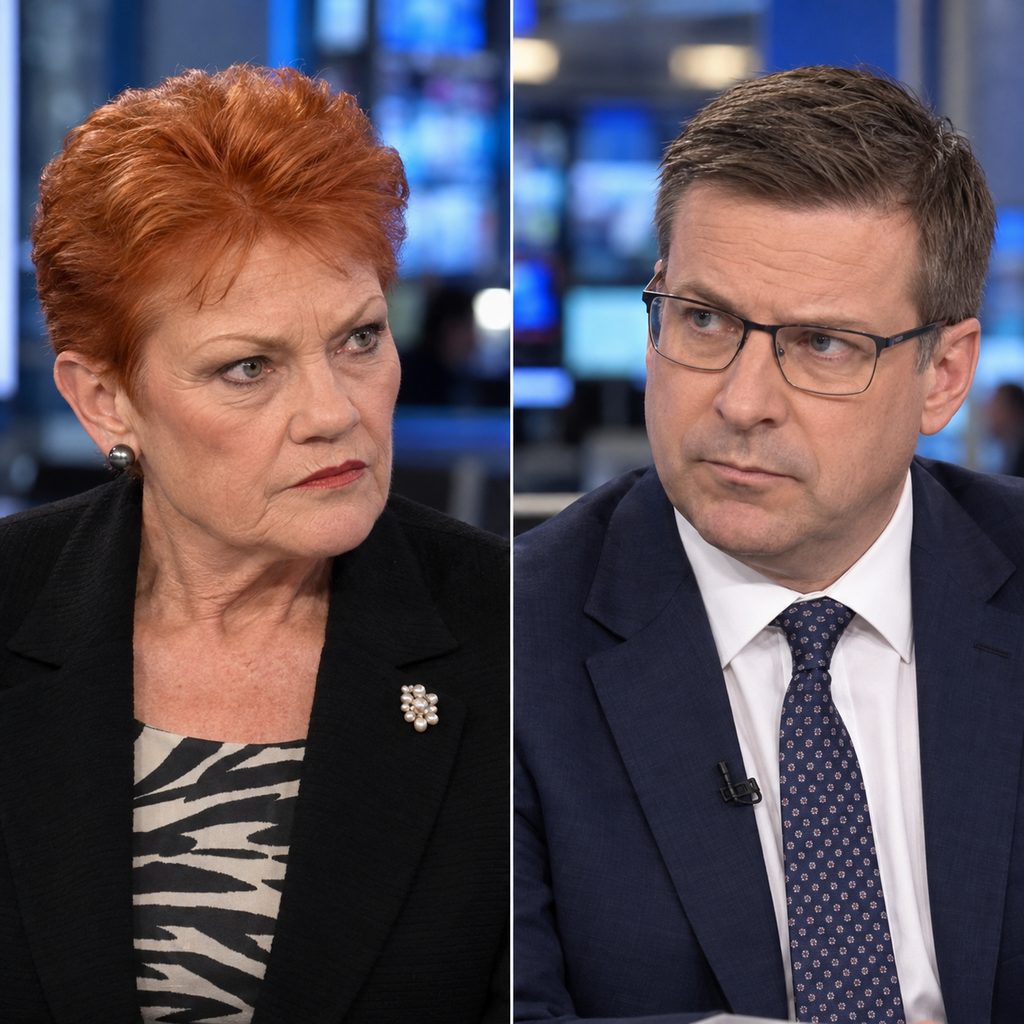
One Nation leader Pauline Hanson has cancelled a scheduled interview with broadcaster Andrew Clennell after criticism of the party’s provocative political cartoons, intensifying a dispute about satire, responsibility and media scrutiny after the alleged attack on independent MP Helen Haines.
The Australian reported that One Nation national director James Ashby informed Clennell by text that Hanson would not proceed with her Monday appearance because he had characterised the cartoons as unhelpful. The messages reportedly conveyed an insulting assessment of Clennell attributed to Hanson. Ashby did not deny the exchange when contacted for comment. The sequence offers a clear account of a cancelled interview and a dispute communicated through a party official, not an independently recorded insult delivered by Hanson on air.
The cartoons had been distributed before the alleged vehicle attack on Haines and portrayed political figures in exaggerated situations, including scenarios invoking physical harm and betrayal. Clennell criticised the imagery against the backdrop of rising concern about political violence. The publication date matters: the material did not emerge as a response to the incident. A journalist should not describe the videos as being created after the attack or assert that they caused the alleged offence.
The confrontation illustrates the distinctive role of political satire. Mockery, exaggeration and caricature have long been part of Australian political culture. Satire can help voters notice contradictions and question people with power. It can also draw justified criticism when imagery appears to celebrate intimidation or present physical violence as a legitimate political response. Those assessments involve context and interpretation, not a simple rule that an offensive cartoon is unlawful.
One Nation uses provocative communication to draw attention to its political message. The party is entitled to make its case and defend its media output. Clennell, as an interviewer, is likewise entitled to question whether its depiction of politicians crosses an ethical line. Hanson is under no general obligation to accept every interview invitation, and cancelling one does not establish misconduct. The newsworthiness lies in why the interview was withdrawn and the public debate taking place around that decision.
The timing added sensitivity. Haines had suffered serious injuries in an alleged attack, prompting parliamentarians to reflect on the tone of political communications. The question of whether violent cartoons are ‘unhelpful’ was therefore not merely an aesthetic judgement. It was part of a broader discussion about how politicians communicate with audiences who may already be angry at the political system. That context helps explain the reaction without proving a causal link to violence.
Attribution is a central safeguard in reporting the messages. When a party official writes that the leader regards a journalist in a particular way, it may be reasonable to report that the official conveyed the leader’s view. It is a different claim to say the leader personally sent the message. It would be more misleading still to invent a face-to-face exchange or place the reported insult in quotation marks as if heard directly from Hanson’s mouth.
Clennell’s role also requires context. A political interview is not simply free publicity for a party, although politicians often hope to use it that way. Broadcasters may ask difficult questions, and viewers can judge whether the questions are informed and fair. Declining a difficult interview can create the impression that a politician is unwilling to engage with scrutiny, but that impression remains an interpretation rather than a factual finding about motive.
The dispute raises a question for political parties: when content is designed to provoke, what responsibility do leaders accept for the public reaction it generates? Some audiences will recognise satirical conventions immediately. Others may read a portrayal of a stabbing or attack more literally. Party officials can defend the intended meaning and explain their choices. Journalists can ask why those particular images were selected and what the party believes viewers should take from them.
There is an important distinction between criticism of expression and demands for censorship. Clennell reportedly criticised the cartoons as unhelpful; that is not equivalent to saying they must be outlawed. A viewer may object strongly to the content without seeking government punishment. Likewise, a party may vigorously defend provocative satire while accepting that other people have a right to condemn it. Treating all disagreement over political imagery as an attack on free speech obscures that distinction.
Public discussion would benefit from details about the audience, circulation and intended message of the cartoons, but such details should not be invented. It is possible to describe the visible violent motifs and reactions without claiming to know how every viewer interpreted them. Strong causal claims about the effect of a campaign require evidence far beyond a broadcaster’s criticism or the anger prompted by an individual image.
The Haines case must remain legally separate. Authorities are investigating an alleged attack on the independent MP. The fact that political figures are debating rhetoric in the aftermath does not make any party, broadcaster or particular piece of satire responsible for that act. If new evidence emerges, the situation can be updated. Until then, speculation about the attacker’s motivations risks turning a legitimate public discussion into an unsupported accusation.
Political broadcasters have their own accountability obligations. A host who calls material unhelpful should be ready to explain the basis for that assessment and allow the party a fair chance to respond. Viewers can then distinguish criticism based on the actual cartoons from criticism based on assumptions about One Nation supporters. Fairness does not require a host to suppress genuine questions, but it does require accurate characterisation of what has been published.
An effective response by the party would need to deal with the particular imagery at issue. Is a violent act presented as a joke about betrayal between leadership rivals, or is it an attempt to encourage an audience to admire intimidation? The difference may be obvious to some viewers and contested by others. The political issue is partly about whether a leader accepts responsibility for the reasonable range of interpretations that provocative imagery can attract.
This controversy also reflects the way news interviews serve two audiences. Political organisations want to communicate with sympathetic voters, while broadcasters have responsibilities to a wider public that may be sceptical or hostile to the politician. A cancellation can reinforce the party’s appeal among supporters who dislike the media, while leaving undecided viewers with fewer answers. Those political effects are plausible considerations, not a proven explanation of Hanson’s private decision.
The text-message exchange should be viewed with similar care. The source of an attributed insult affects both fairness and reliability. Describing the content as a message relayed by Ashby gives readers the information necessary to evaluate it. Stripping away that context for a more dramatic quote would misleadingly convert an indirect report into a direct statement. The strongest coverage is exact about who communicated with whom.
The interview cancellation is still consequential for the audience. It removed an opportunity for a senior political figure to address criticism through direct questioning. A broadcast conversation might have clarified whether Hanson stood by the cartoons, how she understood their imagery and what she expected party supporters to make of them. Those questions remain legitimate regardless of the broadcaster’s personal reputation or the party’s dislike of his comments.
Party officials can communicate with newsrooms in blunt terms, and journalists can report those interactions when they bear on public accountability. Reporting should nevertheless avoid sensationalising a private message beyond its verified content. The words a source uses, whether the source personally witnessed the comment and whether the relevant person has responded all matter. That discipline is particularly important when a dispute itself has become a vehicle for publicity.
Political leaders face a strategic choice when confronted by criticism of an attention-grabbing campaign. They can explain or defend the campaign in public, modify it, or avoid an encounter they consider unfair. None of those choices proves the merit of the original imagery. Voters can evaluate them as evidence of a party’s communications approach, but should not infer a hidden agreement or an unspoken reason without support.
The row also shows how quickly the focus of a political controversy can shift. The original subject was the appropriateness of animated scenes featuring violence and political figures. After the cancellation, public attention moved to whether a senior politician should speak to a journalist who criticised the material. Both are legitimate news questions, but they are not identical. A report that focuses only on the insult risks losing sight of the cartoons, while one that discusses only satire misses the concrete cancellation and the party’s explanation. Keeping both strands visible makes the account useful rather than merely provocative.
The next development would be a direct statement from Hanson explaining the cancellation, a renewed interview or further attributable comment from the party or broadcaster. An apology, a policy decision or a change in cartoon content has not been established by the reported text exchange. For now the confirmed story is a sharp dispute and a cancelled appearance, with no verified connection between the cartoons and the alleged attack on Haines.