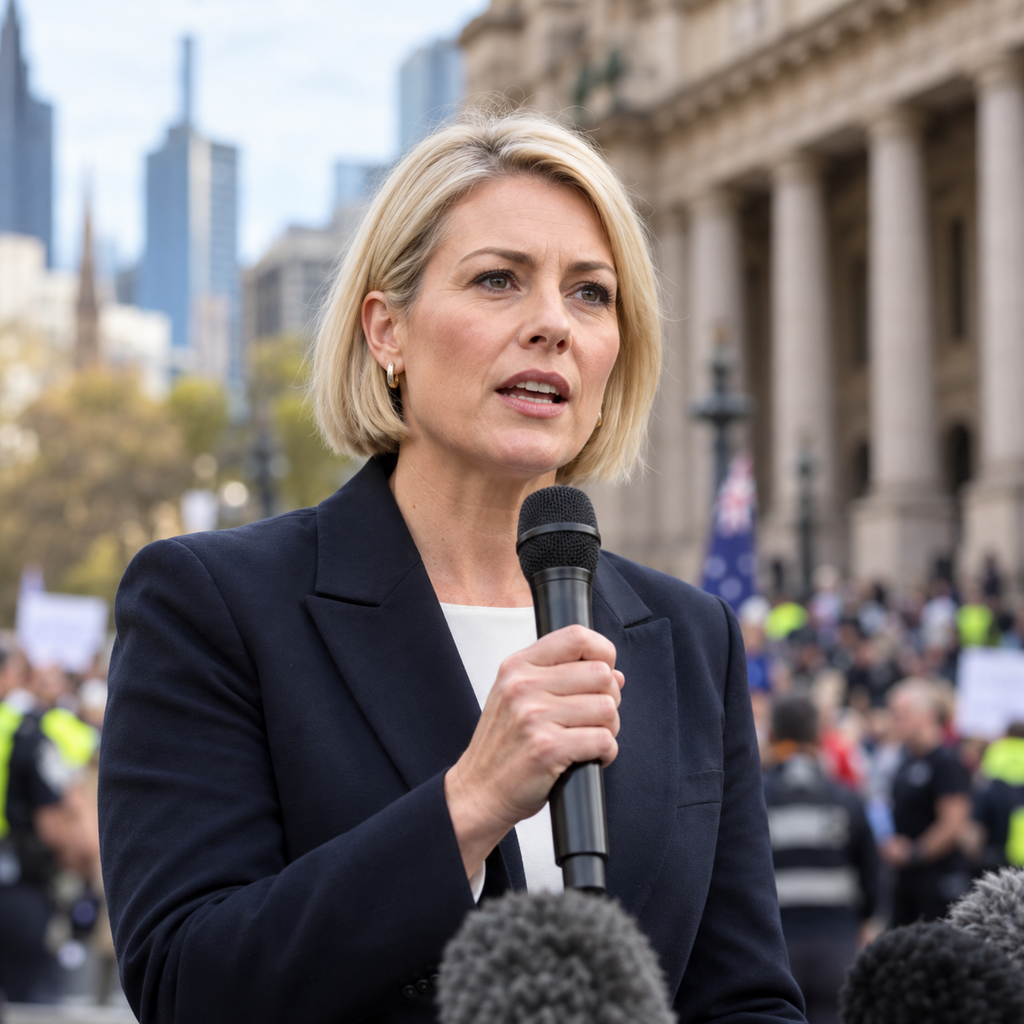
Victorian Liberal leader Jess Wilson has promised to outlaw the protest chant “globalise the intifada” if her party wins the November state election, arguing that the words threaten Jewish Australians and should be treated as incitement to violence. The pledge has already prompted a sharp public response from the Jewish Council of Australia, which opposes criminalising pro-Palestinian slogans. The clash is about much more than the wording of one chant: it puts political protest, community safety and the limits of criminal law at the centre of the campaign.
Wilson outlined the policy in an interview with ABC Radio Melbourne on Monday. She linked the language at demonstrations to fears among Jewish families about visiting central Melbourne on weekends. She said the Liberals would change Victoria’s laws against incitement if elected. Her position reflects the argument that public authorities should intervene when a phrase is understood by part of the community as an exhortation to violence, rather than wait for a direct act of intimidation or assault.
Wilson’s proposal is not existing Victorian law. No person could lawfully be described as having breached a newly announced Liberal ban simply because the opposition leader has proposed it. For a new offence to take effect, a government would need to introduce legislation, persuade Parliament to pass it and meet the relevant legal requirements. Police and courts would then have to apply the precise wording of the statute to actual cases rather than a campaign speech.
The disputed phrase requires careful description. The Arabic word “intifada” literally refers to a shaking off or uprising, and the term has been used for different periods of Palestinian resistance, including episodes marked by violence against civilians. Many Jewish Australians hear the internationalised form of the chant as a call to spread violence or hostility beyond Israel and the Palestinian territories. Some pro-Palestinian protesters use it to express a demand for political liberation. Reporting that only one meaning exists would conceal a central reason the dispute is so heated.
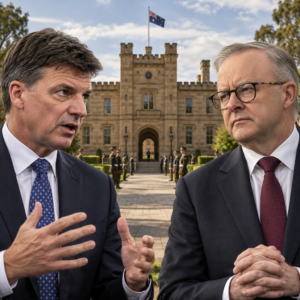
The Jewish Council of Australia, a group that does not purport to speak for every Jewish Australian, released a statement condemning Wilson’s proposed protest restrictions. It objected to treating pro-Palestinian expression as inherently dangerous and warned against restrictions that could reach people exercising rights to peaceful political protest. The council also raised concerns about a wider package of proposals, including move-on powers, demonstration permits and possible funding consequences for organisations accused of promoting antisemitism. Those objections should be attributed to the council, not presented as a consensus among Jewish organisations.
The positions should not be flattened into a claim that either side is indifferent to public safety. Wilson says she is responding to the fear of Jewish community members and an obligation to prevent incitement. Her critics argue that an expansive speech prohibition may sweep up peaceful demonstrators, including Jewish protesters critical of Israeli government conduct, and may create uncertainty about what police can penalise. The substantive disagreement concerns how to identify a real threat while preserving expression that is offensive, provocative or unpopular but not criminal.
Queensland has already passed legislation banning specified slogans, including the phrase at the centre of the Victorian dispute. The Queensland measure has been challenged in the High Court, adding a significant legal dimension to Wilson’s promise. The existence of a court challenge does not establish that the ban is invalid; likewise, passage of a statute does not automatically resolve questions about constitutional limits. The final legal position depends on judicial decisions and the terms of the law that is actually enacted.
Australia does not have a United States-style constitutional free-speech clause. The High Court has instead recognised an implied freedom of political communication that limits legislative power in specific circumstances. It is not simply a personal right to say anything, nor does it mean that governments can ban any phrase merely by labelling it offensive. Lawyers examining such laws commonly ask whether restrictions burden political communication, serve a legitimate purpose and go further than reasonably necessary to achieve it. Any new Victorian measure would be assessed against the applicable legal framework and its actual provisions.
Another question is how prosecutors would prove an offence. A statute might require an intention to incite violence, a likelihood of violence, or other elements determined by lawmakers. Context could include accompanying signs, audience, speaker conduct and the circumstances of a rally. A blanket prohibition on a sequence of words would operate differently from an offence that targets threats or incitement demonstrated by surrounding conduct. Voters cannot judge the proposal’s practical reach without seeing those details.
Police enforcing protest laws face difficult operational choices. A large demonstration can include thousands of people chanting different messages, moving through several streets and responding to counter-protesters. Officers must distinguish between keeping traffic flowing, responding to actual threats, protecting participants and enforcing any language-specific offences. Expanding powers without clear guidance could create inconsistent decisions; failing to respond to credible threats could leave communities feeling unprotected. Operational accountability therefore matters as much as campaign rhetoric.
Supporters of the proposal may point to the psychological effect of recurring messages that they regard as threats. A family that avoids the CBD out of fear experiences a real reduction in public participation even where no criminal offence has been established. Public safety policy cannot disregard that experience. At the same time, the right to protest is exercised precisely when a political message causes discomfort to officials or to parts of the public. A durable approach has to distinguish protective intervention from suppression of disagreement.
Those distinctions also affect civic groups and charities. If a future government considers withholding funding from organisations it says promote antisemitism, the definition, decision-maker, evidence requirements and appeal mechanisms become critical. Funding conditions are not identical to criminal penalties, but they can exert significant pressure on speech and participation. Any such scheme would require scrutiny of administrative fairness and the risk that political disagreement is confused with discriminatory behaviour.
The proposal is emerging amid a state election campaign, when security concerns and demonstrations are highly visible. Parties have incentives to offer decisive answers to problems that voters feel are not being controlled. A promise to prohibit named words is politically simple to communicate. The eventual work of defining an offence, training police and resolving contested applications is much less simple. That gap between slogan and implementation is one of the principal issues readers should examine.
Victoria’s existing anti-vilification, public order and criminal laws already provide mechanisms for responding to some threats and discriminatory conduct. Whether those mechanisms are insufficient is a separate evidentiary question from whether particular words are offensive. Policymakers could publish examples of enforcement gaps, explain why current offences do not address them and show how a new rule would improve safety. Without that information, observers may disagree over whether the proposal fills a genuine legal gap or principally signals a political position.
The different responses also show why it is inaccurate to treat the Jewish community or the pro-Palestinian movement as internally uniform. Individuals and organisations within each hold different views about Israel, Palestinian rights, police powers, protest tactics and how to respond to antisemitism. The Jewish Council’s opposition to Wilson’s pledge is one concrete illustration of that diversity. Other Jewish organisations have argued for tougher restrictions. A fair report attributes claims to identifiable speakers rather than converting a group’s statement into the unanimous view of a whole community.
The Jewish Council’s response also reminds voters that antisemitism policy cannot be evaluated solely through a contest over words. Governments may need to address threats against synagogues and schools, improve responses to harassment and support effective reporting. These measures have distinct legal and budgetary implications. A phrase ban might be promoted as part of a broader package, but it cannot be assumed to solve every safety concern. Likewise, opposing the criminalisation of a slogan does not by itself amount to denying those concerns. Asking each side for operational detail would expose whether its preferred approach can be implemented fairly and effectively.
The election question for Wilson is whether the Liberals can translate their message into a legally coherent, enforceable and proportionate policy. The question for opponents is how they propose to address fear and threats without the phrase-specific offence Wilson wants. Both sides can be pressed for detail. Neither can resolve the dispute through labels alone, because the underlying test concerns consequences for people who need to feel safe and for people who need to be free to protest.
For now, Wilson has made a political promise and the Jewish Council has publicly challenged it. The Queensland litigation remains part of the background, not a verdict on a Victorian law that has yet to be written. The next material developments will be the release of draft statutory wording, responses from other stakeholders and any binding court decision affecting similar restrictions. Until then, the proposal should be reported as a contested election pledge rather than an enacted prohibition.