Some Victorian Coalition MPs and candidates have criticised a planned advertising campaign by conservative advocacy group Advance, warning that its message could complicate their attempt to win a majority at the state election. The campaign uses artificial intelligence-generated imagery and urges voters to put Labor last, but critics within Coalition ranks say that approach may advantage smaller right-leaning parties rather than strengthen Liberal and National candidates. Advance rejects that interpretation, arguing that preference flows are central to defeating Labor.
The disagreement has exposed an important distinction between an outside organisation’s campaign against the government and the election strategy of the parties seeking to replace it. Advance is not the Victorian Coalition, and its advertising decisions are not automatically the Coalition’s position. Reports of discontent come from several MPs and candidates, some quoted without names. That means the criticism should be attributed to the individuals reported as expressing it, not presented as a unanimous official resolution by the Liberal and National parties.
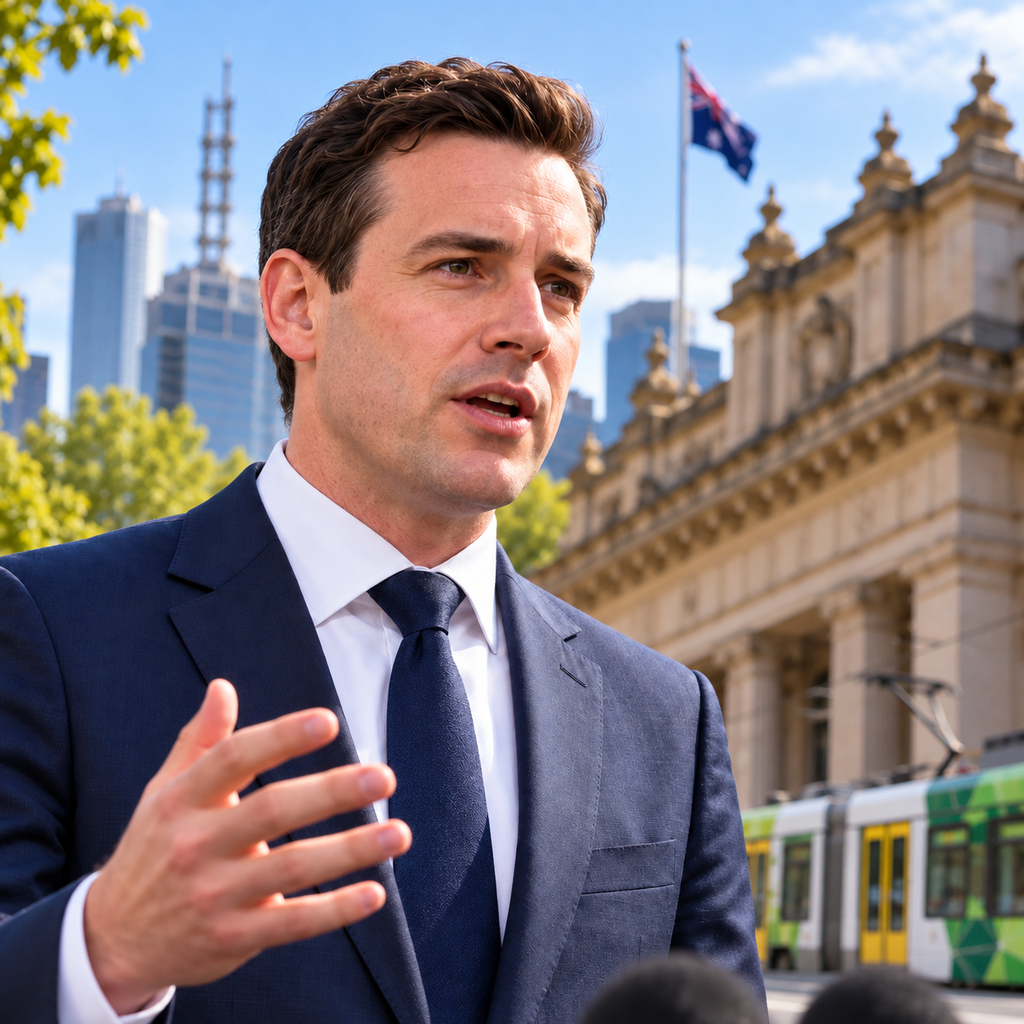
Reporting has indicated that Advance was preparing an advertising effort estimated at about $350,000 and focused on 20 Labor-held seats across suburban and regional Victoria. Its centrepiece is a 60-second AI-generated advertisement featuring fictionalised images of Premier Ben Carroll and former premiers Jacinta Allan and Daniel Andrews. The message encourages voters to rank Labor last. These are campaign communications, not actual footage of the political figures taking part in the events depicted.
Coalition critics are concerned because a simple anti-Labor message may not explain why a voter should place Liberal or National candidates above One Nation or other contenders. In a contest for single-member lower-house seats, the first-preference share, the elimination of lower-polling candidates and the flow of preferences can all influence the final result. A campaign designed to punish the government can therefore produce a different outcome from one designed to maximise the Coalition’s chance of forming government.
Some of the electorates identified in reporting, including Pakenham, Bass, Hastings, Melton and Yan Yean, feature complex contests where parties on the conservative side of politics may compete for similar voters. For a Coalition candidate seeking to finish ahead of another challenger, a prominent message urging voters only to rank Labor last may offer limited help. It could even encourage first-preference votes for a minor party that later changes which contenders reach the final stages of counting.
Advance has pushed back strongly. Its representatives say critics misunderstand how preferential voting operates and argue that the Coalition cannot assume it will defeat Labor alone in every electorate. Under this view, voters whose first choice is a minor party can still express a preference between Labor and the Coalition, and encouraging anti-Labor preference flows may ultimately help non-Labor candidates. That is a campaign strategy claim, not a guaranteed prediction of election outcomes.
Electoral analyst Ben Raue has suggested that the approach could have consequences for the Coalition in seats where One Nation gains support and Liberal or National candidates need to establish themselves as the principal alternative to Labor. The importance of these dynamics depends on local candidate strength and voting patterns, which cannot be known in full before polling day. The analysis therefore describes a possible electoral effect rather than proof that the campaign has already cost any party a seat.
The AI element has created another layer of controversy. Artificially generated campaign images can be visually striking and inexpensive to distribute, but they also raise questions about whether viewers understand that a scene is invented. A person may recognise a politician’s face and assume that an apparent gesture, setting or meeting was captured from reality. Even when the wider political message is clearly opinion, the form of the image can blur the distinction between recorded events and creative attack advertising.
Campaigns using synthetic imagery need to communicate their purpose without implying that fabricated scenes are evidence. Readers should distinguish an AI-generated portrayal of public figures from authenticated photography or footage. The issue is not whether political advertising may use satire or illustration; it is whether the presentation makes the fictional character of a scene sufficiently clear. Political opponents have incentives to interpret disputed material strategically, so careful attribution and an accurate description of what the material shows are essential.
The 28 November state election provides the backdrop. Victorian Labor is seeking to retain government, while the Coalition hopes to gain enough seats to govern. Advance’s stated objective is to help remove Labor from office, but the parties disagree over the best route to that result. Whether particular preferences ultimately help or hurt a candidate depends on electorate-specific counts that have not yet occurred. It would be inaccurate to write that the campaign has already changed an election result.
Anonymous sourcing introduces further limits. MPs and candidates may privately express frustrations that differ from official party statements, and some may criticise a tactic without opposing the broader aim of defeating Labor. A report can accurately describe a factional disagreement while still avoiding an unsupported claim that the whole party has declared war on the advocacy group. The central verified dispute is about messaging and electoral strategy, not a formal split or a change of party leadership.
The controversy also highlights the growing role of non-party organisations in election communication. These groups can spend money, select messages and amplify issues without taking instructions from the party most likely to benefit. Their independence can be useful to supporters who want stronger advocacy, but it can also create practical problems for campaign coordinators trying to keep a consistent message. A major party may be unable to control a third party’s materials while still being judged by voters for associations they perceive.
Preferential voting adds a complication often missed in simplified slogans. Asking a voter to place Labor last does not tell that voter whether to rank Liberal, National or another party first, nor does it guarantee that every preference will eventually be distributed in a way that benefits the Coalition. The ballot’s ordering rules and each electorate’s candidate field determine how votes transfer. Readers should consult the Victorian Electoral Commission for official voting instructions, rather than treating a partisan advertisement as a substitute for an explanation of the system.
As the election approaches, Advance may continue defending its strategy while individual Coalition candidates emphasise their own local priorities. The effects of the campaign will remain contested until votes are counted and there is evidence of how voters responded. For now, the story is one of strategic disagreement: a group seeking to damage Labor has chosen a message that some of Labor’s opponents fear could damage them as well. The ultimate judgment belongs to voters, not to pre-election claims about a result that has not yet happened.
A core difficulty for outside campaign groups is that they can define the opponent more clearly than the preferred replacement. A message urging voters to reject Labor tells them whom to oppose but may not tell them which non-Labor candidate has the best chance of winning a particular seat. Coalition organisers generally need voters to associate their own candidates with local policies and a credible alternative government. That strategic difference can become more pronounced where several parties compete for a similar pool of voters.
Preferential voting can make these calculations counterintuitive. A first-preference vote for a minor party is not always wasted, because the ballot may transfer if that candidate is eliminated. But the order in which candidates are eliminated matters, and preferences cannot rescue a candidate who fails to reach a competitive position at the necessary stage. For that reason, a campaign that raises the visibility of another right-leaning party could have different effects across seats. Analysts can model scenarios, but the final results depend on ballots actually cast.
Seat-by-seat effects also depend on local candidate recognition and issues. In one electorate, voters may be focused on transport, housing or community services, while another contest may centre on crime or taxation. A statewide slogan can reinforce an existing preference but may not persuade voters who are undecided between two opposition alternatives. The criticism from Coalition figures is partly about this mismatch between a broad ideological message and the practical requirements of winning enough individual seats to form government.
Artificially generated visual material adds a responsibility to prevent confusion. Political ads have long used caricature, dramatic editing and hypothetical scenes; generative technology makes those techniques easier to produce at scale. A realistic image of a public figure can appear authentic when viewed quickly on a phone or shared without context. Campaign authors and publishers therefore need to consider whether viewers will clearly understand that they are seeing a created portrayal rather than a photograph or recording of something that happened.
That is not the same as saying all synthetic political advertising is inherently false. A clearly labelled satirical representation may communicate opinion without purporting to document an event. The risk grows when a campaign’s style, caption or distribution encourages people to mistake a fabricated scene for evidence. News coverage should avoid perpetuating that confusion by describing what is generated and not repeating the scene as fact. Electoral arguments can be robust without inventing real-world conduct by the individuals depicted.
Advance’s view is that the larger anti-Labor objective and preference strategy justify the approach. Coalition critics question whether the tactics align with the electoral arithmetic necessary for a majority. Both are strategic positions about a future event, and neither can be verified as successful before the poll. Even after election day, attributing a seat outcome to one advertisement would require evidence beyond the fact that the campaign ran in that electorate.
The disagreement illustrates the limits of political coordination between parties and advocacy organisations that share some goals but maintain separate agendas. A campaign may help a broader political movement while frustrating a particular candidate’s tactical needs, or the reverse. Voters are entitled to know who is speaking, what their campaign is asking and whether images are authentic. Those questions are more immediately answerable than predictions about the eventual election result.