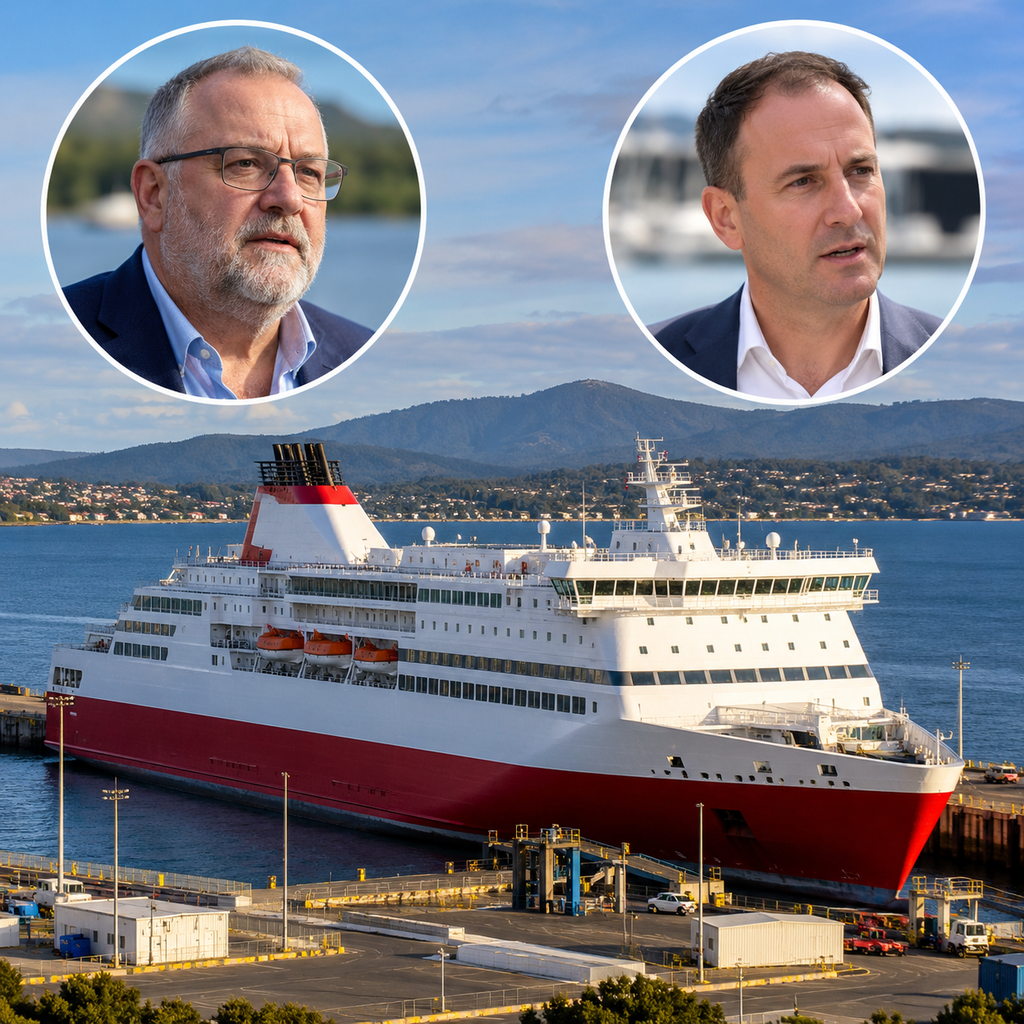
Tasmania’s state-owned ferry operator TT-Line has reported a $723 million accounting loss for 2025–26 after major reductions in the recorded value of its ships and terminals, prompting renewed criticism of the Spirit of Tasmania replacement project. Chairman Ken Kanofski insists the company remains solvent and says the bulk of the loss does not represent cash leaving the business in that financial year. Labor leader Josh Willie has publicly criticised the broader ferry program, arguing that delays and cost overruns have damaged confidence in its management.
The result has become another flashpoint in a long-running dispute about the cost of replacing vessels and upgrading the terminals that connect Tasmania with mainland Australia. The immediate figure is striking, but understanding it requires separating an accounting write-down from the price of new ships, the debt owed by the company and the actual cash required to operate the service. Those are related issues, but they are not interchangeable measures of financial loss.
TT-Line’s reported statutory loss was dominated by a $646.9 million write-down across its ferry and terminal assets. A write-down occurs when accounting values are reassessed downwards to reflect what those assets are considered worth to the company. It can substantially affect the reported profit or loss without requiring an equivalent cash payment on the day the adjustment is recognised. That distinction does not make the loss irrelevant. It means the figure must be explained accurately before conclusions are drawn about liquidity or solvency.
Kanofski says the reassessment has not changed the company’s existing debt position or its request for government equity. He has emphasised that the operator achieved around $1.5 million in operating profit over the year and maintains a positive outlook as new vessels and facilities enter service. An operating profit and a large statutory loss can coexist because they measure different things. The operating result focuses on trading performance, while the accounting result includes non-cash charges and other financial items.
The older Spirit of Tasmania I and II vessels were written down from $174.3 million to $87.5 million. The new Spirit IV and V vessels were reduced from around $1.086 billion to approximately $717.9 million. The recorded values of the Devonport and Geelong terminals were also reduced. Those figures signal that the assets are valued differently from earlier balance-sheet assessments; they should not be treated as proof that equivalent amounts of money disappeared into an unexplained transaction.
The project nevertheless has serious cash and public-finance questions attached to it. Earlier scrutiny found the replacement program had cost about $717 million more than forecast in the original business case. The Tasmanian government announced a $506 million equity injection and later raised TT-Line’s borrowing capacity by $410 million. These are separate funding and financing decisions. They are relevant to taxpayers’ exposure and the operator’s future debt servicing, but they should not be added to the write-down as though every figure represents a new expense in the same reporting period.
Labor’s Josh Willie has called the Spirit project an absolute fiasco and criticised the reputational impact of the delays. That language expresses the opposition’s judgment of the government’s management, not a legal determination that officials committed wrongdoing. The chair’s response focuses on the operational case for the new assets and the accounting nature of the latest headline loss. The political disagreement therefore centres on whether the long-term benefits can justify the delays, extra financing and capital values now on the books.
The history of the project helps explain why the accounts have attracted so much attention. Tasmania depends on reliable Bass Strait connections for tourists, vehicles and freight. Replacement ferries promise improved capacity and modern facilities, but construction schedules, terminal readiness and delivery arrangements have faced public scrutiny. When a major vessel is available before all supporting infrastructure is complete, the operator may incur costs without receiving the full commercial benefit it expected. Such mismatches can affect forecasts and valuations even before passengers see the final service.
Kanofski has compared the revaluation of some new assets with the reduction in price of a car after leaving the showroom. The analogy may help explain the mechanics of a write-down, but large infrastructure involves more complicated assumptions about capacity, customer demand, future revenue and long-term operating costs. A lower carrying value can be a rational accounting response to those assumptions. The public still needs to understand why they changed and whether the original business case adequately recognised the risks.
TT-Line says the new ships and terminals leave it well placed for the future. That outcome remains a forecast rather than a guarantee of financial performance. Vessel capacity must translate into passenger bookings, freight volumes and sustainable revenue, while maintenance and borrowing costs continue. Higher tourism activity could improve trading, but slower growth, competition and changes in travel demand could work in the opposite direction. A financially credible outlook should explain the assumptions instead of presenting optimism as certainty.
Debt repayment arrangements are another part of the story. Kanofski says TT-Line’s lender TasCorp and Treasurer Eric Abetz have approved changes to the timing of repayments. Rescheduling can ease near-term pressure, but it does not automatically erase the principal owed. The company therefore needs to generate sufficient revenue over time, manage costs and maintain access to financing. For a state-owned enterprise, these choices also raise questions about how financial risks are shared between customers, the business and the Tasmanian government.
For residents and businesses, the practical measure of success will be dependable sailings, competitive freight links and a service that supports regional tourism without requiring recurring unplanned public contributions. The state has an interest in reliable transport even where individual routes are not highly profitable. That public service objective can justify investment, but it also strengthens the case for transparent budgets, independent assessment and clear reporting when cost and schedule assumptions change.
Passengers should also distinguish the transition to new vessels from the accounting arguments taking place around it. A reported write-down does not itself mean services are cancelled, that tickets are invalid or that the operator has ceased trading. Kanofski has explicitly said the company remains solvent. Equally, that assurance does not end legitimate scrutiny of construction expenses, debt and the reliability of future projections. Financial confidence should rest on evidence of trading performance and the ability to meet obligations.
The next annual results and operating data will offer a more useful test of the competing narratives. If the new vessels and terminals deliver stronger passenger and freight earnings, the chairman’s optimism will have evidence behind it. If the company continues to require unexpected support or misses commercial targets, critics will have further questions to ask. For now, the $723 million headline is real as a statutory accounting loss, while the dispute over whether the project represents value for Tasmania remains open.
The accounting treatment is difficult for a non-specialist reader because it can seem to tell contradictory stories. The company has an operating result for the year, reported values for the ships and terminals it owns, and financing obligations that fall due over time. A change to the value of an asset can affect annual profit without changing the cash in the bank immediately. But it may still alter perceptions of the balance sheet and the return expected from a major public investment. The correct response is neither to ignore the write-down nor to mistake it for a direct cash outflow.
The valuation of an older vessel is shaped partly by what buyers are willing and able to pay. Kanofski has pointed to factors including fuel requirements and changes in global market conditions as explanations for weaker resale values. The new vessels and terminals are different: they are intended to be used in a transport service over many years, so their accounting values depend on projections about that service’s future economic benefit. In both cases, the valuation is an estimate informed by assumptions, not a count of physical dollars spent on a particular day.
Tourism businesses, freight users and regional communities have a legitimate interest in the project’s success regardless of which party wins the political debate. More reliable and capable vessels may increase options for bringing vehicles and goods across Bass Strait, but that opportunity has to be matched by port infrastructure, crew arrangements, pricing and demand. A modern ship that cannot operate efficiently through a terminal will not deliver the full expected benefit. The commissioning process therefore matters just as much as the purchase of the vessel itself.
The state has multiple ways to assess financial performance in the years ahead. Passenger numbers, freight movements, operating margins, debt servicing capacity and the frequency of unplanned government capital injections would give a broader picture than one annual statutory result. Each indicator has limitations: a busy sailing does not necessarily generate strong profits, while a profitable year may still involve an unusually large non-cash adjustment. Publishing a consistent series would make the debate more informative and reduce opportunities for selective use of statistics.
Scrutiny of a government-owned operator should also consider how decisions were made before delays became apparent. Major infrastructure projects need tested business cases, clear responsibility for dependencies and regular reporting on the risk that a vessel or terminal will not be ready on schedule. The public may reasonably ask which assumptions changed, when officials became aware of the change and how spending decisions were adjusted. Those questions do not, by themselves, prove mismanagement by any named person, but they are appropriate issues for parliamentary accountability.
Willie’s criticism and Kanofski’s defence refer to different parts of the same complex story. One is an opposition judgment about project delivery and its public cost; the other is the chair’s explanation of financial accounting and the operator’s future trading prospects. Neither should be flattened into a claim that the company has simply lost $723 million in cash. Tasmania will ultimately have to judge both the stewardship of the investment and the quality of the service it receives.