Amazon Australia has removed a ceiling light listing after a product sold through its marketplace caught fire and melted during laboratory safety testing, according to an investigation by the ABC. The $48 LED oyster-style light was among products that Lighting Council Australia had raised concerns about months earlier. The listing was reportedly taken down within hours of the broadcaster seeking answers. The case has revived questions about whether shoppers can rely on online marketplaces to stop unsafe electrical products reaching Australian homes.
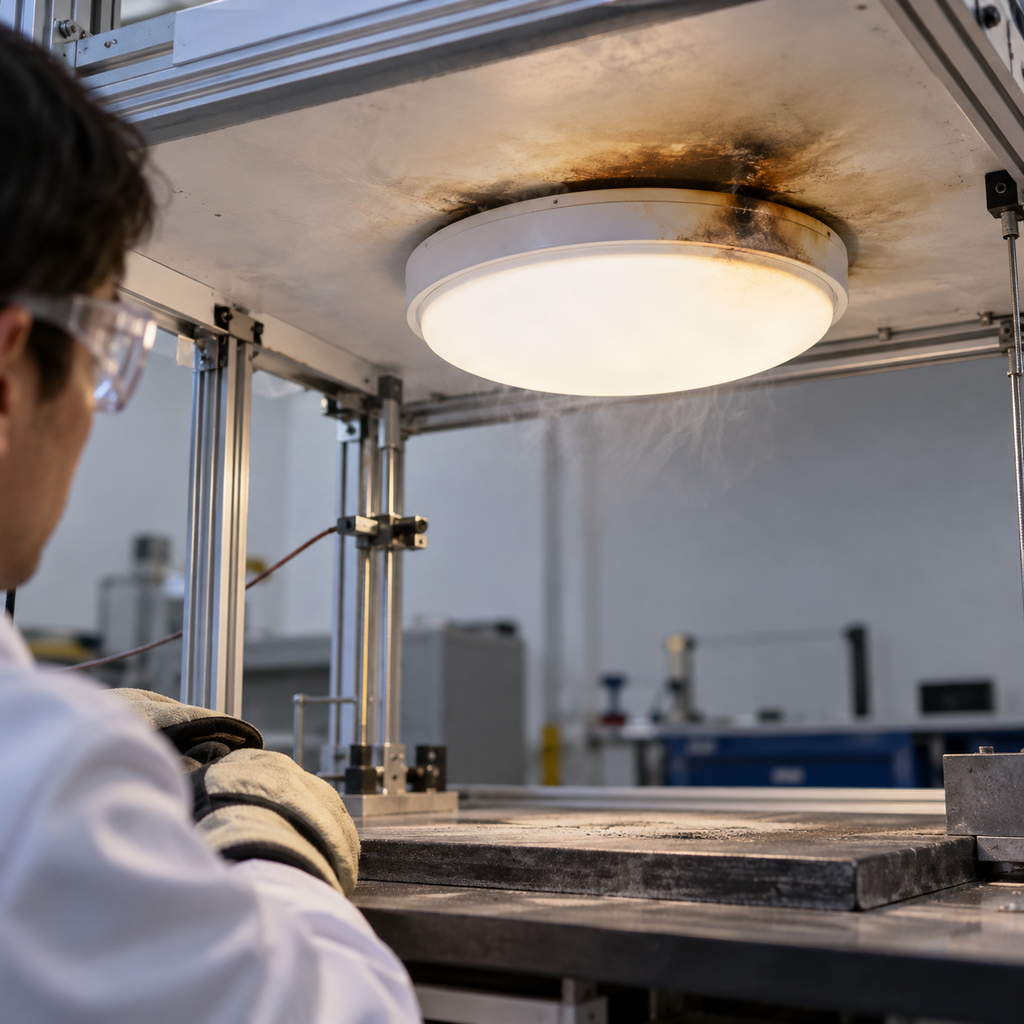
The laboratory result described in the ABC investigation was disturbing. During a glow-wire test intended to assess the behaviour of plastic components in contact with a heat source, parts of the light continued burning after the heat was removed. Molten material dropped onto tissue paper beneath the product and caused it to ignite. The reported outcome did not meet the fire-retardant requirement applied in the test. These findings concern a specific tested light rather than proving that every product of the same general type behaves in the same way.
Lighting Council Australia, an industry body, commissioned the assessment after buying the product online. Its chief executive Malcolm Richards said the organisation wanted to establish whether the light met local safety standards. The ABC reported that a glow-wire was held to the product for 30 seconds. Under the standard described in the report, affected plastic was supposed to self-extinguish within 10 seconds after the test was completed, without flaming drops igniting the tissue paper below. Instead the product continued burning for more than 30 seconds.
The investigation also described a separate electrical hazard. Further testing by Victorian business Clevertronics found that live wiring could be accessed within the product, according to the ABC’s account of the tests. That raised a concern distinct from the burning plastic: a consumer removing a cover could be exposed to an electrical component. The reported test findings do not establish that a particular person was injured by this light, but they point to why electrical compliance requirements matter before an item is installed in a home.
The sequence between the warning and the removal of the listing is central to the story. Lighting Council Australia had written to Amazon about a number of products considered non-compliant. According to the ABC, the light at the centre of the latest testing remained available after those concerns were raised. It was later removed a few hours after the broadcaster asked Amazon questions. The difference between promising to act on a warning and demonstrating that the affected listing is no longer active is important for consumers and regulators assessing marketplace safeguards.
Amazon has disputed any suggestion that it ignores safety duties as a matter of practice. In its response reported by the ABC, the company said sellers must comply with applicable laws and that it uses verification checks, third-party testing for certain products and other proactive controls. It also said it was removing products identified as non-compliant. Those measures are relevant context and deserve to be included, even while the specific product’s continued availability after the initial warning raises questions about the effectiveness of enforcement in practice.
The Lighting Council’s wider research adds weight to concerns about imported electrical products, but it also needs careful interpretation. The ABC reported that the industry body tested more than 130 lights sourced from several online marketplaces, including Amazon, Temu, AliExpress, eBay and Kogan. It found that seven in ten tested products failed at least one Australian safety compliance requirement. A large share of the lights bought from Amazon within the test group also failed a compliance check. The numbers describe the test sample, not a random national survey of every light offered for sale.
That distinction limits what can legitimately be claimed. A failure in a selected sample can reveal concrete product hazards and identify weaknesses in screening, particularly where the same concerns appear across several platforms. It cannot automatically provide the rate at which all Australians encounter unsafe lighting online. The results should not be used to allege that an individual household’s installed lights are dangerous without any product-specific evidence. A measured safety story can explain the problem without turning sample findings into a blanket assertion about all sellers or all imports.
Consumer organisation CHOICE has independently argued that unsafe products offered through online marketplaces are a systemic problem. Its research cited by the ABC found that some online buyers had experienced injury or property damage associated with unsafe purchases. That does not mean the ceiling light in this case caused an injury. Rather, it explains why consumer groups want preventive obligations that are stronger than simply reacting after a dangerous product is discovered. Prevention is particularly consequential with electrical fittings because defects may remain hidden until a product is exposed to heat or ordinary household use.
Australia’s competition and consumer regulator has already been debating the responsibilities of digital marketplaces. The Australian Competition and Consumer Commission has argued that the existing framework leaves gaps, particularly where a platform hosts third-party sellers rather than supplying the goods itself. The regulator has backed stronger mandatory product-safety obligations and effective enforcement powers that work regardless of the way consumers buy an item. That position is part of a broader reform debate and should not be confused with a finding that Amazon has committed a specific offence over the tested light.
The ACCC has also administered a voluntary Australian Product Safety Pledge under which marketplaces commit to improved action on dangerous listings. Amazon Australia is among the platforms that have participated. The regulator announced an updated pledge with additional commitments from marketplaces including Temu and Gumtree. Voluntary commitments can encourage better detection, reporting and removal of hazardous products, but campaigners argue that a voluntary framework alone cannot replace clear mandatory rules with practical enforcement when risk to consumers is serious.
The commercial structure of online retail is one reason the debate is complicated. A customer may see a familiar marketplace name, a convenient checkout system and the promise of fast delivery, but the product might be offered by a separate seller. Consumers may not distinguish between the marketplace acting as retailer and the marketplace facilitating another business’s sale. That difference matters under parts of the current product-safety framework. It is not a reason for shoppers to accept unsafe goods; it is a reason regulators are asking whether legal responsibilities align with how modern retail actually operates.
The Lighting Council also argues that suppliers meeting Australian electrical standards incur the costs of testing, registration and quality control. The ABC reported Richards’ estimate that a local business may spend tens of thousands of dollars on those compliance tasks for a product line. This is the industry’s account of the burden faced by compliant suppliers, not a verified calculation of the costs borne by every seller. Nevertheless, the concern is straightforward: competition is distorted when products that have not met comparable requirements can appear alongside items that have.
The specific failure observed in the glow-wire test shows why compliance cannot be judged from a listing photograph or a star rating. The appearance of a ceiling light gives little indication of how internal wiring is insulated or how plastic will behave under a prescribed heat test. A buyer may see dimensions, brightness and price, none of which establishes that the product has satisfied applicable electrical safety checks. The ABC investigation therefore addresses a risk that ordinary consumer reviews are poorly equipped to detect, rather than simply a dispute over quality or durability.
For anyone concerned about an electrical product already bought online, the sensible response is to identify the item, check any safety or recall information that applies to that exact product and seek qualified advice about installation or removal where electrical work is involved. A dangerous product should not be subjected to amateur fire or wiring tests at home. The ABC’s footage illustrates what happened in a controlled laboratory setting; attempting to reproduce the conditions could put people or property at risk. These precautions follow from the type of hazard identified without asserting that every similar-looking light is unsafe.
The next stage of the broader story concerns policy. The federal government is considering reforms to the product-safety regime, and the ACCC is pressing for rules that address the role of online marketplaces more directly. Industry bodies and consumer advocates disagree on some priorities, but both have highlighted the risk of unsafe goods reaching Australian households. The timing and final contents of any legislative changes remain matters for government, not established outcomes of this particular investigation.
The immediate facts are narrower and more concrete. A light sourced through an Australian marketplace failed the reported fire test, additional electrical concerns were identified, warnings had been provided, and the listing was removed after renewed questioning. Amazon maintains that it has safety controls and requires legal compliance. For consumers, the lesson is not that all online shopping is unsafe but that a recognised platform and a polished product listing are not substitutes for verified electrical safety. Regulators are now considering how to close the gap between that expectation and the obligations in law.






