Queensland’s deputy premier used the protected floor of parliament to repeat rumours about two opposition MPs, triggering an angry rebuttal and a new debate about the boundaries of parliamentary privilege. Jarrod Bleijie raised unsubstantiated allegations concerning Labor members Nikki Boyd and Tom Smith. Both denied the allegation. Boyd called the decision to raise it in parliament disappointing and sexist, questioning why an unsupported personal claim should be used in a political contest.
The episode is not evidence that the rumour was true. Reporting that Bleijie raised it does not establish a relationship, a failure to disclose anything or wrongdoing by the MPs involved. The available record instead documents that a senior government figure used parliamentary proceedings to give the allegation prominence and that the people named rejected it. Those facts are enough to report a serious disagreement without turning private speculation into a supposed revelation.
Boyd’s public response was severe. She said the remarks exposed a problem in the way the Liberal National Party treated women and described Bleijie’s conduct as deeply inappropriate. Smith, speaking separately, rejected the suggestion and criticised the deputy premier for putting it into the public arena. Their denials are not incidental additions to the account. They are necessary to prevent an unfounded allegation being presented as a finding simply because it was made by someone with a senior title.
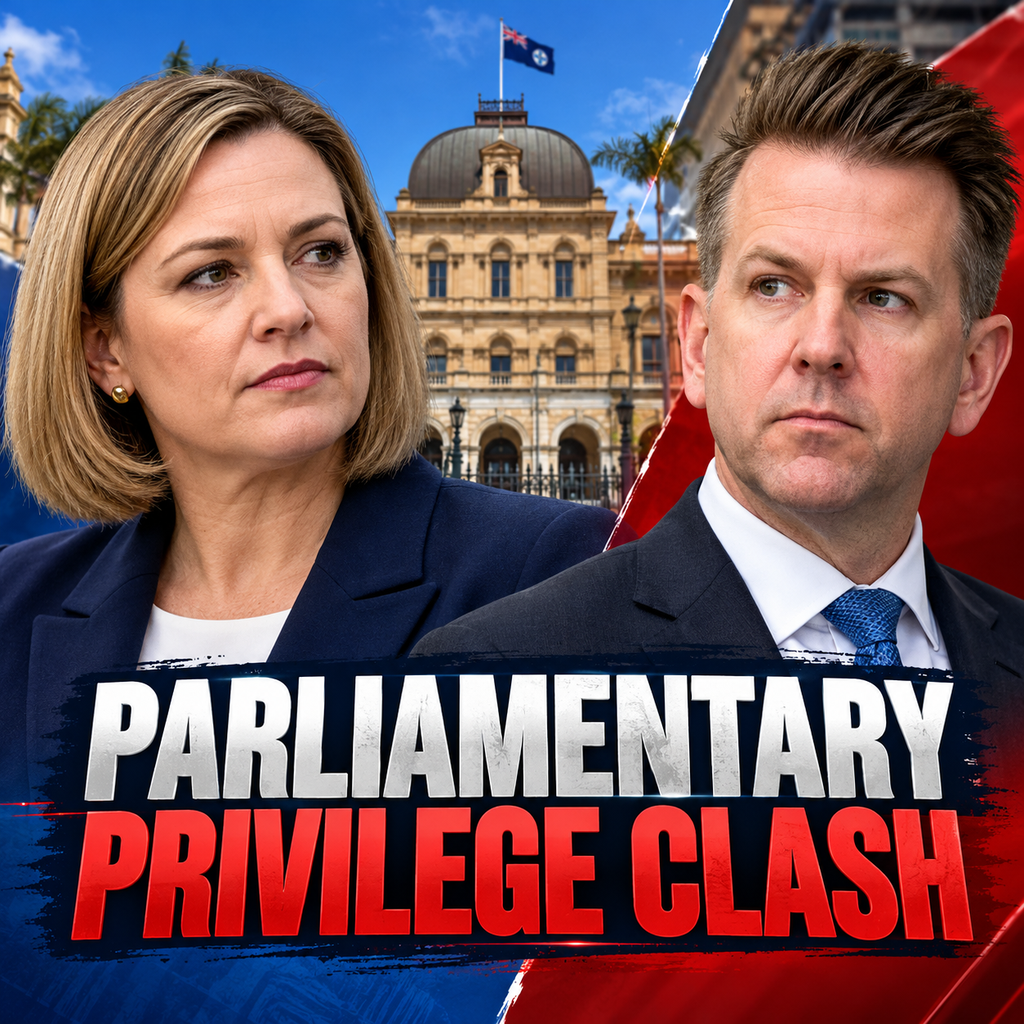
Bleijie’s use of parliamentary privilege is one of the central elements of the story. The privilege protects statements made in the course of parliamentary proceedings from certain legal actions, especially defamation proceedings. It exists because representatives must be able to raise serious matters of public importance without being silenced through litigation. The protection is institutional: it is intended to benefit democratic debate, not to serve as a certificate that any particular allegation is accurate.
That difference is easy to lose when a parliamentary statement becomes a headline. A claim can be said inside the chamber, recorded formally and repeated online within minutes. Readers may assume that an allegation made under privilege carries official verification. It does not. A member’s words remain their words. Independent evidence must still be considered before a journalist can describe an accusation as true, particularly when it concerns a person’s private life or reputation.
Bleijie’s apparent political point concerned standards of disclosure and accountability in public office. Those are legitimate questions in principle. Ministers and MPs may need to declare interests that could affect decisions, and public confidence depends on the integrity of those arrangements. But the existence of a disclosure system does not mean that an unsupported allegation about particular individuals demonstrates a breach. A legitimate question about standards must be separated from the contested factual premise used to raise it.
The political setting also matters. Parliament is an arena in which government and opposition routinely accuse one another of poor judgment, secrecy or weak integrity safeguards. Such exchanges often arise when a government is under pressure over another matter. That context may explain why a public figure chooses an aggressive tactic, but it is not independent proof of the personal allegations being repeated. Nor should an article conflate this dispute with unrelated stories about other politicians’ relationships or ministerial interests.
Boyd argued that Bleijie’s decision was particularly troubling because it involved accusations against a woman in a political workplace. She framed the attack as part of a larger problem with the way women’s reputations can be targeted. That is her assessment of the conduct. A report can convey it fairly without claiming that an independent body has formally found Bleijie guilty of discrimination or harassment. Public controversy, political censure and legal liability operate under different rules.
The practical consequences of using privilege in this way are significant. Someone targeted by a damaging parliamentary statement may have limited ability to pursue an ordinary defamation claim for the words spoken in the House. They can answer publicly, seek procedural remedies or ask for evidence to be produced. But even a strong denial may not travel as far online as the original allegation. That imbalance is one reason for care when headlines and social posts repeat privileged allegations.
The public interest test should be rigorous. If a claim bears on official misconduct, a journalist can ask what documents, decisions or conflicts support it. If no evidence is available, the focus may properly shift to the conduct of the person who made the claim rather than the private speculation itself. That approach allows scrutiny of parliamentary behaviour while minimising unnecessary harm to people whose personal lives have been drawn into the dispute.
There is also a difference between reporting a formal inquiry and reporting political innuendo. An established inquiry may have terms of reference, witness evidence, published findings and appeal processes. A remark made in debate may have none of those protections. The fact that an allegation was uttered at the despatch box cannot stand in for an investigation. In this instance, the most clearly evidenced elements are the accusation being made, the denials and the political reaction.
Queenslanders have substantial issues that warrant detailed parliamentary attention: public health services, policing, housing, infrastructure and budget priorities all involve decisions that affect households. Time devoted to speculation about MPs’ private lives can displace scrutiny of those decisions. That does not require accepting every view put forward by opposition figures about the incident. It is a reminder that legislative privilege was designed to facilitate useful debate on public business, not merely generate attention.
Former parliamentary figures and academic observers questioned the quality of the exchange. Their reactions added to a debate about whether the legislature’s reputation suffers when personal allegations dominate. Such commentary should be attributed as opinion, not described as a formal ruling on the conduct. Even a strongly worded criticism by an expert is distinct from a disciplinary process or a judgment by a court.
The defamation dimension also shapes editorial responsibility outside parliament. Journalists and page operators do not automatically inherit the same protections when copying allegations into articles, captions or images. A quotation or summary must be accurate, proportionate and clearly presented as an unproven claim, with denials given sufficient prominence. An image that staged an invented secret meeting or implied documentary proof would distort the known facts, even if its accompanying article contained a later caveat.
For the same reason, this story should not be packaged as proof of a scandal. The verifiable controversy is about Bleijie’s intervention and Boyd’s rebuttal. A responsible headline can convey the conflict without presenting the disputed personal claim as settled. Readers who want to judge a politician’s integrity deserve more than an allegation and an eye-catching picture. They deserve to know whether there was an inquiry, what evidence exists, and what the named people have said in response.
Questions about parliamentary standards are different from investigations into possible misconduct. Legislatures can have their own ethical processes and codes of conduct, while law-enforcement and courts follow separate evidentiary rules. A member’s allegation under privilege is not a referral, charge or finding simply because it was spoken in an official setting. Reports that blur those processes can seriously harm reputations. If a formal investigation later begins, it should be described on its own evidence and terms, not retroactively invented from an earlier debate.
There is a cost-of-governance dimension, although it cannot be assigned an invented dollar amount. Parliamentary sitting time, ministerial attention and official communications are public resources. The purpose of that expenditure is to produce and scrutinise laws, budgets and administration. When debate centres on unsupported personal speculation, there is a legitimate question about whether members are using their privileges in the public interest. That criticism should not be confused with a claim that a particular incident constitutes unlawful spending.
For social-media news pages the risk is magnified. A large portrait of the accused figures next to a word such as ‘exposed’ may imply a factual finding that the article itself denies. A new composite image must not depict an imaginary meeting or private act as if captured by a camera. If visuals are used, recognisable editorial portraits and a headline focused on the parliamentary row preserve the distinction between the documented confrontation and the unsupported underlying rumour.
Readers can reasonably ask the deputy premier to explain why parliamentary privilege was necessary, what evidence would justify the allegation and whether an independent process would have been more appropriate. Those are questions about accountability, not accusations that he committed an offence. They also allow the people he named to be heard without requiring them to prove the negative of an unsourced claim. The test for a responsible account is whether a reader comes away understanding what happened in parliament, rather than believing a rumour has been independently confirmed.
The case illustrates how the rules that protect speech inside parliament can also create a heavy obligation of restraint. Bleijie chose to raise a serious personal allegation in a setting where his words were legally protected. Boyd and Smith denied it, and Boyd criticised the tactic as sexist and unacceptable. There is no evidentiary basis in the reporting examined to go beyond that record and assert the underlying claim as true. The more significant question is whether politicians can use a valuable parliamentary protection responsibly while maintaining the trust of the public they represent.