A clash between Attorney-General Michelle Rowland and One Nation leader Pauline Hanson placed a difficult democratic principle at the centre of Australian politics: threats against elected representatives must be condemned regardless of party, while politicians remain free to challenge the rhetoric and conduct of their opponents.
Hanson argued that Prime Minister Anthony Albanese had contributed to a dangerous climate for her by denouncing hard-right populism and criticising One Nation. Rowland rejected the implication that political criticism alone was responsible for threats and urged Hanson to examine her party’s behaviour and associations. Hanson called that response a form of victim-blaming and demanded an apology. The exchange was direct in substance but unfolded through public comments and responses rather than a face-to-face debate.
The dispute began with Albanese’s remarks at a Labor gathering, where he criticised hard-right political movements as divisive and dishonest. Hanson took particular offence at the language and said she was concerned for her own safety. She told the ABC she needed police protection when meeting people and blamed the prime minister’s words for increasing the danger. Those comments are important evidence of her stated concern; they are not independent proof that the prime minister caused any threats or unlawful conduct against her.
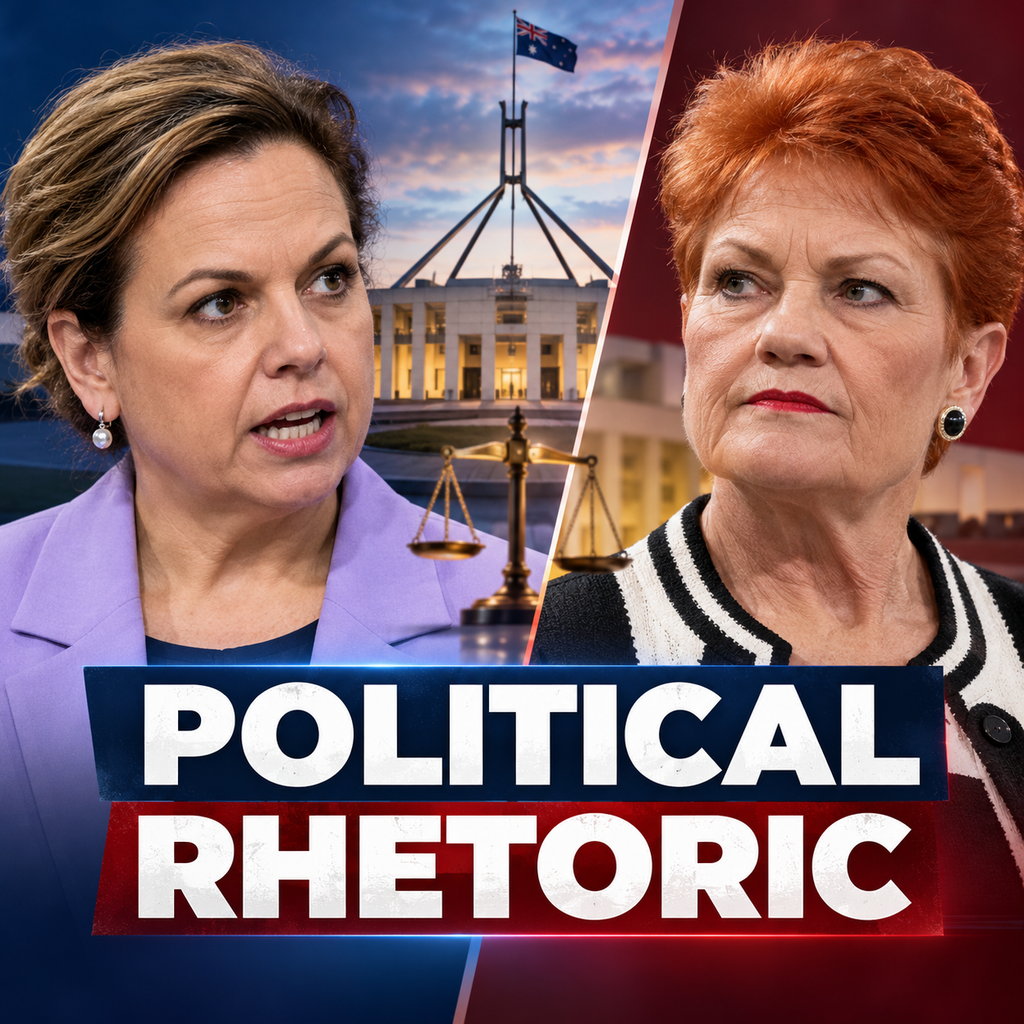
Rowland, as the country’s first law officer, faced questions about both the political dispute and the wider threat environment. She acknowledged the serious dangers experienced by female politicians across different parties and said she did not wish harm on anyone. She then argued that Hanson should consider what her own political language and the party’s culture might be contributing to the broader climate. The distinction between those positions is essential: criticism of rhetoric is not the same as permission to threaten a person.
Hanson nevertheless regarded the response as inappropriate from an attorney-general. In a public statement she said a minister should not suggest that threats can be justified because someone belongs to a particular party. She sought an apology, portraying Rowland’s comments as unfair to someone describing genuine fears. There is no need to accept Hanson’s causal argument about Albanese’s speech in order to recognise that a public representative should be able to travel and meet constituents without intimidation.
The ABC reported that security agencies and researchers have been increasingly concerned about threats, harassment and politically motivated violence. Security officials have warned of a more volatile environment, while published research has described troubling encounters involving MPs and parliamentary staff. Those sources establish a broader problem. They do not identify the author of any particular threat against Hanson, determine the appropriateness of a specific protection arrangement or demonstrate that an ordinary political speech led to a specific threatening message.
That distinction matters in law and in public debate. Threatening a person is conduct, not merely a strongly expressed opinion. It may trigger police attention depending on the words, context and applicable law. By contrast, an elected representative saying that another party is dangerous or divisive is generally a political judgment that voters can dispute. The two forms of expression cannot be treated as interchangeable simply because both generate heated reactions online.
Rowland’s office also carries distinctive institutional expectations. An attorney-general can be a partisan participant in government debates, but the position is associated with upholding the rule of law and equal protection. Critics can therefore examine her language closely while recognising that making a contentious political observation does not automatically amount to a legal finding or official permission for mistreatment. It would be inaccurate to present Hanson calling the comments slanderous as a court determination that defamation occurred.
Hanson’s concern also raises questions about police and parliamentary security arrangements. Protective measures may depend on assessments that are not made public. The Australian Federal Police declined to detail arrangements for individual parliamentarians in the reporting examined. That caution is appropriate: publishing operational security information could create risks of its own. News coverage should not speculate about where officers travel, how many are deployed or what confidential threat assessments say.
A politician should not have to prove that an opponent caused a threat before receiving sympathy for experiencing one. But a claim that a particular speech incited violence requires a more exacting standard than mere temporal proximity. Was the speech an explicit instruction or encouragement to commit an offence? Is there evidence connecting it to any actual threatening conduct? Were other factors involved? Without those answers, a story can accurately report Hanson’s accusation while withholding the conclusion she wanted audiences to draw.
Rowland’s criticism of political behaviour should be examined under an equally careful standard. She made serious comments about people associated with the One Nation political environment. Those comments require attribution and sourcing rather than being repeated as undisputed characterisations of every member or supporter. A broad allegation about extremism can affect reputations beyond the politicians involved. Fair treatment does not demand avoiding uncomfortable facts; it demands establishing the basis for specific claims.
The pressure generated by digital platforms complicates the dispute. Politicians increasingly communicate through short video clips and social posts that reward emphatic language and can spread rapidly outside their original context. A message condemning an opponent may be received by audiences already primed for hostility. That social dynamic is a reason for care, but it cannot substitute for evidence when determining who is legally or morally responsible for a particular threat.
The consequences reach beyond public figures. Parliamentarians and staff may become less willing to speak publicly, attend local events or engage with constituents if harassment is normalised. Women in politics can face gendered threats and abuse that differ from ordinary criticism of their policy positions. If intimidation discourages capable people from seeking office, voters lose options and communities lose contact with representatives. Security therefore serves the public interest, not just the comfort of political professionals.
There is, however, a corresponding danger in using security concerns to suppress legitimate criticism. Politicians must be accountable to constituents and opponents for their policies, affiliations and statements. A forceful rebuttal of a party’s ideas remains a part of democracy. The boundary to defend is between criticism and coercion: arguing that a politician’s claims are wrong is one thing; trying to frighten them out of public life is another.
A useful standard should apply consistently. Threats against Hanson are unacceptable, even for Australians who strongly oppose One Nation. Threats against Rowland, Albanese or any other figure are equally unacceptable. That principle leaves plenty of room for adversarial politics. People can challenge a leader’s explanation for why threats occurred, question whether rhetoric is responsible, and demand evidence when causal accusations are made.
Public authorities assessing threats must work from evidence rather than political preference. A threat against a minor-party politician should receive appropriate consideration under the same laws and procedures that protect a minister. The existence of a controversial ideology does not strip anyone of that protection. At the same time, protection of a person is not an endorsement of their views. This separation is essential if a security agency is to retain confidence across a polarised electorate.
The public may be tempted to infer a direct causal chain whenever a speech receives a hostile online reaction. But political communities include many participants, and a threatening message may have a history not visible from public reporting. Even where particular rhetoric is criticised for raising tensions, criminal responsibility for a threat depends on the conduct of the person who made it and the applicable legal standard. A headline claiming that a prime minister caused violence would require evidence not established by the reported exchange.
Social platforms introduce another level of responsibility. Content may be recommended because it provokes strong responses, and public figures have limited control over how supporters interpret their words. That possibility does not mean every heated political statement is equivalent to encouragement of violence. Parties can, however, model responsible behaviour by denouncing intimidation clearly, avoiding ambiguous approval of threats and correcting false claims when they become widespread. Such practices strengthen rather than weaken the right to dispute an opponent’s position.
For journalists, a consistent editorial approach is essential. Describe what each politician said, who was addressed, what evidence supports claims about threats and how the other party replied. Avoid depicting unverified security arrangements as confirmed or giving readers the impression that a disputed allegation of incitement was found by police. In this clash, the strongest common ground should be straightforward: political contest is lawful and necessary; intimidation is not an acceptable instrument of that contest.
The exchange ended with rival political assessments rather than a court ruling. Hanson considered Rowland’s reply victim-blaming and wanted an apology. Rowland urged Hanson to reflect on the conduct and rhetoric associated with her party while recognising risks to women in public office. What remains for the public is a more important standard than either side’s political advantage: evidence before assigning responsibility, protection against intimidation without ideological exceptions, and the freedom to criticise powerful people without fear of violence.
The public should resist a false choice between safety and political scrutiny. A security complaint deserves appropriate assessment, and an opponent’s public rhetoric remains open to challenge. Neither principle requires accepting allegations of incitement without evidence. The two can and should coexist in a healthy democracy.