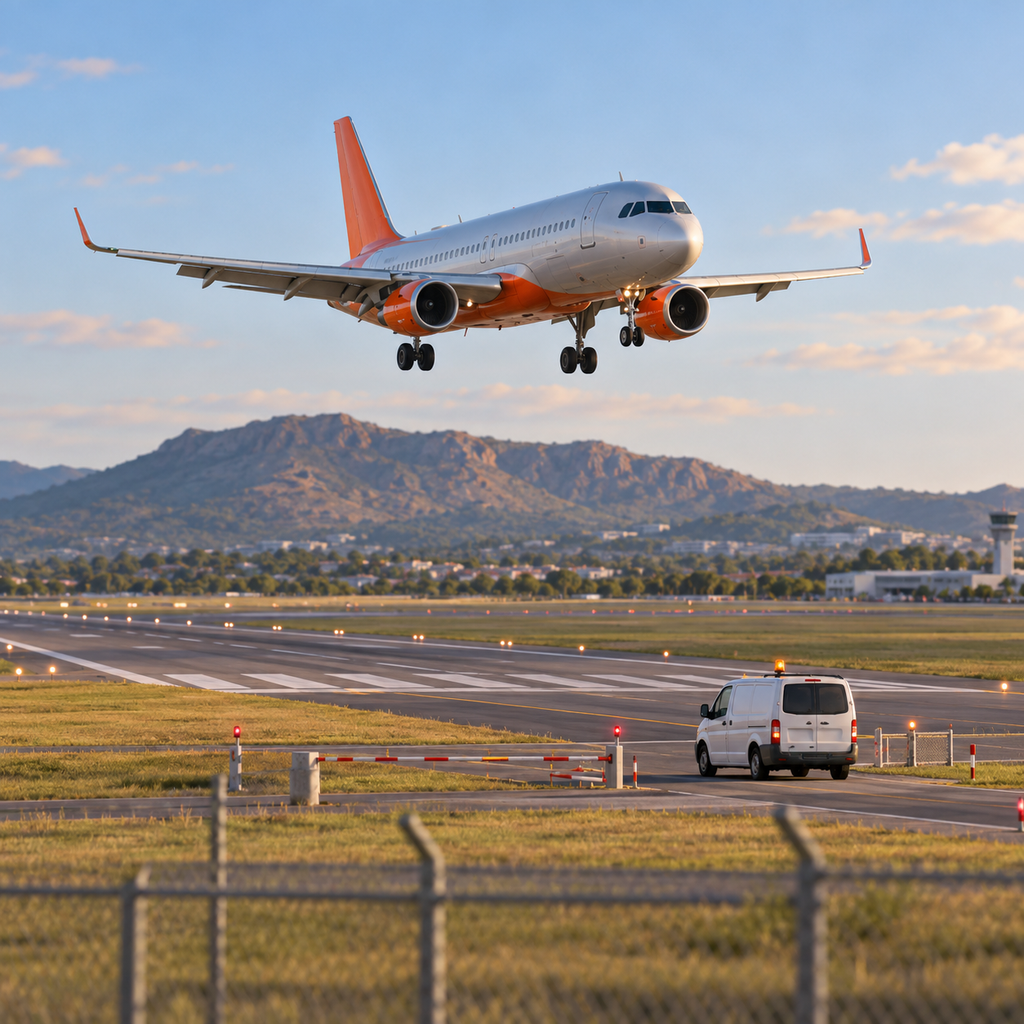
A Jetstar passenger flight passed low above the ground as a white van entered a runway area at Townsville Airport, prompting an investigation into a serious aviation safety incident. The Australian Transport Safety Bureau says the vehicle stopped near the outer edge of the runway while the Airbus A320, approaching from Brisbane, passed at approximately 50 feet above ground level. The aircraft then landed and the van continued crossing. Nobody was injured and no damage was reported. Investigators have not determined how the vehicle came to be in the aircraft’s path, and the agency’s account does not establish fault by the driver, flight crew or air traffic controllers.
The incident involved Jetstar flight JQ908, operating from Brisbane to Townsville in north Queensland. The aircraft was an Airbus A320-232 registered VH-VGQ, according to the ATSB’s public investigation record. As the crew approached runway 01, they observed a white van entering at the runway threshold. The van stopped at the outer edge as the aircraft passed, after which the aircraft landed and the vehicle resumed moving across the runway. Those are the central movements described by the investigator. The published record does not offer a complete minute-by-minute sequence or a final explanation for the incursion.
The distinction matters because the story has sometimes been compressed into a dramatic claim about a plane coming within 15 metres of a vehicle. The ATSB’s recorded figure is about 50 feet above ground level, roughly equivalent to 15 metres. It describes the height of the aircraft as it passed through the runway area. It is not presented by the bureau as a separately measured horizontal distance between the aircraft and van. An exact aircraft-to-vehicle separation cannot be independently calculated from that figure alone, and treating it as a surveyed gap would give readers a degree of precision the primary investigation has not supplied.
The bureau classifies the occurrence as a serious incident involving a runway incursion and near collision. That classification signals the nature of the safety event; it should not be confused with a finding that a collision occurred. The aircraft landed, the van resumed its crossing, and the public ATSB record lists no injuries or damage. The absence of physical harm is an important outcome, but it does not remove the reasons for examining how aircraft and ground vehicles were able to occupy the same runway environment at such a sensitive moment in a landing approach.
Runways require coordination among several groups of people, and the published details are not yet sufficient to say which part of that coordination needs attention in Townsville. Ground vehicles can have legitimate reasons to operate within an airport, but permission, positioning, communications and separation are all matters that investigators may need to examine in a runway-incursion case. Those are possible lines of inquiry, not findings about this vehicle. The ATSB has not publicly identified the van driver’s instructions or communications, nor has it said that the driver ignored an order. Its current record does not justify assigning blame to anyone.
According to the ATSB, the evidence-collection phase will include interviews with people involved, a review of recorded data and the gathering of other relevant information. Such evidence can provide the context missing from an initial occurrence summary: what each participant could see, what instructions or warnings were available and how events developed over a short period. The bureau says it will publish a final report when the investigation is complete. If investigators identify a critical safety issue before then, the agency says relevant parties will be informed so action can be taken without waiting for the final document.
The investigation remains active and its final report is pending. The ATSB’s public record identifies the occurrence as an aviation investigation. The occurrence summary is deliberately concise. It records the aircraft, route, location, vehicle and key events, but it does not provide a concluded causal chain. For readers, that means the most significant outstanding question is not whether the aircraft landed safely — that is established — but how the crossing and landing approach came into conflict and whether there are lessons for airport operations.
Jetstar has confirmed that the aircraft landed normally. In comments reported by the ABC, a spokesperson said the airline was working with the ATSB to understand what happened. That is a statement about cooperation with the investigation, not an announcement of its outcome. The airline has not, in the material reviewed, provided a public conclusion about the vehicle driver or about air traffic control decisions. Reporting should preserve that boundary rather than attributing potential failures to the operator simply because its aircraft was involved.
Townsville Airport has an unusual operational context. It serves civilian aircraft and is also used by Defence, with air traffic control services provided by the Royal Australian Air Force. The Department of Defence told the ABC that it was working with the ATSB in relation to the runway incursion and would not provide further comment while the investigation remained under way. The presence of civilian and military activities makes clear why several organisations may hold relevant information, but it does not establish that the joint-use arrangement caused this particular event.
The incident is attracting attention partly because it is not the only recent aviation safety matter being examined in the region. The ABC has identified other ATSB investigations involving operations at or near Townsville Airport. These include a Jetstar flight whose crew rejected a take-off after identifying a performance-calculation error, a Qantas aircraft that reported low fuel following unsuccessful approaches in poor visibility, and a separate airborne near-collision between other aircraft west of the airport. The events are different in character and occurred in different circumstances. They should not be combined into a single narrative of a proven systemic failure.
In the rejected-take-off case, the separate ATSB record says a Jetstar crew identified a performance calculation error as the aircraft began taking off and rejected the take-off. That event concerned pre-departure performance information, not a van entering a landing runway. In the west-of-Townsville occurrence, the reported issue involved two aircraft approaching each other in the air. Those distinctions are central to fair coverage: several safety investigations in one area may reasonably raise questions, but their existence alone does not show a shared cause or a recurring breach of the same procedure.
Griffith University safety researcher Sidney Dekker told the ABC there would be stronger grounds for concern about a common problem only after investigators had determined what lay behind the individual occurrences. His warning against drawing premature connections is relevant here. The known events justify scrutiny and close attention to the resulting reports. They do not yet support a claim that Townsville Airport has a particular unresolved defect, that a named agency knowingly ignored an established danger, or that the same operational mistake explains every incident.
The human implications are straightforward even without a dramatic reconstruction. Passengers aboard a scheduled domestic flight expect the landing environment to be clear and safely managed. People working on the ground also rely on instructions, visibility and effective coordination in areas where aircraft are operating. A runway-incursion investigation therefore concerns the safety of both airborne and ground personnel. But the public details do not show what the passengers could see or feel, whether there was any alarm in the cabin, or what conversations took place. Inventing such details would misrepresent the evidence available.
Nor is there a basis to reconstruct the van’s exact route or to infer its intended destination. The ATSB describes its entry near the runway threshold, the point at which it stopped and the fact that it later continued crossing. That is enough to understand why the event warranted examination. A fuller account of ground movements may depend on records and interviews not yet released. Until investigators publish them, the most defensible description remains the sequence given by the bureau rather than a speculative account built around what might have happened seconds earlier.
The wording used to describe the low pass deserves particular care. A photograph of an Airbus A320 or a runway can help readers recognise the setting, but a composite image that pretends to capture the aircraft directly above the van would be misleading unless it came from genuine footage of the incident. No publicly established image in the reviewed source material is known to record that exact moment. A neutral photograph of Townsville Airport, or a clearly identified illustrative image of the aircraft type and a generic service van, would communicate the subject without presenting invention as documentation.
The same caution applies to conclusions about how narrowly a collision was avoided. The bureau labels the matter a near collision and specifies that the aircraft passed at roughly 50 feet above ground level. It does not provide a confirmed closest-point distance along every dimension, and it does not say that the vehicle was struck or damaged. Describing the aircraft as passing low over the area where a white van had entered the runway is both compelling and more precise than reducing the incident to a single purported measurement of the gap between them.
Investigators may ultimately examine the airport’s procedures, instructions, physical layout and recorded communications. Whether any of those factors contributed remains unconfirmed. A final report may identify safety actions that were taken before publication, lessons applicable to other airports, or findings that are narrower than early public discussion suggests. The bureau has committed to alerting relevant parties promptly if it finds an urgent safety problem. That process is designed to separate the immediate task of preventing harm from the longer work of establishing what actually happened.
For now, the essential facts are clear: a scheduled Jetstar aircraft was approaching Townsville, a white van entered the runway environment, the van stopped near the outer edge, and the aircraft passed at about 50 feet above ground before landing. The vehicle subsequently crossed, and the event ended without reported injury or damage. The ATSB is examining how that sequence arose. The responsible editorial approach is to report those facts, explain the limits of the available measurement, and leave responsibility and broader implications open until the evidence can support firm findings.