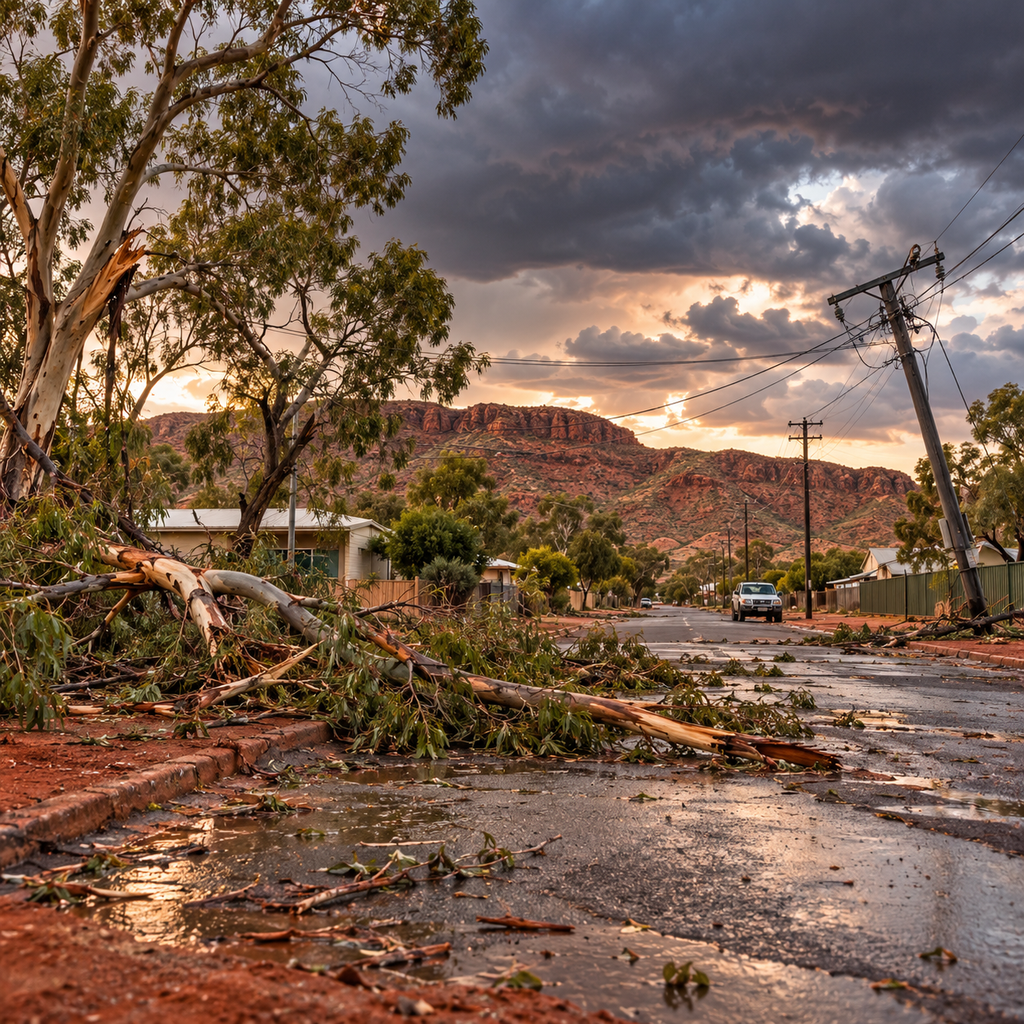
Alice Springs residents are facing a difficult clean-up after a powerful storm tore through the Central Australian town, bringing damaging winds, falling trees and widespread electricity outages. The Bureau of Meteorology recorded a gust of 96 kilometres an hour, while Power and Water Corporation initially reported about 9,000 properties without power. Electricity has since been restored to many customers, although repair crews are still working through significant damage across the network. More unsettled weather is also a concern. The immediate challenge for residents is not only recovering from what has already happened but keeping homes, roads and people safe while vulnerable infrastructure is being repaired.
The storm struck quickly, with heavy rain, hail and violent wind sweeping across the town. Fallen branches blocked roads and struck vehicles, fences were knocked down, and some homes experienced roof damage. Local emergency services received requests for assistance from across Alice Springs rather than from one isolated neighbourhood. Council staff and residents began removing debris as soon as conditions allowed, while electricity workers inspected damaged poles and powerlines. The extent of the impact explains why repairs could not be completed immediately: crews are not simply restoring a single switch, but dealing with physical damage at several points in the network.
The recorded 96-kilometre-an-hour gust came from the weather station at Alice Springs Airport. The Bureau of Meteorology said it ranked among the stronger local wind observations for the month in the historical record, illustrating the force of the storm without requiring a claim that every neighbourhood experienced exactly the same wind speed. Gusts at one monitoring site are useful evidence of conditions, but they do not measure the force on every roof or tree. Local effects depend on exposure, building condition and where the most intense part of a storm passes, so individual damage should not be automatically attributed to a single observed number.
Power and Water’s initial report described approximately 9,000 properties losing electricity as a result of the storm. Later ABC reporting, citing the utility, said service had been restored to about 5,000 houses while roughly 4,000 remained without power at that stage. Those numbers describe different moments in the same emergency. Reporting that all 9,000 were still without electricity would be inaccurate once restoration had progressed. The remaining count is also subject to change as crews finish repairs and reconnect customers. Anyone needing the live status of their address should consult the company’s current outage notices, rather than rely on a figure in an earlier news article.
Power and Water says teams have found fallen lines, damaged electricity poles, fallen trees and other damage to the network. Crews from Darwin, Tennant Creek and Katherine were mobilised to reinforce the local response. Work on damaged infrastructure can involve more than removing debris: a pole may need replacement, lines must be made safe, and damaged connections may require inspection before supply can resume. The utility has warned that restoration in some areas will take several days because of the scale of the damage. That is a practical assessment of repair work, not a promise that every customer will have electricity restored at one fixed time.
The utility has also explained that essential infrastructure is being prioritised during restoration. This approach is significant for a town where a prolonged outage can affect the ordinary functioning of homes and businesses, as well as services that depend on reliable power. Exactly which street will be connected next may depend on equipment, access and safety checks. Although residents understandably want a clear timetable, Power and Water has said it cannot always give an exact restoration time while assessments continue. A responsible update should acknowledge that uncertainty rather than announce a deadline unsupported by the network operator.
Damaged private electrical connections create a different problem from failures on the public network. Power and Water says a house whose service line has been pulled away or disconnected may need inspection by a registered electrician and a Certificate of Compliance before it can be safely reconnected. This requirement helps prevent an unsafe restoration to damaged wiring. Residents should check official guidance for their own property instead of assuming every outage can be fixed by utility crews alone. Homeowners should also avoid approaching or touching damaged cables, even when nearby lights are out and the street appears quiet.
Safety messages from the utility and emergency services are emphatic: fallen powerlines must be treated as live. A line on the ground, trapped in a tree or caught in debris can remain dangerous. Residents should not try to move branches that are in contact with electrical infrastructure or approach damaged poles to see whether electricity has returned. Power and Water asks people to report fallen powerlines through its emergency contact number, while immediate life-threatening emergencies should be directed to triple zero. These precautions are especially important during clean-up, when the urge to clear a driveway or open a blocked street can bring people close to a hazard.
People who depend on electricity-powered life-support equipment have been specifically urged by Power and Water to activate their emergency management plans rather than waiting for local supply to return. The warning recognises that an outage lasting several days may require arrangements beyond those needed for an ordinary interruption. A general news report cannot determine what is medically appropriate for an individual household, but it can highlight the utility’s instruction and the need to use emergency health services when a serious medical problem arises. For families affected by the storm, reliable official information is more valuable than an unverified promise that the power will be back shortly.
The Northern Territory Emergency Service has been responding to damage across the town, including trees on buildings and vehicles and compromised roofs. ABC reporting quoted an emergency services official saying there had been around 50 requests for assistance. That figure describes recorded requests at the point of the report rather than the full count of damaged properties. Some households may manage smaller problems themselves, while others need specialist assistance. No reliable estimate in the reviewed material establishes the total insured value of losses or the final number of damaged homes, so those figures should not be guessed from photographs of the storm.
Alice Springs Town Council says debris and access problems have required immediate attention to roads, footpaths and public facilities. The council has been concentrating on priority areas, including locations where fallen vegetation affects movement through town. Some public sites experienced damage, but council staff also worked to keep services operating where safe. A picture of a branch lying across a vehicle communicates the severity of a local impact, yet it should not be presented as evidence that every street suffered the same damage. Accurate reporting needs both the broad pattern of disruption and the local variation in how it affected different communities.
The weather threat had not finished once the most damaging gusts passed. Bureau of Meteorology forecasters warned of further thunderstorms over Alice Springs and surrounding parts of Central Australia, with heavy rain, strong winds and potentially large hail among the hazards. The forecast was dependent on where storms formed and moved, so it should be understood as a risk rather than a guarantee that each locality would be hit again. For residents with temporary roof protection, fallen branches still to remove or power network crews at work, the possibility of another storm adds urgency to securing loose material and following updated warnings.
The emergency has also extended beyond Alice Springs itself. Power and Water reported disruption affecting several communities and localities in Central Australia, including places outside the town’s centre. Remote or dispersed networks can be challenging to inspect and repair when severe weather has damaged multiple lines and roads. The public updates identify affected regions but do not provide a final customer-by-customer restoration schedule. Coverage of the recovery should not overlook those communities simply because the town supplies the most visible images. People beyond Alice Springs may be waiting for crews and confirmed information about the state of their electrical infrastructure.
Northern Territory police have urged drivers to adjust to the conditions, observe road closures and avoid flooded areas. The advice is not limited to the period when rain is falling. Debris, pooled water, weakened trees and electrical equipment may remain dangerous during the following clean-up. Residents needing authoritative warnings can consult the Bureau of Meteorology and SecureNT. Photographs circulating online can help convey the scale of a storm but may not show the latest position of a road or hazard. Official updates are the safer basis for deciding whether to travel or return to a damaged property.
The storm has prompted cooperation among electricity crews, emergency services, council workers and neighbours. ABC reporting describes local residents helping remove branches and clear damaged areas, while additional specialist teams were mobilised from other Northern Territory centres. Those contributions are part of the recovery effort, but there are limits to what untrained volunteers should attempt. Moving light debris from a safe area is different from cutting timber near an electrical line or climbing onto a damaged roof. The utility’s repeated advice to stay away from powerlines is a reminder that the most useful assistance sometimes begins with leaving a hazardous job to trained workers.
The financial effects of the storm will take longer to establish. Households may need repairs to roofs, fences or vehicles, and businesses may face disruption while electricity and access are restored. The inspected official releases do not provide a final damage bill or an independently verified count of insurance claims. Such numbers could change as inspections proceed and reports are filed. It is too early to declare a total economic loss or to attach a particular number of days without power to every affected neighbourhood. A sound account should focus on confirmed damage and the work now being undertaken, leaving aggregate estimates to properly sourced updates.
Power and Water has said it will keep providing outage updates as repairs progress. Residents whose electricity has not returned should follow that live information, report dangerous fallen infrastructure and avoid damaged connections until they are declared safe. Emergency services are continuing the practical work of clearing hazards and helping affected households, while weather forecasters are monitoring the possibility of further severe conditions. The recovery is still changing from one locality to the next. For the moment, the clearest picture is of a powerful storm that caused widespread damage and an initial outage affecting about 9,000 properties, followed by a difficult but continuing restoration effort.






